

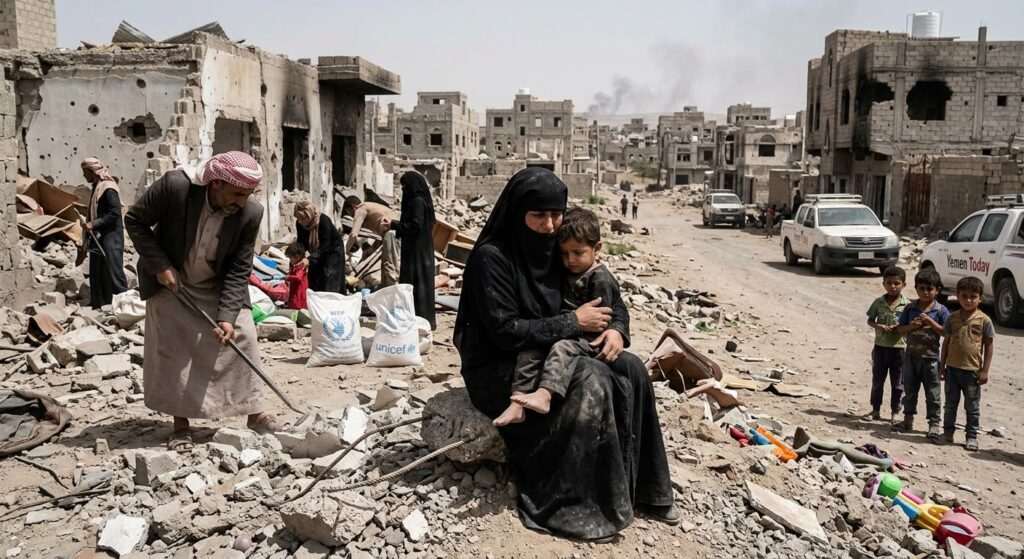
ADEN/SANAA — Yemen has slid back into full-scale war. That was the stark assessment delivered by UN Special Envoy Hans Grundberg to the Security Council on October 9, as hostilities spread across multiple frontlines, displacing more than 200,000 people in just two months and pushing the country’s humanitarian crisis toward collapse. With government forces launching a major counter-offensive, Houthi militants striking deep into Saudi territory, and diplomatic efforts struggling to gain traction, Yemen stands at its most dangerous moment since the 2022 truce.
The Battle for Bab al-Mandab
The current escalation is rooted in the Houthis’ strategic gambit to control the Bab al-Mandab Strait, one of the world’s most critical maritime chokepoints. Following earlier advances on Mokha and the Red Sea coast, intense fighting has continued in the highlands west and south of Taiz city, and across into Lahj governorate . Earlier this week, the Yemeni government launched a large-scale counter-offensive, reporting that it had retaken areas around the Bab al-Mandab .
The military situation remains highly fluid. Houthi military spokesman Yahya Saree claimed on October 6 that his forces had repelled multiple advances by Saudi-backed government troops near the strait, launching 10 ballistic missiles at troop concentrations . However, a Houthi military official acknowledged to Xinhua that government forces still controlled Dhubab, a coastal district southwest of Taiz near the Bab al-Mandab, as well as its military airstrip .
On October 13, Yemeni government warplanes conducted nine airstrikes targeting Houthi personnel and military equipment in Taiz province—five in the Al-Dhabab area and four in Al-Misrakh district . Clashes continued on the Al-Shaqab front south of Taiz city .
The human cost is mounting with alarming speed. Since the start of August, the Office of the UN High Commissioner for Human Rights has verified at least 46 civilians killed and more than 130 injured—more than half of those killed and nearly a third of those injured were children . The true toll is likely far higher, as communication blackouts and access restrictions prevent real-time verification .
A Displacement Crisis of Unprecedented Scale
More than 200,000 people have been displaced across Yemen since the beginning of August, according to the International Organization for Migration—the highest level of new displacement since the 2022 truce . The figure has risen with staggering speed: from 76,000 in mid-September to over 145,000 by the end of the month, and now surpassing 201,000 .
Taiz governorate has borne the heaviest burden, accounting for 57 percent of the displaced—over 114,000 people . Three districts alone—Al Ma’afer, Jabal Habashi, and Ash Shamayatayn—account for three in four of those recorded in Taiz . Displacement has now spread across 10 governorates, with significant numbers also recorded in Lahj, Aden, Abyan, and Al Hodeidah .
The crisis is also crossing borders. More than 3,700 people have fled by sea to Djibouti, arriving exhausted in overcrowded boats with little food or water . Most are women and children. For many, this is not their first displacement—families who rebuilt their lives once, or twice, have lost everything again .
A Health System on the Brink
The fighting is pushing Yemen’s already fragile health system closer to collapse. Only three in five assessed health facilities across the country are fully functioning, and few have trauma care capacity . Conflict-related casualties are placing severe pressure on the system, limiting other essential services including emergency care for women giving birth .
Disease outbreaks are accelerating at an alarming rate. More than 7,800 suspected cholera cases have been reported this year, with the caseload tripling in just three weeks—from 217 suspected cases in week 36 to 647 in week 39 . The last four weeks account for 1,892 of the year’s 7,871 cases and 11 of the 27 deaths, with 89 percent of rapid diagnostic tests returning positive .
Measles is also spreading rapidly, with more than 22,000 suspected cases and 128 deaths reported this year . Fewer than half of Yemeni children are vaccinated against the disease—far below the 95 percent needed to stop transmission . A strong El Niño event is expected to worsen conditions from October 2026 through March 2027, with hotter, drier weather expected to fuel cholera, dengue, and malaria outbreaks .
Even before this escalation, 2.2 million children under five were acutely malnourished, including more than half a million suffering from severe acute malnutrition . Nearly 250 schools have closed, leaving more than 137,000 students out of the classroom without access to school feeding programs .
Humanitarian Response Overwhelmed and Underfunded
Humanitarian organizations are delivering what they can. Since the beginning of August, UN agencies and partners have provided emergency assistance to more than 131,000 people affected by the recent escalation, including food, shelter, health, and protection services . Mobile medical teams have been deployed, rapid response mechanisms activated, and urgent medical supplies delivered .
But the response is falling dangerously behind. The humanitarian appeal is only 22 percent funded . Close to $20 million has been mobilized in direct response to the recent escalation—nearly $11 million through the Yemen Humanitarian Fund and another $9 million through the Central Emergency Response Fund—with an additional $18 million allocated from CERF for life-saving assistance across Yemen . Yet these funds cannot fill the gap.
“The gap between needs and resources is widening precisely as crisis grows,” Mohamed Yahya, Assistant Secretary-General for Humanitarian Affairs, told the Security Council. “Aid organizations are already making difficult decisions: which needs to cover and which communities to drop” . The immediate cost of underfunding is clear: fewer clinics operating, fewer children receiving nutrition treatment, fewer families receiving food, fewer women accessing maternal health care—and ultimately, more preventable deaths .
The humanitarian operation also faces severe access constraints. Seventy-two UN colleagues remain arbitrarily detained, with many facing serious health problems . Their release is “especially urgent,” Grundberg told the Council .
Houthi Attacks on Saudi Arabia
The Houthis have dramatically expanded their military campaign beyond Yemen’s borders. In recent weeks, they have carried out attacks against civilian and energy infrastructure in Saudi Arabia, including strikes on Abha International Airport and King Khalid International Airport in Riyadh that killed and injured civilians .
Grundberg condemned these attacks and reiterated his call on the Houthis to cease them . He warned that the group’s threats against Saudi-linked commercial ships in the Red Sea “undermine the freedom of navigation of every country” and are “becoming enmeshed with the broader confrontation over control of maritime trade routes and the stresses on the international energy market” .
The maritime dimension has global implications. A tanker was reportedly attacked about 60 nautical miles south of Mocha on October 4, with the crew reporting multiple explosions near the vessel . The Houthis have claimed responsibility for targeting an Aramco facility in Riyadh with ballistic missiles and drones . The combined pressures on the Bab al-Mandab and Strait of Hormuz have pushed energy prices higher and forced shipowners and charterers to make immediate decisions on routing, insurance, and crew deployment .
Diplomacy Struggles to Gain Traction
Despite the military escalation, diplomatic efforts continue. Grundberg has engaged intensively with the Yemeni government, the Houthis, and regional and international stakeholders in Riyadh, Muscat, Cairo, and Washington . “There is broad recognition that this is a defining moment, not only for Yemenis, but also for the region,” he said .
Iran has offered to mediate between Saudi Arabia and the Houthis. Iranian Foreign Minister Abbas Araghchi held a phone call with his Saudi counterpart, Prince Faisal bin Farhan, warning that continued military approaches would “complicate the situation” and expressing readiness to support dialogue . Analysts view the offer as part of Tehran’s broader diplomatic strategy to reduce pressure and enhance its regional influence .
Saudi Arabia, however, has set firm conditions. A regional source indicated that Riyadh will not accept a ceasefire with the Houthis until the Saudi-backed Yemeni government regains all territory lost in recent weeks .
The Yemeni government’s position is equally uncompromising. Foreign Minister Afrah Al-Zouba stated that restoring state institutions and bringing all weapons under state authority are essential for lasting peace, stressing that any agreement must preserve Yemen’s unity and prevent the Houthis from maintaining independent weapons or political authority outside state institutions .
A Nation’s Future at Stake
Grundberg delivered a pointed message to the Security Council: “While military pressure can strengthen political leverage, war and diplomacy are not mutually exclusive. Ultimately, gains on the battlefield cannot substitute for the negotiations that will be required to settle the conflict” .
Yemen has been ranked by the International Monetary Fund as the world’s poorest country . After more than a decade of war—since the Houthis seized Sanaa in September 2014, prompting a Saudi-led coalition intervention in March 2015—the country’s civilians are once again bearing the brunt of escalating violence .
“Children are entitled to special protection, and their recruitment and use in armed conflict is prohibited,” Grundberg reminded the Council . “Parties must also respect and protect medical facilities, humanitarian personnel and operations, and persons who are no longer taking part in hostilities” .
For the 40 million Yemenis who have endured more than a decade of conflict, the message from the Security Council chamber is grim. The war has returned in full force. The diplomacy has not. And the world’s attention—and funding—remains dangerously absent. As IOM Director General Amy Pope warned: “Yemen must not become a forgotten crisis. The world has the means to help. It must use them now” .