

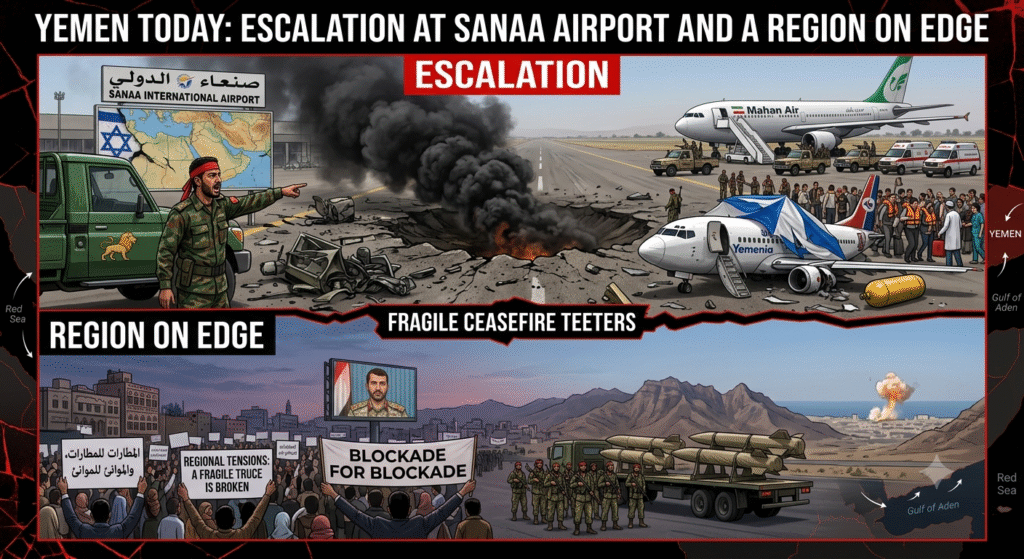
July 19, 2026 — Day 3 of the Crisis
The past week has witnessed a dangerous escalation in Yemen’s long-running conflict, with tensions surrounding Sanaa International Airport threatening to unravel fragile regional de-escalation efforts. As an Iranian aircraft carrying a Houthi delegation was diverted, and airstrikes targeted the airport, the Houthis have announced the “end of the de-escalation phase” with Riyadh.
Part 1: The Incident That Escalated Tensions
The current crisis was triggered on July 13 when an Iranian aircraft carrying a Houthi delegation was diverted to Hodeidah airport, which the Houthis control, after Sanaa International Airport came under airstrikes . The strikes, which the Houthis attributed to Saudi Arabia, prompted the group to declare an end to the de-escalation phase with Riyadh.
Sanaa International Airport has been a critical flashpoint in Yemen’s conflict. It serves as the primary gateway for humanitarian aid to the Houthi-controlled capital. The UN has repeatedly warned that attacks on civilian infrastructure, including airports, constitute violations of international humanitarian law and risk exacerbating an already catastrophic humanitarian situation .
Part 2: The International Response
China, as President of the UN Security Council, convened an emergency meeting on the situation in the Middle East, with Yemen at the center of deliberations. Chinese Chargé d’Affaires Sun Lei expressed “serious concern” over the escalating tensions surrounding the airport and called for maximum restraint from all parties .
Sun emphasized: “We have always maintained that the sovereignty, security, and territorial integrity of all countries in the Middle East and the Gulf region, including Yemen, should be respected” . He also stressed that “civilians, humanitarian workers, and civilian objects should be protected” .
The Chinese envoy linked the Yemen crisis to the broader Middle East situation, noting that “the ceasefire arrangement reached between the United States and Iran is being challenged, which is deeply concerning” . He called on the US and Iran to resume follow-up negotiations as soon as possible and reach a comprehensive agreement.
Part 3: The Broader Context
Yemen’s crisis does not exist in isolation. It is part of a wider regional volatility:
The US-Iran Deal at Risk: The preliminary peace agreement signed on June 18 is under strain. Iran has threatened a “decisive response” to any US “breach of contract,” while the US has issued warnings that the “deal is scheduled to get signed tomorrow” no longer holds.
The Houthi Threat: The Houthis have demonstrated their ability to disrupt global shipping through attacks on Red Sea and Gulf of Aden maritime routes. Their advanced drone and missile capabilities, supplied by Iran, continue to pose a significant threat.
Saudi Arabia’s Dilemma: Riyadh has sought to extract itself from the Yemen conflict through de-escalation talks, yet continues to face cross-border attacks. The Houthi “end of the de-escalation phase” threatens to undermine months of diplomatic work.
Part 4: The Humanitarian Catastrophe
UN officials warn that the latest escalation comes at a time when Yemen is facing one of the world’s worst humanitarian crises. The UN Assistant Secretary-General briefed the Security Council on the humanitarian implications of the airport attacks . Yemen’s civilian population faces critical shortages of food, water, and medical supplies.
Part 5: The Path Forward
The Security Council meeting concluded with unanimous calls for de-escalation. China stressed “a renewed outbreak of hostilities serves no one’s interests, and military means cannot resolve the issues” .
The immediate priorities are clear: protecting Sanaa airport as a humanitarian lifeline, implementing prisoner exchange agreements, and returning to the political track. But with the Houthis declaring an end to the de-escalation phase, and regional powers increasingly drawn into the confrontation, the path forward is more precarious than ever.
