

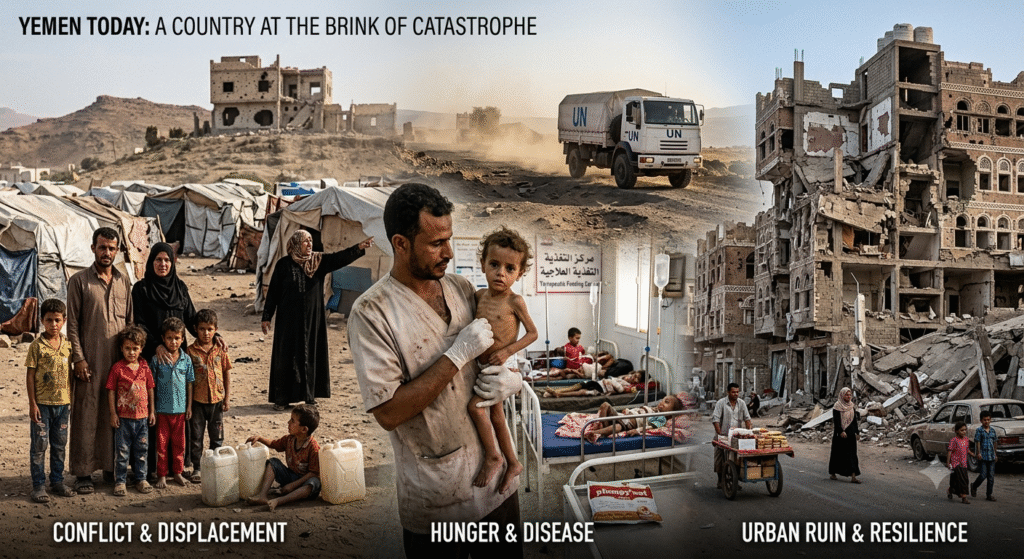
As of August 2026, Yemen faces its most dangerous moment since the 2022 UN-mediated truce. A resurgent conflict, a humanitarian catastrophe that has left six million people on the brink of famine, and a collapsing aid system have created what UN officials describe as a “manufactured catastrophe” of staggering proportions .
🚨 The Return to Large-Scale Conflict
UN Special Envoy Hans Grundberg delivered a stark warning to the Security Council in mid-August: “Yemen today faces a more serious risk of return to large-scale conflict than at any point since the 2022 UN-mediated truce” . Military activity has intensified along frontlines, with recent Houthi attacks in Ma’rib, Hadramawt, Mokha and elsewhere causing casualties among both military personnel and civilians .
The Houthis announced a naval blockade on Saudi Arabia in the Red Sea on July 20, a move they described as a response to what they term a Saudi “siege” of Yemen . The Saudi-led coalition responded with airstrikes on Houthi military facilities in the port city of Hodeidah .
The situation is becoming entangled with wider regional confrontations. Renewed Houthi attacks on commercial vessels in the Red Sea and Gulf of Aden risk deepening Yemen’s entanglement with regional tensions already under pressure from the crisis in the Strait of Hormuz .
Civilian casualties are rising. UN High Commissioner for Human Rights Volker Türk expressed alarm at the escalating civilian toll, reporting at least seventeen civilian casualties from Houthi attacks since August 6 . A Houthi missile hit the Jaw al-Naseem camp for internally displaced people in Ma’rib, injuring six civilians including a child . The port of Mokha has been repeatedly attacked, with three port workers killed and four injured in an August 9 strike .
The military rhetoric is escalating. Tareq Saleh, a member of Yemen’s Presidential Leadership Council, has vowed to retake Sanaa and the strategic Red Sea port city of Hodeidah from the Houthis, stating that “securing the Red Sea and Bab al-Mandab begins with retaking Hodeidah and Sanaa” . In response, government-aligned forces have reported intercepting Houthi drones west of the interim capital Aden .
💔 A Humanitarian Catastrophe Unfolding
The violence is occurring against a backdrop of what the UN describes as the world’s worst humanitarian crisis. The humanitarian appeal for Yemen is barely 20 percent funded, a shortfall that has crippled UN operations .
Food insecurity has reached catastrophic levels. Over half of Yemen’s population is experiencing acute food insecurity. Six million people—the highest number globally—face “Emergency” levels of deprivation bordering on famine . The World Food Programme’s latest IPC analysis projects that during the June-September 2026 lean season, an estimated 5.4 million people (51% of the population in government-controlled areas) will face acute food insecurity . Even the post-harvest period is unlikely to bring meaningful recovery .
The health system is at a breaking point. Facilities lack basic supplies and personnel. Disease outbreaks are surging—in Ma’rib alone, authorities have declared a health emergency due to a measles outbreak, the second-highest case count globally this year . Nearly 11 million women and girls require humanitarian support, including over 750,000 pregnant women. Three women die every day from preventable pregnancy-related complications .
A new threat is emerging. El Niño conditions are forecast to cause a 40% reduction in rainfall across key agricultural areas, which will devastate crops, water availability and rural livelihoods . This compounds the impacts of extreme heat and water stress in a country already one of the most vulnerable to climate change .
💰 The Funding Gap: A Man-Made Crisis
The crisis is being driven by a catastrophic shortfall in humanitarian funding. With the appeal barely 20 percent funded, the calculation is brutal: when funding drops, rations are cut, clinics close, and protection services disappear .
The economic collapse is a key driver. Yemen’s economy has become a “front line,” with trade, revenues and essential services increasingly politicized . The country faces a fragmented currency system—a new Rial in the south and an old Rial in the north—and competing central banks, creating significant internal trade barriers . Fuel prices in government-controlled areas have risen, renewing pressure on domestic fuel affordability .
Humanitarian access remains a significant hurdle. Between July 2025 and July 2026, over 200 humanitarian access incidents were recorded across the country. Interference, violence against staff, and movement restrictions continue to impede relief operations . Of particular concern is the detention of 73 UN, NGO, and civil society staff by Houthi authorities, whose families have lived with uncertainty for months .
🔮 The Path Forward: A Call for Action
UN officials have issued an urgent call for action. Tom Fletcher, UN Under-Secretary-General for Humanitarian Affairs, has made three key demands: provide flexible, predictable funding now; protect civilians and ensure principled humanitarian action; and maintain focus on Yemen .
📝 Conclusion
Yemen today stands at a precipice. The convergence of renewed conflict, economic collapse, climate shocks, and a collapsing aid system has created a crisis of extraordinary severity. As UN Special Envoy Grundberg warned, “four years of calm can be lost in a few weeks of escalation” . For the Yemeni people, a return to full-scale war would mean every ordinary ambition once again placed at the mercy of the fighting—and a new generation sent to the front lines instead of having the chance to reimagine their country’s future .
