

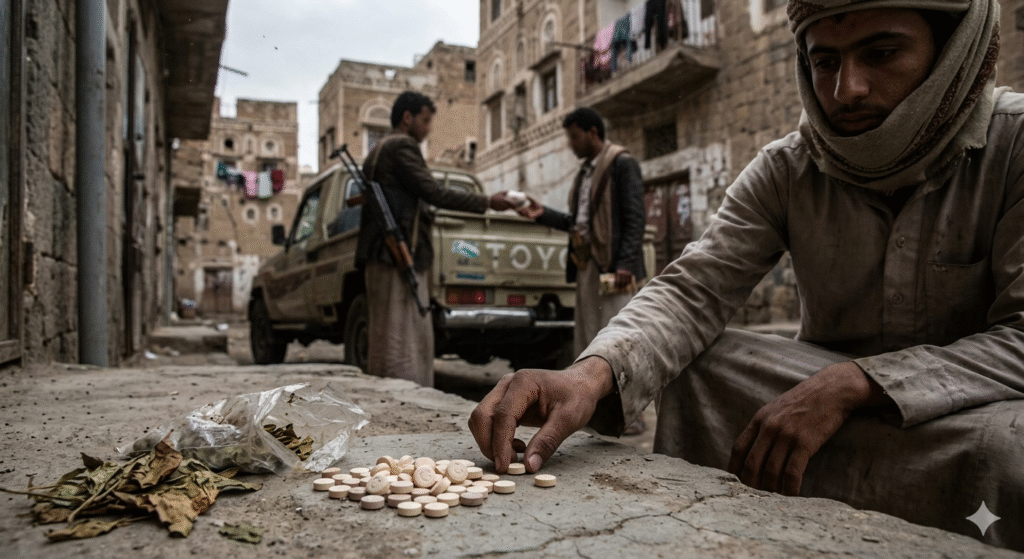
In the eleventh year of its devastating civil war, Yemen has become the Middle East’s newest and most dangerous narcotics hub. What was once a nation whose primary drug problem was the culturally entrenched stimulant khat has now evolved into a major transit and reprocessing center for synthetic narcotics—most notably the amphetamine known as Captagon. A combination of state collapse, grinding poverty, and the calculated actions of warring factions has transformed Yemen into what experts describe as a “black economy” that fuels conflict while destroying society from within .
Here is the state of Yemen’s drug crisis today.
Part 1: From Khat to Captagon – The Shifting Drug Landscape
For generations, the only drug of consequence in Yemen was khat, a leafy stimulant chewed socially for hours each day. The habit is staggering in scale: approximately 90 percent of Yemeni men and 50 percent of adult women use khat regularly . The plant accounts for about 6 percent of GDP, one-third of agricultural GDP, and provides employment for one in seven working Yemenis .
But the war has changed everything. While khat remains a national pastime, a far more dangerous trade has exploded. Captagon—an amphetamine known locally as “Haboub Al-Sarfa”—has flooded the country. In 2025 alone, seizures in Yemen totaled 1.7 million pills, up from just 358,000 pills the year before . This dramatic increase reflects not just more trafficking but a fundamental shift in the nature of Yemen’s drug economy.
Part 2: The Houthi Connection – Drugs as a Tool of War
A recent report from the Mokha Center for Strategic Studies reveals a dangerous evolution: drug trafficking in Houthi-controlled areas is no longer mere smuggling. It has become a “multi-dimensional tool used for financing and social influence,” part of what the report describes as a “black economy” linked to the Houthi group since the escalation of the conflict in 2014 .
The report explains that the Houthis employ this trade to secure financial resources beyond international oversight—funds then used to purchase weapons and finance military operations. This represents a strategic shift: drugs are not just a revenue stream but an intentional weapon of war.
Even more alarming, the report describes what it calls the “soft dismantling” of society: spreading addiction to weaken society’s ability to resist, leading to widespread behavioral and cognitive decline .
Part 3: A Regional Spillover from Syria’s Collapse
The timing of Yemen’s Captagon explosion is not coincidental. With the fall of Bashar al-Assad’s regime in Syria, the world’s largest Captagon production hub collapsed—but the trade did not die. It merely shifted.
Caroline Rose, an expert on military and national security at the New Lines Institute, told The National that traffickers, facing pressure in Lebanon and Syria, actively sought to “diversify routes” . Yemen, with its deep security fractures, rampant lawlessness, and strategic location on the Red Sea, became an ideal alternative.
The drugs arrive by boat, sometimes from remote areas of Oman across the border into Yemen’s Al Mahra governorate. From there, they move along known, protected routes—the same corridors used to ferry weapons—before crossing into Saudi Arabia, where purchasing power is higher and a single pill can sell for as much as $20 .
Part 4: Al-Jawf – The Crossroads of Contraband
No place illustrates Yemen’s transformation into a drug hub better than Al Jawf governorate in the country’s north. Food and water are scarce in this region of 590,000 people, but drugs are abundant. Al Jawf is now one of Yemen’s largest transit hubs for the growing drug trade .
The geography is strategic. Al Jawf shares a porous 300-kilometer border with Saudi Arabia, and “all transit lines pass through this territory,” according to a security source quoted by The National . The drugs move on “donkeys and drones,” utilizing ancient smuggling routes adapted for modern contraband.
What makes Al Jawf particularly dangerous is its political fragmentation. Control is shared between the Houthis and the internationally recognized government, creating a vacuum in which traffickers operate with impunity. “Cars carrying vast amounts of drugs pass publicly through neighborhoods,” a senior official in Al Jawf told The National. “It has become common knowledge that the people involved are protected, not only by armed individuals but by powerful gangs and their networks” .
Part 5: The Weaponization of Poverty – Women and Children as Smugglers
The economic collapse that has pushed 82 percent of Yemen’s 41 million people into poverty has created a new and disturbing phenomenon: the recruitment of women and children into the drug trade.
Lieutenant Colonel Abdulaziz Hadi Abdullah, Director of the Anti-Narcotics Department in Al-Jawf, revealed that Houthi leaders are deliberately entrapping women and children in hashish and drug smuggling. “The deteriorating living conditions of citizens, lack of income, and economic stagnation have motivated women and children to engage in this smuggling, which has become an easy means for quick enrichment and profit” .
This is described as “an unusual crime and a major threat to society”—not merely because of the drugs themselves, but because it represents the systematic erosion of traditional social structures. Families that once relied on agriculture or trade are now drawn into criminal networks as a survival mechanism.
Part 6: Captagon’s Grip – More Than Just a Pill
Captagon is not a new drug, but its mass production and distribution during the Syrian civil war transformed it into a regional epidemic. Originally developed by a German company in the 1960s to treat ADHD and narcolepsy, the illicit version manufactured in underground labs contains a potent mix of amphetamines.
The effects are devastating. Captagon induces euphoria, suppresses appetite, and allows users to stay awake for days—qualities that have made it popular among fighters on battlefields from Syria to Yemen. But the long-term consequences include psychosis, cardiovascular damage, and severe addiction.
In Yemen, the drug is now being sold openly in homes in Houthi-controlled areas, according to local anti-narcotics officials. The Houthi leadership, they say, is actively competing to control the trade, with different factions vying for dominance. “The release of arrested smugglers has become public, depending on the strength of the mediation and the Houthi faction the smuggler works for” .
Part 7: The Captagon Monopoly – From Assad to the Houthis
Under Bashar al-Assad, Syria held an estimated 80 percent of the global Captagon market, with the trade valued at approximately $57 billion as of 2023 . The industry was systematically linked to the regime’s military and intelligence apparatus, providing a crucial source of hard currency amid sanctions.
With Assad’s fall, the structure collapsed—but the demand did not. Traffickers scrambled to find new production sites and transit routes. Yemen, with its existing smuggling infrastructure and sympathetic Houthi leadership, became a prime candidate.
The New Lines Institute has documented that Yemen is not merely a transit point but is becoming a reprocessing and distribution center. Areas under Houthi control are “no longer merely transit routes for drugs, but have become centers for reprocessing, mixing, and distribution” . This represents a qualitative shift: Yemen is moving from a corridor to a node in the global narcotics network.
Part 8: The Government Response – Seizures and Symbolic Destruction
Despite the overwhelming odds, Yemeni security forces continue to fight back. Recent operations have yielded significant seizures:
- In March 2026, authorities in Hadramawt arrested one of the most dangerous drug dealers in Al-Mukalla, seizing crystal meth, narcotic pills, hashish, three pistols, hand grenades, and ammunition .
- In January 2026, the Military Prosecutor’s Office of the Third Military Region destroyed 327 kilograms of hashish seized during an operation intercepting Houthi-linked smugglers attempting to enter Marib province .
- In March 2026, the Yemeni Navy intercepted a vessel near Bab al-Mandab, capturing nearly 250 kilograms of illegal drugs, including 85 parcels of crystal methamphetamine and 119 bags of hashish .
These operations demonstrate capability and commitment. But they are drops in a rising ocean. For every shipment seized, many more pass through.
Part 9: The Maritime Dimension – Bab al-Mandab as a Smuggling Highway
Yemen’s strategic location on the Bab al-Mandab strait—one of the world’s most vital maritime chokepoints—has made it an ideal transit hub for drug smuggling. The same waters that carry oil tankers and container ships now carry speedboats loaded with Captagon and hashish.
A collaborative security operation in Lahj Governorate’s Al-Subaiha districts intercepted one such vessel, leading to the seizure of a quarter-tonne of amphetamines and hashish . The operation was part of an ongoing campaign targeting drug trafficking and organized crime along Yemen’s southern coastline.
The international implications are significant. Saudi Arabia, the primary destination for much of this traffic, has been a key partner in efforts to bolster Yemen’s maritime security capabilities. The United Kingdom has also provided support, recognizing that Yemen’s drug crisis is not just a Yemeni problem but a regional threat.
Part 10: The Social Destruction – Addiction, Crime, and the End of Community
The human cost of Yemen’s drug crisis extends far beyond the addicts themselves. The Mokha Center report highlights alarming indicators: rising crime rates linked to addiction, the decline of educational systems, and accelerating signs of social disintegration .
For a nation already shattered by war, this social collapse is existential. Traditional tribal structures that once provided governance and dispute resolution are being corrupted by drug money. Families are torn apart as members become addicts or traffickers. Children grow up in environments where drug use and smuggling are normalized.
The Houthis, according to the report, are using drugs in recruitment operations, targeting younger age groups “with the aim of enhancing combat capability by reducing critical awareness and weakening individual willpower” . This is chemical warfare waged against a population already traumatized by a decade of violence.
Part 11: The Profits – A $57 Billion Industry Finds a New Home
The numbers are staggering. The global illegal Captagon trade was estimated to be worth about $57 billion as of 2023 . With Syria’s production disrupted, a significant portion of that value is now flowing through Yemen.
The Houthis, facing international pressure on other funding sources, have embraced the drug trade as a replacement. The Mokha Center report warns that this pattern of a “militia economy” goes beyond cross-border criminal activity, becoming instead “a tool of influence within a broader regional network linked to financing and arms operations” .
The report’s conclusion is ominous: the continuation of this trend could lead to “the entrenchment of a fully integrated illegal economy, threatening what remains of state institutions and turning Yemen into a hub for the production and export of drugs” .
Part 12: The Path Forward – What Must Be Done
The Mokha Center report calls for a comprehensive approach to confront this phenomenon . Key recommendations include:
- Classifying drug trafficking activities as terrorism financing, enabling the application of international sanctions regimes.
- Activating international sanctions against individuals and entities involved in the trade.
- Establishing regional mechanisms to combat smuggling, recognizing that no single country can solve the problem alone.
- Launching social protection and rehabilitation programs targeting those affected, especially children, as part of a long-term strategy to rebuild social cohesion.
The window for action is closing. Every day that the drug trade expands, it becomes more entrenched, more normalized, and harder to dismantle. As one senior official in Al Jawf told The National, when asked how everyone gets away with it: “They’re all friends” . Breaking those friendships—the networks of corruption that link traffickers, militia leaders, and corrupt officials—is the essential task.
Conclusion: A Nation Held Hostage
Yemen today is not just a country at war. It is a country being systematically hollowed out by narcotics. The Houthis have weaponized drugs to fund their military campaign and to weaken the society they seek to control. Poverty has forced women and children into the smuggling trade. A regional criminal network has found a safe harbor in Yemen’s chaos.
The seizure of 1.7 million Captagon pills in a single year is both a measure of law enforcement’s effort and a testament to the scale of the problem. Behind each pill is a potential addict. Behind each shipment is a militia commander growing richer. Behind each smuggling route is a community losing its children to a trade that offers quick money and slow death.
As the Mokha Center report concludes: the continuation of this trend threatens “what remains of state institutions” and could turn Yemen permanently into “a hub for the production and export of drugs” . For a nation that has already endured so much, that is a fate too terrible to contemplate—and too urgent to ignore.
