

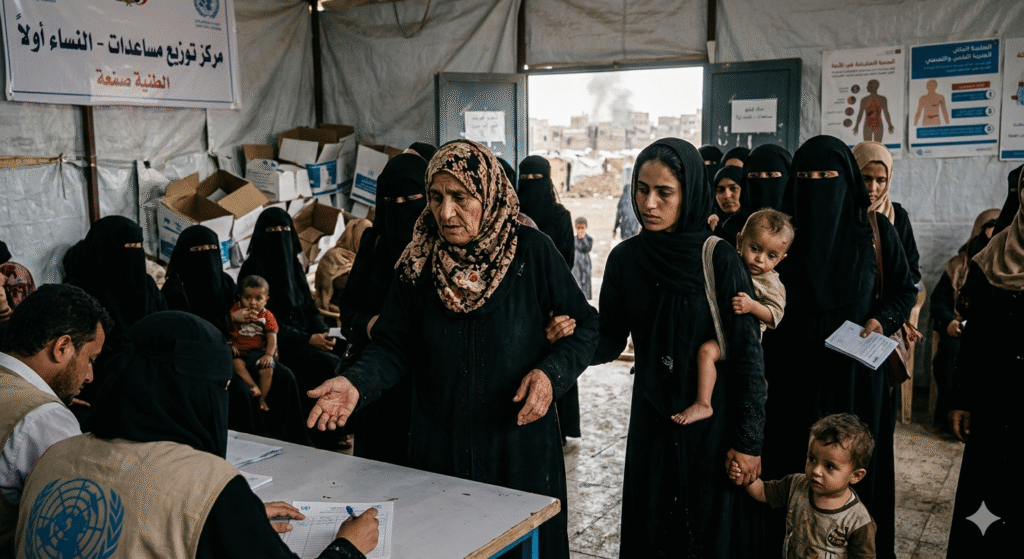
April 16, 2026 – After a decade of devastating conflict, Yemen remains the world’s worst humanitarian catastrophe. But within this grim statistic lies an even more troubling truth: the crisis is profoundly gendered. While all Yemenis suffer, women and girls bear the heaviest burden. More than 10.95 million women and girls require humanitarian assistance across the country in 2026—nearly half of all those in need . From malnutrition and maternal health collapse to economic exclusion and shattered education, the challenges facing Yemeni women today are not merely severe; they are existential.
The Scale of Need: Millions of Women in Crisis
The numbers are staggering. Across Yemen, more than 22 million people need humanitarian aid—a figure that continues to rise . Of these, 10.95 million are women and girls . This includes internally displaced women, those living under the de facto authorities, and those in marginalized communities such as the Muhamasheen .
The humanitarian system is struggling to keep pace. Severe funding constraints in 2025 forced the United Nations to scale back critical life-saving programs, particularly in areas controlled by de facto authorities . For 2026, the humanitarian community has requested $2.16 billion to reach 12 million people with targeted assistance, but whether donors will meet this request remains uncertain .
As Edem Wosornu of the UN Office for the Coordination of Humanitarian Affairs told the Security Council in April 2026: “What I am about to share is not new – but a deterioration of an already terrible situation. One which worsens every day. Across Yemen, millions of people are surviving day by day. A decade of conflict has left people hanging by a thread” .
The Malnutrition Crisis: Mothers Starving to Feed Their Children
Perhaps the most urgent dimension of the crisis is nutrition. Yemen faces one of the world’s worst malnutrition emergencies. According to OCHA, 2.2 million children under five are acutely malnourished, including 516,157 suffering from severe acute malnutrition—the most dangerous form, which carries a high risk of death without immediate treatment .
But what is less often reported is that malnutrition devastates mothers as well. An additional 1.3 million pregnant and breastfeeding women are expected to be malnourished in 2026 . The World Health Organization estimates that a further 1.3 million pregnant and nursing mothers suffer from malnutrition .
For these women, the consequences are catastrophic. Malnourished mothers face life-threatening complications during pregnancy and childbirth. Their babies are born underweight, with weakened immune systems, facing an uphill battle from their first breath . As the UN Security Council briefing noted: “For too many children and too many mothers, this means irreversible, lifelong physical and cognitive damage, stunting – and even death” .
Maternal Health: When Childbirth Becomes a Death Sentence
Yemen’s health system has been systematically dismantled by a decade of conflict. Only 59.3 percent of health facilities are fully functional . For women, the consequences are dire. Long distances to travel, a lack of appropriate facilities, and shortages of qualified medical staff lead to complications that, in the absence of postnatal follow-up, can have lasting effects on women’s health and quality of life .
In northwestern Yemen, a recent needs assessment by the MSF Foundation revealed a hidden crisis: pelvic floor dysfunctions among mothers. A survey of 109 women at Haydan hospital found frequent cases of urinary or bowel incontinence, as well as moderate to severe pelvic pain, often radiating to the lower limbs and limiting daily life activities .
Elizabeth Braga, a physiotherapist with the MSF Foundation specializing in women’s health, explained the scale of unmet need: “On average, nine women per day could benefit from specialized follow-up to regain continence, mobility, autonomy, and dignity” . Yet no such services currently exist. The MSF Foundation plans to return to Yemen in the second semester of 2026 to train local physiotherapy teams in women’s health, but for now, millions of women suffer in silence .
The broader health picture is equally grim. Vaccine-preventable diseases are spreading fast—cholera, measles, and diphtheria are ravaging communities in numbers that place Yemen among the worst in the world . Women, as primary caregivers, are both disproportionately affected by these outbreaks and bear the burden of caring for sick family members.
Economic Exclusion: Barriers to Livelihoods
Across Yemen, rural women play a crucial role in caring for their families. But economic and social barriers often prevent them from earning the income needed for their children’s healthy development. Many lack education and training, with little access to essential financial tools such as savings accounts, e-wallets, or small business loans .
This exclusion not only restricts women’s ability to make informed financial decisions but also leaves their families vulnerable to the economic shocks and food insecurity that are all too common across the country .
The story of Dunia, a mother of three from Al-Mawasit district in Taiz Governorate, illustrates this struggle. With her husband working sporadic day jobs, the family lacked stable income. The struggle to meet basic needs had a huge impact on her daughter, Haya.
“Haya’s health deteriorated because of poor nutrition and my lack of knowledge about proper hygiene,” Dunia explains. She had started her daughter on solids at just three months. “She became very weak, lost her appetite, and often fell ill because her immune system was weakened” .
However, Dunia’s story also shows a path forward. With support from the World Bank and the United Nations Development Programme, she joined a village savings and loan association (VSLA) that provided training and access to financing. She chose beekeeping as a business because it suited her rural environment, required little capital, and fed into existing demand .
“I now have a relatively stable income. I can cover my family’s basic needs, buy my children’s school supplies and medicine, and repay the loan. My next plan is to start saving for emergencies, while I grow my business” .
Digital tools have been crucial to this success. E-wallets enable secure and private financial transactions, helping women grow both confidence and autonomy around money. “I receive payments from customers and purchase necessities through my e-wallet without having to leave home or travel long distances,” says Dunia. “This has saved me time and effort – and reduced the risks around travel” .
Education: A Generation of Girls Left Behind
Yemen is “critically unprepared” for education futures, ranking in the 11th percentile worldwide and placing 158th out of 189 countries in education readiness . Core capabilities are weak across most dimensions, and essential systems face significant constraints.
For girls, the situation is particularly dire. According to the Global Education Futures Readiness Index, “Gender parity leans toward boys in secondary pathways, signalling persistent barriers for girls” . These barriers are multidimensional: poverty forces families to prioritize boys’ education when resources are scarce; security concerns limit girls’ mobility; early marriage removes girls from school entirely; and the destruction of school infrastructure—compounded by a lack of female teachers—creates environments where girls cannot safely learn.
The consequences extend beyond individual lives. When girls are denied education, an entire country’s economic future is put at risk. Hardship drives children out of school, and the lack of learning leaves potentially irreversible marks on cognitive and physical development . As the UNDP notes, this creates a cycle of poverty and malnutrition that spans generations.
Water, Sanitation, and Hygiene: A Silent Crisis for Women
In 2026, 14.4 million people require WASH assistance across Yemen . Water scarcity and damaged infrastructure heighten health vulnerabilities, but for women and girls, the burden is unique.
In households without water on the premises—the majority across Yemen—women and girls are responsible for collection. They walk farther, wait longer, and carry heavier loads as water sources dry up or become contaminated. Each hour spent securing water is an hour stolen from other activities: caring for children, generating income, or simply resting.
The lack of adequate sanitation facilities also disproportionately affects women and girls. Open defecation or overcrowded, unlit latrines expose them to harassment, violence, and disease. Menstrual hygiene management becomes nearly impossible without private facilities, clean water, and sanitary products, forcing girls to miss school and women to miss work.
International Response: Funding and Programs
Recognizing the severity of the crisis, international actors are mobilizing. The European Union has announced a €5 million call for proposals to support the economic empowerment of women in Yemen. The global objective is to “support the economic empowerment of women and their inclusion in the formal economy by creating dignified formal jobs, supporting businesses, and promoting entrepreneurial, digital, and financial skills that reduce dependency on external aid” .
Specific objectives include the creation of dignified job opportunities for women, enhanced financial inclusion, and the establishment of women-led trade and business linkages with EU, Middle East, and Gulf region supply chains .
In March 2026, Yemen’s Minister of Industry and Trade met with UN Women’s Operations Director in the temporary capital of Aden to discuss enhancing strategic partnerships aimed at economically empowering women. The meeting emphasized that women are “essential partners in economic development, particularly in liberated provinces” and proposed specialized training programs and the development of gender-sensitive trade and industrial policies .
The UNDP, in partnership with the Social Fund for Development, is implementing an integrated approach that combines conditional cash transfers for nutrition with village savings and loan associations, building long-term economic resilience for women .
Political Recognition: Women’s Leadership
At the political level, the National Women’s Committee convened a meeting in the capital Sana’a in April 2026 to discuss implementation mechanisms for the outcomes of the Muslim Women’s Conference, focusing on ways to integrate and empower the poorest segments of society, including the marginalized “Ahfad Bilal” community .
The meeting addressed mechanisms for enhancing the integration of this group across various educational stages and pathways, as well as economic empowerment through technical and vocational education and training programs, and psychosocial support to reduce begging and address root causes .
The Path Forward: From Relief to Resilience
The challenges facing Yemeni women are overwhelming, but they are not insurmountable. The integrated approach demonstrated by programs like the UNDP’s Cash for Nutrition and VSLA model offers a blueprint: combine immediate life-saving assistance with long-term economic empowerment; address health and nutrition alongside financial inclusion; and center women not as passive recipients of aid but as agents of their own recovery.
As the UN Humanitarian Country Team has committed to a more “people-centred, locally led and cost-effective approach” , there is growing recognition that women must be at the heart of this shift.
But humanitarian action alone cannot reverse the drivers of Yemen’s crisis. Reducing long-term needs requires joint efforts of all actors to restore essential services, revive livelihoods, and strengthen resilience to future shocks, reinforced by progress toward a political solution .
Conclusion: A Generation at Risk
The women of Yemen today face a convergence of crises that would break almost any population: malnutrition that threatens their lives and their children’s futures; a health system that cannot safely deliver babies; economic exclusion that traps families in poverty; and shattered education that denies girls the chance to learn.
Yet even amid this devastation, there are stories like Dunia’s—of women who, with the right support, transform their lives and their communities. The question is not whether Yemeni women are capable of resilience; they have proven that they are. The question is whether the international community will provide the sustained, flexible funding needed to turn that resilience into lasting change.
Without it, as the UN Security Council was warned, “millions of people will remain at risk of deepening hunger, preventable illnesses, and protection threats” . And among those millions, women and girls will continue to bear the heaviest burden of a war they did not start and a crisis they cannot escape.
