

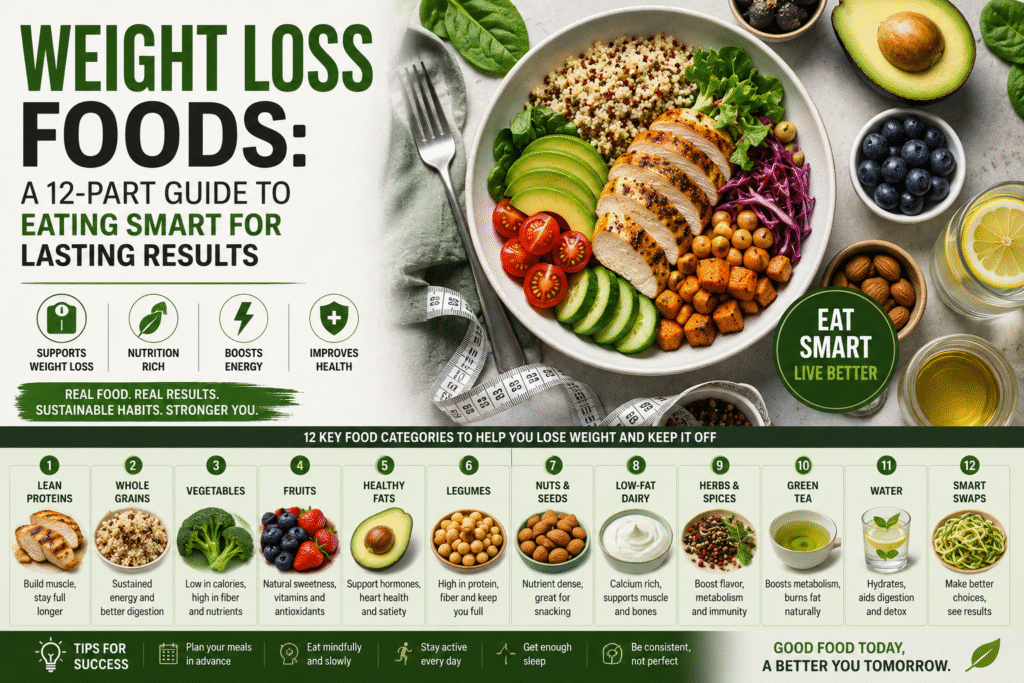
Introduction: Food as Medicine, Not Enemy
In a world flooded with fad diets, detox teas, and appetite-suppressing supplements, the fundamental truth about weight loss remains refreshingly simple: the right foods, eaten in the right way, can transform your body without starvation or suffering. Weight loss is not about eating less—it is about eating better. The foods you choose determine your energy levels, hunger hormones, metabolic rate, and ultimately, your ability to shed excess pounds and keep them off. This 12-part guide explores the most effective, science-backed weight loss foods and how to incorporate them into your daily life.
Part 1: Leafy Greens — The Ultimate Low-Calorie Powerhouse
Leafy green vegetables sit at the very top of any weight loss food list—and for excellent reasons. Spinach, kale, Swiss chard, arugula, lettuce, and collard greens are incredibly nutrient-dense while being remarkably low in calories. A full cup of raw spinach contains just 7 calories, while offering substantial amounts of vitamins A, C, K, folate, iron, and calcium .
The secret to their weight loss power lies in their combination of high volume and low energy density. You can eat a large bowl of leafy greens, feel physically full, and consume fewer calories than a single bite of cheesecake. Additionally, leafy greens are rich in fiber and water, both of which add bulk to your meals without adding calories, helping you stay satisfied for longer periods .
Beyond their mechanical satiety effects, leafy greens contain thylakoids—compounds that have been shown to reduce hunger and increase feelings of fullness . Several studies have demonstrated that adding thylakoids to meals can reduce cravings and lower calorie intake throughout the day.
Practical tip: Start every lunch and dinner with a leafy green salad dressed with vinegar and a small amount of olive oil. This simple habit fills your stomach with low-calorie nutrition before you reach for higher-calorie main dishes.
Part 2: Cruciferous Vegetables — Broccoli, Cauliflower, and Cabbage
The cruciferous family—broccoli, cauliflower, Brussels sprouts, cabbage, and kale—deserves its own category for weight loss. These vegetables are packed with fiber and protein, two nutrients that play significant roles in satiety. Protein influences appetite-regulating hormones, while fiber slows digestion, keeping you feeling full for hours after eating .
A single cup of chopped broccoli contains approximately 2.4 grams of protein and 2.4 grams of fiber, yet only 31 calories. The combination is potent: research suggests that people who eat more vegetables, particularly cruciferous varieties, tend to have lower body weights .
Cruciferous vegetables also contain sulforaphane, a compound that has been studied for its potential effects on fat cells. Some research indicates that sulforaphane may help prevent the formation of new fat cells and stimulate the breakdown of existing fat stores .
Practical tip: Roast a large batch of broccoli and cauliflower at the beginning of each week. Toss with olive oil, salt, and pepper, then roast at 400°F (200°C) until edges are crisp. Add to lunches and dinners throughout the week.
Part 3: Lean Proteins — Chicken, Turkey, and Fish
Protein is the single most important nutrient for weight loss, and lean meats provide it in its most concentrated form. Chicken breast, turkey breast, white fish, and lean cuts of beef deliver substantial protein with minimal fat and calories .
A 100-gram serving of cooked chicken breast provides 31 grams of protein and only 165 calories. A similar serving of cod offers 20 grams of protein at just 82 calories .
The weight loss benefits of protein are multifaceted. First, protein has a high thermic effect—your body burns approximately 20-30% of the calories from protein during digestion and absorption, compared to just 5-10% for carbohydrates and 0-3% for fats . Simply eating protein boosts your metabolism.
Second, protein is the most satiating macronutrient. Studies consistently show that increasing protein intake reduces hunger, decreases cravings, and naturally lowers total calorie consumption . One study found that increasing protein from 15% to 30% of total calories caused overweight women to eat 441 fewer calories per day, losing 11 pounds over 12 weeks without any other dietary restrictions .
Practical tip: Aim to include a palm-sized portion of lean protein at every meal. Breakfast, lunch, and dinner should all contain protein sources, which helps stabilize blood sugar and control hunger throughout the day.
Part 4: Whole Eggs — The Breakfast Champion
Eggs have suffered an undeserved reputation due to outdated concerns about dietary cholesterol. Modern research has thoroughly debunked the myth that eggs raise blood cholesterol in most people. What remains undisputed is eggs’ extraordinary power for weight loss .
A whole large egg contains approximately 6 grams of protein, 5 grams of fat, and only 77 calories. The protein in eggs is highly bioavailable, meaning your body can absorb and utilize it efficiently .
Studies comparing egg-based breakfasts to grain-based breakfasts reveal striking differences. Overweight and obese women who ate eggs for breakfast consumed significantly fewer calories at lunch and throughout the subsequent 36 hours compared to those who ate bagels—despite both breakfasts containing the same number of calories . Another study found that eating eggs for breakfast led to 65% greater weight loss over eight weeks compared to an equal-calorie bagel breakfast .
The yolk matters. Nearly half of the protein and most of the nutrients are found in the yolk, including choline, which supports metabolism and liver function. Unless you have a specific medical condition, eat the whole egg.
Practical tip: Hard-boil a dozen eggs at the start of the week. Keep them in the refrigerator for quick, portable protein snacks or easy additions to salads and lunches.
Part 5: Legumes — Beans, Lentils, and Chickpeas
Legumes are the forgotten superfood of weight loss. Black beans, kidney beans, pinto beans, lentils, chickpeas, and peas combine the best features of proteins and carbohydrates in a single, fiber-rich package .
A single cup of cooked lentils contains 18 grams of protein, 16 grams of fiber, and only 230 calories. The fiber content alone is remarkable—the average American consumes just 15 grams of fiber daily, while this one cup provides more than half that amount .
The weight loss power of legumes comes from their effect on appetite. The combination of protein and fiber—both soluble and insoluble—slows digestion, stabilizes blood sugar, and triggers the release of appetite-suppressing hormones. People who eat legumes regularly report feeling fuller for longer and consuming fewer calories at subsequent meals .
Multiple studies have confirmed these effects. A systematic review found that legume consumption significantly reduced body weight and body fat, even when diets were not specifically designed for weight loss .
Practical tip: Replace half of the meat in any recipe with cooked lentils or beans. This reduces calories and saturated fat while adding fiber and maintaining protein content. Use lentils in pasta sauce, chickpeas in curry, and black beans in tacos.
Part 6: Soups — The Volume Eating Strategy
Soups represent a brilliant strategy for weight loss that many people overlook. When you blend vegetables, broth, and protein into a warm, liquid-based meal, you create a food with remarkably low calorie density .
Research demonstrates that people who eat soup before a meal consume 20-30% fewer total calories during that meal compared to those who skip the soup . The mechanism appears to be both physical and psychological: the liquid volume triggers stretch receptors in the stomach, signaling fullness to the brain, while the warmth and flavor provide sensory satisfaction.
The key is choosing the right soups. Clear vegetable soups, broth-based soups, and lentil or bean soups are excellent. Cream-based soups, cheese-heavy soups, and those made with coconut milk are significantly higher in calories and should be consumed less frequently.
Practical tip: Make a large pot of vegetable soup each weekend. Use low-sodium broth, plenty of leafy greens and cruciferous vegetables, and add beans or lentils for protein. Have a cup before lunch and dinner to naturally reduce your calorie intake.
Part 7: Berries — Nature’s Sweetest Weight Loss Tool
For anyone with a sweet tooth, berries are the answer to weight loss cravings. Strawberries, blueberries, raspberries, and blackberries deliver intense sweetness and flavor with remarkably few calories .
A full cup of strawberries contains 50 calories and 3 grams of fiber. A cup of raspberries provides 64 calories and an extraordinary 8 grams of fiber—nearly one-third of the daily recommended intake .
The deep colors of berries come from anthocyanins, antioxidant compounds that may also influence fat storage and metabolism. Some research suggests that anthocyanins can reduce the activity of enzymes involved in fat absorption and storage .
Berries also have a low glycemic index, meaning they do not cause rapid spikes in blood sugar that lead to subsequent crashes and cravings. This makes them an ideal sweet treat for anyone trying to lose weight without feeling deprived.
Practical tip: Keep frozen berries in your freezer at all times. Add to Greek yogurt, oatmeal, smoothies, or simply thaw and eat as a dessert. Frozen berries are often more affordable and are frozen at peak ripeness, preserving their nutrient content.
Part 8: Nuts and Seeds — The Healthy Fat Powerhouses
Despite their high calorie density, nuts and seeds have earned a surprising place in weight loss diets. Walnuts, almonds, pistachios, chia seeds, flaxseeds, and pumpkin seeds are rich in protein, fiber, and healthy fats that work together to control appetite .
The evidence is compelling: people who eat nuts regularly tend to have lower body weights and less abdominal fat than those who avoid them . This counterintuitive finding is explained by nuts’ ability to reduce hunger, increase calorie burning, and—remarkably—pass through the digestive system partially undigested, meaning not all of their calories are absorbed .
Almonds have been particularly well-studied. Research shows that people who eat almonds as a snack eat fewer calories at subsequent meals, and that the body absorbs only about 80% of the calories from whole almonds because of their tough cell walls .
The key is portion control. Because nuts are calorie-dense, a small handful—approximately one ounce or 28 grams—is a serving. Larger portions can easily add hundreds of calories.
Practical tip: Pre-portion nuts into small bags or containers at the beginning of the week. Keep one in your bag, one in your desk, and one in your car so you always have a healthy snack within reach, avoiding desperate trips to vending machines.
Part 9: Greek Yogurt — The Protein-Packed Dairy
Not all yogurts are created equal, and Greek yogurt stands head and shoulders above the rest for weight loss. The straining process that makes Greek yogurt thick and creamy also removes much of the whey, leaving a product with approximately twice the protein of regular yogurt .
A typical 170-gram (6-ounce) serving of plain, non-fat Greek yogurt contains 17 grams of protein, 6 grams of carbohydrates, and just 100 calories . The protein comes predominantly from casein, which digests slowly and provides a sustained release of amino acids, keeping you feeling full for hours .
Studies have linked yogurt consumption to lower body weight, less abdominal fat, and better metabolic health. One study found that eating yogurt as a snack reduced hunger and led to participants eating 100 fewer calories at dinner compared to those who ate a lower-protein snack .
The key is choosing plain, unsweetened varieties. Flavored yogurts often contain added sugars that can add 15-20 grams of sugar per serving—the equivalent of four to five teaspoons—which undermines any weight loss benefits.
Practical tip: Buy plain, non-fat Greek yogurt in large tubs. Sweeten naturally with fresh berries or a drizzle of honey. Add a handful of nuts or seeds for crunch. This combination provides protein, fiber, and healthy fats in a single satisfying snack.
Part 10: Whole Grains — Oats, Quinoa, and Brown Rice
Refined grains—white bread, white rice, regular pasta, and most breakfast cereals—are stripped of their fiber and nutrients, leaving rapidly digesting starches that spike blood sugar and leave you hungry within hours. Whole grains are the opposite .
Oats, quinoa, brown rice, barley, and whole wheat are intact grains containing all three parts of the seed: the bran (fiber-rich outer layer), the germ (nutrient-packed core), and the endosperm (starchy center). This intact structure means whole grains digest slowly, providing steady energy without blood sugar spikes .
A half-cup of dry rolled oats contains 5 grams of protein and 4 grams of fiber. A cup of cooked quinoa offers 8 grams of protein and 5 grams of fiber .
Studies comparing whole grains to refined grains find striking differences. People eating whole grains have lower calorie intake at subsequent meals, reduced hunger, and greater weight loss compared to those eating refined grains—even when total calorie intake is matched . The fiber in whole grains also feeds beneficial gut bacteria, which may influence metabolism and weight regulation through the gut-brain axis .
Practical tip: Start your day with a bowl of oatmeal made with water or unsweetened almond milk. Top with berries, a spoonful of nuts, and a sprinkle of cinnamon. This breakfast provides sustained energy and stable blood sugar for hours.
Part 11: Avocados — The Satiety Superfruit
Avocados are unique among fruits: they are rich in fat, not carbohydrates. While this makes them calorie-dense—one medium avocado contains approximately 240 calories—their specific nutritional profile makes them valuable for weight loss .
The primary fat in avocados is oleic acid, the same monounsaturated fat found in olive oil, which has been linked to reduced inflammation, improved heart health, and better metabolic function . Avocados are also rich in fiber—about 10 grams per medium fruit—and contain only 2 grams of digestible carbohydrates .
Research has demonstrated that adding half an avocado to a meal significantly reduces hunger and desire to eat for hours afterward . One study found that overweight adults who included half an avocado at lunch reported 40% less desire to eat for three hours after the meal, compared to those who ate the same lunch without avocado .
Practical tip: Add half an avocado to your lunch salad or spread a quarter-avocado on whole-grain toast. The healthy fats help your body absorb fat-soluble vitamins from the vegetables you eat alongside it.
Part 12: Water and Green Tea — The Zero-Calorie Boosters
No discussion of weight loss foods is complete without addressing beverages. What you drink matters as much as what you eat, and two beverages stand out for their weight loss benefits .
Water is the simplest weight loss tool available. Drinking water increases the number of calories you burn through a process called water-induced thermogenesis . Drinking 500 ml (17 ounces) of water increases metabolic rate by 24-30% for 60-90 minutes .
Even more importantly, drinking water before meals reduces calorie intake. Studies show that drinking 500 ml of water 30 minutes before a meal leads to consuming 13-22% fewer calories during that meal . Over time, this simple habit can produce significant weight loss .
Green tea offers additional benefits beyond those of water. It contains caffeine, which is known to increase fat burning, and catechins, particularly epigallocatechin gallate (EGCG), which works synergistically with caffeine to increase metabolic rate and fat oxidation .
Research suggests that green tea extract can increase calorie burning by 4% and fat burning by 17% over 24 hours . While these effects are modest, they add up over weeks and months of consistent consumption.
Practical tip: Keep a water bottle on your desk and sip throughout the day. Drink one full glass of water before each meal. Replace sugary beverages—soda, sweetened coffee drinks, juice—with water and unsweetened green tea. These simple changes eliminate hundreds of empty calories daily while boosting your metabolism.
Conclusion: The Power of Whole Foods
Weight loss is not about deprivation, starvation, or eliminating entire food groups. It is about choosing foods that work with your body’s natural hunger and satiety signals rather than against them. The foods outlined in this guide—leafy greens, cruciferous vegetables, lean proteins, whole eggs, legumes, soups, berries, nuts and seeds, Greek yogurt, whole grains, avocados, water, and green tea—share common characteristics: they are minimally processed, nutrient-dense, and rich in protein, fiber, or both .
Start by adding these foods to your diet rather than taking anything away. Replace one meal or snack at a time. Drink water before meals. Begin lunch with a soup or salad. Keep pre-portioned nuts and boiled eggs within reach. These small, sustainable changes, practiced consistently, will transform your body without the misery of dieting. The science is clear: the right foods are the most powerful weight loss tool you will ever have.