

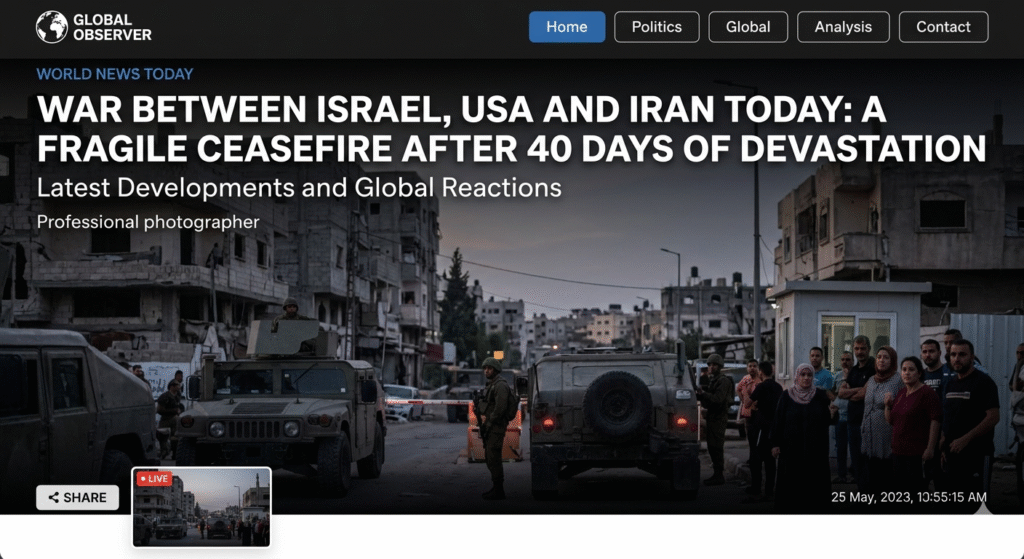
April 8, 2026 – After 40 days of relentless conflict that has reshaped the Middle East, the United States, Israel, and Iran have entered a fragile two-week ceasefire. The pause, brokered by Pakistan and announced barely an hour before President Donald Trump’s deadline to “obliterate” Iran was set to expire, has halted the aerial bombardment—but not the fighting in Lebanon . As the world exhales, the scale of destruction is only now becoming clear: over 3,700 dead, thousands of strikes, and a global economy left reeling.
Here is the state of the war today.
The Ceasefire: A Two-Week Pause, Not a Peace
The agreement, which took effect late Tuesday, April 7, is limited but significant. Iran has agreed to guarantee safe passage for maritime traffic through the Strait of Hormuz—a vital chokepoint through which one-fifth of the world’s oil passes—for two weeks . In return, the United States has suspended its bombing campaign. Negotiations between Washington and Tehran are scheduled to begin Friday in Islamabad, Pakistan .
President Trump declared the outcome “a total and complete victory, 100 per cent, no question about it” . In a series of posts on Truth Social, he announced that Iran would cease uranium enrichment and that the United States would “work closely with Iran” to extract “nuclear dust” from bombed sites .
But the celebration is one-sided. While Trump touts “regime change,” Iranian officials have presented the deal as a victory of their own, claiming the agreement permits continued enrichment—a claim the White House disputes .
The Exclusion: Lebanon Remains a Battlefield
Critically, the ceasefire does not apply to Lebanon. Israel has explicitly stated that the pause in fighting with Iran “does not include Lebanon,” directly contradicting earlier announcements by Pakistani mediators who claimed the truce would be region-wide .
The implications are immediate and deadly. On Wednesday, the Israel Defense Forces (IDF) launched what it called the largest wave of strikes across Lebanon since the conflict began. In just ten minutes, the air force attacked 100 Hezbollah command centers and military infrastructure targets in Beirut, the Bekaa Valley, and southern Lebanon . Thousands of residents in Beirut’s southern suburbs have been ordered to flee their homes as airstrikes continue to pummel the Lebanese capital.
Lebanon was drawn into the war after Iran-backed Hezbollah launched rocket fire on Israel in retaliation for the US-Israeli strikes that killed Iran’s supreme leader . Since March 2, more than 1,530 people have been killed in Lebanon, including at least 129 children, according to Lebanese health authorities .
40 Days of War: The Numbers Behind the Devastation
Between February 28 and April 6, the scale of military operations was staggering. According to data from the Armed Conflict Location and Event Data Project (ACLED), US-Israeli forces carried out 3,007 attacks on Iran, while Iran launched 1,511 retaliatory strikes .
The human cost across the region has been catastrophic:
- Iran: 2,076 confirmed deaths (rights groups estimate as high as 3,546, including over 1,600 civilians)
- Lebanon: 1,530 killed, 4,812 wounded
- Iraq: 109 killed
- Israel: 26 civilians and 11 soldiers killed
- United States: 13 military personnel killed
- UAE, Kuwait, Bahrain, Qatar, Saudi Arabia, Oman: 31 combined deaths
The war also reached beyond the immediate combatants. French, Turkish, and other foreign nationals were among the casualties .
Energy Infrastructure: The Strategic Target
Both sides deliberately targeted energy infrastructure, creating shockwaves through the global economy. Iran effectively closed the Strait of Hormuz early in the conflict, choking off one-fifth of the world’s oil and gas supply .
The list of damaged facilities reads like a map of the region’s energy backbone :
- UAE: Eight sites hit, including the Ruwais refinery, Habshan gas facility, and Das Island LNG terminal
- Saudi Arabia, Bahrain, Kuwait: Multiple refineries struck, including Ras Tanura, Bapco, and Mina Al-Ahmadi
- Iran: South Pars gas field and Bushehr nuclear plant damaged
- Qatar: Ras Laffan LNG facility affected
The impact on global oil markets was immediate. Brent crude surged past $110 per barrel, and the IMF estimated that the war had shrunk global oil supply by 13% . European natural gas prices jumped 70% .
The Economic Fallout: Inflation, Hunger, and Uncertainty
The war’s effects extend far beyond the battlefield. IMF Managing Director Kristalina Georgieva warned that the conflict will lead to “higher inflation and slower global growth,” with vulnerable countries facing the most severe consequences .
The World Food Program has cautioned that millions will face acute hunger if the war continues into June. Fertilizer supplies—critical for global crop yields—have been disrupted, threatening food prices worldwide .
Even with the ceasefire, the damage may be lasting. “Even if the war is to stop today, there would be a lingering negative impact to the rest of the world,” Georgieva said .
Military Operations: What the US and Israel Achieved
US Defense Secretary Pete Hegseth offered a blunt assessment of the military campaign, codenamed Operation Epic Fury. According to Hegseth, Iran’s missile program has been “functionally destroyed,” its navy “is at the bottom of the sea,” and the United States now “owns their skies” .
The US carried out 800 strikes on Tuesday night alone, the final night of the bombing campaign, destroying what Hegseth described as Iran’s defense industrial base . American B-2 bombers dropped 30,000-pound bunker-busting Massive Ordnance Penetrators (MOPs) on underground nuclear facilities at Fordow, Natanz, and Isfahan .
Trump personally announced the strikes on three nuclear sites, writing on social media: “We have completed our very successful attack on the three Nuclear sites in Iran, including Fordow, Natanz, and Esfahan. All planes are now safely on their way home” .
Iran’s Response: Retaliation and Leverage
Despite the damage, Iran has maintained its ability to strike back. Tehran shot down at least two US aircraft during the conflict, with one F-15E pilot rescued by special forces and another crew member still missing as of last week .
Iran’s primary leverage throughout the war has been the Strait of Hormuz. By throttling the world’s most vital oil artery, Tehran kept energy prices high and pressured Washington to find a diplomatic off-ramp . Even with the ceasefire, the strait’s reopening is gradual—just ten ships passed through on Wednesday, compared to the 50-100 that would transit in peacetime .
What Comes Next: Negotiations in Islamabad
The next two weeks will determine whether the pause becomes a lasting peace or merely a lull before another round of fighting. Pakistani Prime Minister Shehbaz Sharif has invited US and Iranian delegations to Islamabad for talks beginning Friday .
The obstacles are immense. Iran reportedly wants the US to accept Tehran’s continued control over the Strait, recognize its right to uranium enrichment, lift all sanctions, pay reparations, and withdraw all troops from the region—demands the White House is unlikely to accept .
Trump has warned that if the deal “isn’t good, we’ll go right back” to military action “very easily” . For now, the bombs have stopped falling on Iran. But in Lebanon, the strikes continue. And the world watches, hoping that 40 days of war will not be followed by 40 more.
