

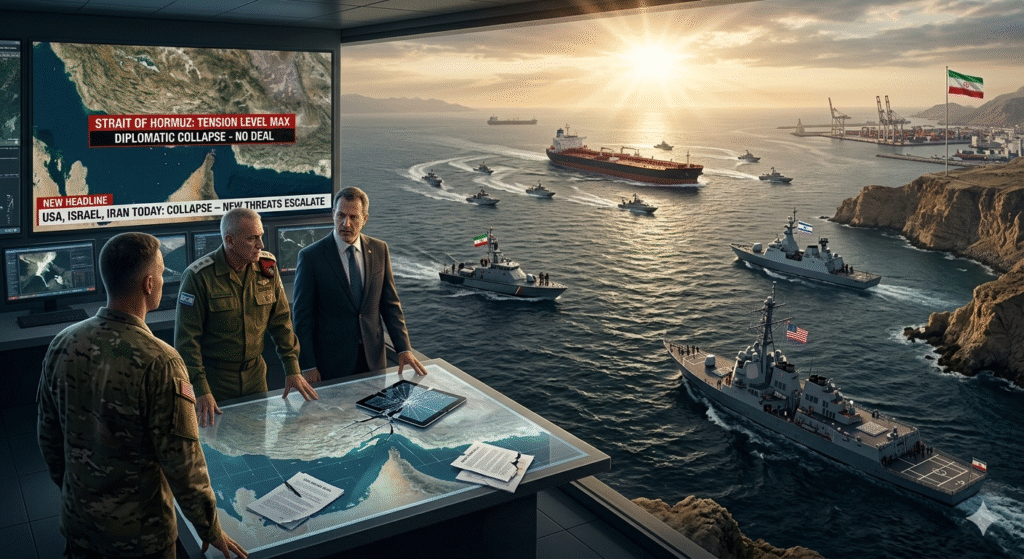
Islamabad/Washington, April 12, 2026 – In a dramatic turn of events that brings the Middle East to the brink once more, high-stakes peace talks between the United States and Iran have collapsed. After 21 hours of marathon negotiations in Islamabad, US Vice President JD Vance announced early Sunday that no agreement was reached, accusing Tehran of refusing to provide a long-term commitment to abandon its nuclear weapons program .
As the two-week ceasefire brokered just days ago hangs by a thread, both sides are now digging in. Iran has declared it is “in no hurry,” while President Donald Trump has signaled that a naval blockade and renewed military action may be imminent . Here is the state of the crisis at this last minute.
Part 1: The Collapse in Islamabad – 21 Hours for Nothing
The negotiations, held in Pakistan’s capital and mediated by local officials, represented the highest-level face-to-face talks between Washington and Tehran in 47 years. The US delegation, led by Vice President JD Vance and including special envoy Steve Witkoff and senior adviser Jared Kushner, met with Iran’s Parliament Speaker Mohammad Bagher Ghalibaf and Foreign Minister Abbas Araghchi .
Despite the historic setting, the atmosphere soured quickly. Vance told reporters that the US had been “quite flexible” and “quite accommodating,” but that Iran had “chosen not to accept” the proposals . “The bad news is that we have not reached an agreement,” Vance said. “I think that’s worse news for Iran than for the United States” .
Iranian state media confirmed the deadlock, reporting that “unreasonable demands” from the American side prevented progress. Tehran specifically rejected conditions regarding the Strait of Hormuz and its “peaceful nuclear energy” rights .
Part 2: The Nuclear Sticking Point – Vance’s ‘Final Offer’
The core dispute that shattered the talks was unmistakably the nuclear issue. Vance stated that the US needs to see “an affirmative commitment that they will not seek a nuclear weapon and they will not seek the tools that would enable them to quickly achieve a nuclear weapon” .
He emphasized that this commitment must be long-term, not just a temporary pause. “The simple question is, do we see a fundamental commitment of will for the Iranians not to develop a nuclear weapon — not just now, not just two years from now, but for the long term?” Vance asked. “We haven’t seen that yet” .
The US left the negotiating table with what Vance called a “final and best offer,” giving Tehran time to reconsider . However, Iranian media quickly shut the door, stating, “Iran is in no hurry, and until the US agrees to a reasonable deal, there will be no change in the status of the Strait of Hormuz” .
Part 3: Tehran’s Response – ‘No Trust in the Opposing Side’
The Iranian delegation did not mince words upon departing Islamabad. Parliament Speaker Mohammad Bagher Ghalibaf issued a stark statement explaining the failure: “Before the negotiations, I emphasized that we have the necessary good faith and will, but due to the experiences of the two previous wars, we have no trust in the opposing side” .
Ghalibaf claimed that while the Iranian delegation put forward forward-looking initiatives, “the opposing side ultimately failed to gain the trust of the Iranian delegation in this round of negotiations” . He added a warning to Washington: “America has understood our logic and principles, and now it’s time for it to decide whether it can earn our trust or not” .
A source close to the Iranian delegation went further, accusing the US of attempting to secure through negotiation what it failed to achieve during the war .
Part 4: The ‘America First’ vs. ‘Israel First’ Ultimatum
Adding a layer of political complexity, Iran’s First Vice President Mohammadreza Aref laid down a clear ultimatum regarding the composition of the US negotiating team. In a post on X, Aref warned that a deal is only possible if Washington adopts an “America First” approach rather than an “Israel First” agenda .
“If we negotiate in Islamabad with representatives of ‘America First,’ an agreement beneficial to both sides and the world is probable,” Aref wrote. “However, if we face representatives of ‘Israel First,’ there will be no deal” . He concluded with a threat: “We will inevitably continue our defence even more vigorously than before, and the world will face greater costs” .
This rhetoric highlights the deep suspicion in Tehran that the US delegation, which includes prominent figures close to the Israeli government, is acting primarily in the interest of Israel rather than seeking a genuine bilateral resolution.
Part 5: Trump’s ‘Trump Card’ – Naval Blockade and Minesweepers
While Vance was speaking in Islamabad, President Trump was telegraphing the next phase of US strategy from Washington. Hours after the talks collapsed, Trump signaled an intense military action against Iran, with reports indicating he is considering a naval blockade .
Trump confirmed that US warships have begun de-mining operations in the Strait of Hormuz. “They probably have a couple of mines in the water. We have mine sweepers out there. We’re sweeping these straits,” Trump told reporters . Defense Secretary Pete Hegseth added that American warships have started operations to secure the strait and remove sea mines allegedly laid by Iran .
Trump downplayed the stakes of the failed negotiations, insisting, “Regardless what happens, we win.” He added, “Whether we make a deal or not makes no difference to me” .
Part 6: Netanyahu’s Victory Lap – ‘The Campaign is Not Over Yet’
In Jerusalem, Prime Minister Benjamin Netanyahu struck a tone of triumphant defiance following the collapse of the talks. He declared that the joint US-Israeli campaign had succeeded in “crushing” Iran’s nuclear and ballistic missile programs .
“We have succeeded in crushing the nuclear programme, and crushing the missile programme,” Netanyahu said in a televised statement. “We have reached a situation in which Iran no longer has a single functioning enrichment facility” .
However, he warned that the fight is far from finished. “The campaign is not over yet. Iran wanted to eliminate us. Now it is fighting to survive. We still have more to do” . His comments came as Israeli strikes continued to rock Lebanon, a front that remains excluded from the ceasefire agreement.
Part 7: The Lebanon Front – War Rages On
While the world focused on Islamabad, the violence on the ground never stopped. Even as the ceasefire with Iran was ostensibly in effect, Israel launched one of its largest waves of strikes across Lebanon .
At least six people were killed in an airstrike on the town of Qana in southern Lebanon on Sunday, and Israel intercepted a drone launched from Lebanese territory . Lebanese health authorities have reported that the death toll in Lebanon since the conflict expanded has surpassed 2,020 people, including hundreds of civilians .
Netanyahu has been explicit that Lebanon is not covered by the Iran ceasefire, creating a volatile situation where a general de-escalation in one theater is accompanied by intense escalation in another.
Part 8: The Economic Warfare – Oil, Mines, and Global Supply
The immediate trigger for the original two-week ceasefire was the blockage of the Strait of Hormuz, through which approximately 20% of the world’s oil passes. With the talks collapsed, that waterway remains the primary battlefield.
Iran has warned that there will be no change in the status of the strait until the US agrees to a “reasonable” deal . The IRGC has specifically warned that any attempt by military vessels to transit the strait will be met with “a strong response,” insisting that only non-military vessels would be allowed to pass under specific regulations .
The US military has already begun mine-clearing operations, with two destroyers transiting the strait in a show of force . The coming days will likely determine whether the strait is reopened by force or remains a chokehold on the global economy.
Part 9: The Diplomatic Wreckage – Pakistan’s Plea
The host nation, Pakistan, found itself in an awkward position as the talks imploded. Foreign Minister Ishaq Dar insisted that it is “imperative” for both Washington and Tehran to uphold the ceasefire, urging them not to let the collapse of the talks lead to a resumption of full-scale war .
According to reports, Pakistani officials had urged the Iranian delegation to enter the talks “with a new spirit,” and there were initial “positive signals” . Those hopes were ultimately dashed. Despite the failure, Iran’s foreign ministry stated that “diplomacy never ends” and that consultations with Pakistan will continue .
Part 10: China and the Global Response
The international community watched the collapse with alarm. Australia’s Foreign Minister Penny Wong urged a continuation of the ceasefire, expressing disappointment that the talks ended without agreement .
Meanwhile, Trump warned China of serious consequences following reports that Beijing is preparing to supply weapons to Iran . This warning adds another layer of great-power tension to an already volatile situation, threatening to expand the conflict beyond the Middle East.
Part 11: The Internal Israeli Dissent – Protesters in Tel Aviv
Despite Netanyahu’s强硬 stance, there is growing discontent within Israel regarding the endless wars. Approximately 800 Israeli protesters rallied in Tel Aviv on Saturday to protest against the wars in Iran and Lebanon, accusing Netanyahu of attempting to derail the ceasefire with Iran .
Protesters chanted “No to endless wars, no to a government of death,” carrying banners reading “In Bibi, we don’t trust” . One protester, Martin Goldberg, claimed that Israel’s massive attack on Lebanon immediately after the Iran ceasefire was an attempt to sabotage the broader peace process. This domestic pressure represents a significant wild card in Israel’s decision-making.
Part 12: The Last Minute – What Happens Now?
As of this moment, the two-week ceasefire is still technically in effect, but it is critically wounded. Vance has left Islamabad, and the Iranian delegation has also departed . The “final offer” remains on the table, but Tehran has shown no indication of accepting it.
The immediate future hinges on the Strait of Hormuz. If the US proceeds with its naval blockade and mine-clearing operations without Iranian consent, the ceasefire will almost certainly shatter. If Iran continues to hold the strait hostage, the economic pressure on the West will become unbearable.
For now, the world waits. The guns are quiet, but the mines are in the water, the bombers are on the runways, and the diplomats have gone home. In the Middle East, a last-minute reprieve has turned into a last-minute ultimatum.
