

Abu Dhabi, UAE — Two months ago, the skies over the United Arab Emirates were filled with inbound missiles and drones. Hundreds of projectiles launched from Iran streaked toward the country’s cities and critical infrastructure. The world braced for a dramatic escalation, for economic collapse, for panic. None of that happened .
Instead, what unfolded was a masterclass in modern statecraft. Advanced air defense systems intercepted over 500 ballistic missiles and more than 2,000 unmanned aerial vehicles . Business continued. Schools remained open. Ports operated. Flights took off and landed. And behind the scenes, diplomats worked the phones, de-escalating tensions while projecting unmistakable strength.
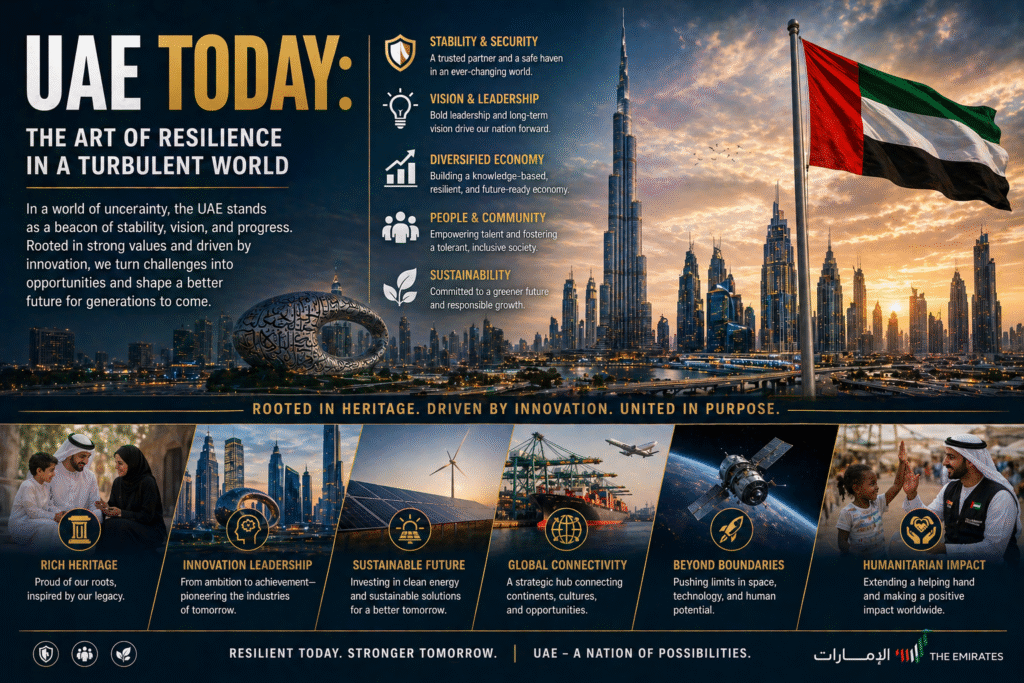
Welcome to the UAE today — a nation that has transformed geopolitical crisis into a showcase of resilience, and in doing so, has redefined what it means to be a regional power in the 21st century.
The Numbers That Tell the Story
Let us begin with the raw data, because the UAE’s economic performance in 2026 defies expectations. According to the Central Bank of the UAE, the nation’s economy is projected to grow by 5.6 percent this year, outpacing the Gulf Cooperation Council average of 4.8 percent . Only Qatar ranks higher regionally.
This growth is not merely about oil. The hydrocarbon sector is expanding — forecast at 7.3 percent — but the real story lies elsewhere. Non-oil sectors, including financial services, manufacturing, trade, tourism, and transportation, are sustaining momentum that would be the envy of any developed economy .
Consider what this means. While much of the world grapples with inflationary pressures and geopolitical uncertainty, the UAE is expanding its economic base. Dubai continues to attract multinational corporations and wealthy investors through favorable tax policies and free zones. Abu Dhabi is building industrial depth, investing in renewable energy, and deploying sovereign wealth fund-backed projects .
S&P Global Ratings recently reaffirmed the UAE’s sovereign credit rating at “AA/A-1+” with a stable outlook. The agency estimates that the UAE government’s consolidated net asset position will reach about 184 percent of GDP in 2026. That is not merely strong — that is among the strongest sovereign balance sheets anywhere on the planet .
The Strategy: Strength Without Escalation
Yet numbers alone do not capture what makes the UAE’s current trajectory remarkable. The real story is strategic.
When Iran launched its attacks beginning in February 2026, the UAE faced a classic dilemma: retaliate and risk a wider war, or absorb the blows and appear weak. It chose a third path — one that Dr. Mohammed Ibrahim Al Dhaheri of the Anwar Gargash Diplomatic Academy describes as “strength without escalation” .
“Restraint is not passive,” Al Dhaheri explained in a recent interview. “It reflects a deliberate strategic choice, grounded in the confidence that the UAE can defend its sovereignty decisively” .
This is not empty rhetoric. The UAE demonstrated operational capability — intercepting hundreds of incoming threats while protecting critical infrastructure and maintaining national continuity. Having proven it could fight, it chose diplomacy. Having shown its teeth, it extended a hand.
The approach has paid dividends. On April 9, a truce was announced between the United States and Iran. No attacks have been reported since . The UAE emerged from the crisis not as a victim, but as a stabilizing force — a nation that absorbed blows meant to shatter it and emerged more credible than before.
Foreign Policy: A New Sphere of Influence
Beyond its immediate security concerns, the UAE has been quietly building something unprecedented in the Arab world: a genuinely independent foreign policy architecture. Its recent withdrawal from OPEC and OPEC+ sent shockwaves through global energy markets, signaling that Abu Dhabi will no longer let its oil policy be dictated by others .
But the more significant story is the UAE’s expanding footprint across the Middle East and Africa. From the $35 billion deal to develop Egypt’s Mediterranean coast to the strategic investment in Somaliland’s Port of Berbera, the UAE is building a network of economic and security relationships that bypass traditional power brokers .
The centerpiece of this strategy is the relationship with Israel, formalized through the 2020 Abraham Accords. The UAE views this partnership as a “critical lever for regional influence and a unique channel to Washington” . It has also deepened ties with the United States, welcoming defense assistance while maintaining operational independence.
Critics argue that the UAE’s approach — particularly its backing of the Rapid Support Forces in Sudan and east Libya commander Khalifa Haftar — has at times fueled conflict. The UAE strongly denies supplying arms to the RSF, insisting its role is strictly humanitarian . What is indisputable is that the UAE has become an indispensable player in virtually every major conflict and reconstruction effort from the Horn of Africa to the Mediterranean.
The Future is Artificial Intelligence
If the UAE’s economic and foreign policy strategies represent its present, its embrace of artificial intelligence signals its future. In late April, Sheikh Mohammed bin Rashid Al Maktoum announced that the UAE will deploy agentic AI across 50 percent of government sectors and operations within two years .
“Today, AI models can monitor changes, provide analyses, offer recommendations, manage operations, and run an independent series of actions without human intervention,” Sheikh Mohammed said. “AI will be our government executive partner” .
This is not experimental. The UAE has been preparing for this moment since 2017, when it became the first country to appoint a Minister of State for Artificial Intelligence. The UAE Artificial Intelligence Strategy 2031 has been quietly building the infrastructure, talent pipeline, and regulatory framework necessary for mass adoption.
When fully implemented, the UAE will become the first government in the world to roll out agentic AI models at scale across the public sector. The expected benefits include reduced operational costs, boosted productivity, and faster, more efficient services .
Complementing this digital push is a renewed commitment to industrial development. On April 26, Sheikh Mohammed approved a AED 1 billion National Industrial Resilience Fund to support the localization of strategic industries, strengthen supply chain resilience, and accelerate AI adoption in production and operations .
The goal is ambitious: to fully localize more than 5,000 strategic products, ensuring that the UAE is not merely a consumer of global technology but a producer of it .
The Human Dimension: Year of the Family
Amid all this talk of growth, geopolitics, and technology, it would be easy to overlook what the UAE’s leadership considers most important. President Sheikh Mohamed bin Zayed Al Nahyan has designated 2026 as the “Year of the Family” — a deliberate focus on the social foundations that make economic development meaningful .
The initiative is built around three pillars: Roots (strengthening values and intergenerational bonds), Connections (promoting communication and closeness within families), and Growth (providing practical tools to support family development) .
Concrete steps are already underway. The Ministry of Community Empowerment recently launched “Al Yafna,” a community initiative reviving the tradition of group breakfasts in residential neighborhoods. The name comes from an authentic Emirati word for the vessel around which people gather and share — a small but symbolically powerful effort to rebuild social cohesion in an era of rapid change .
Navigating the Headwinds
None of this is to suggest that the UAE’s path is without obstacles. The ongoing conflict and closure of the Strait of Hormuz has forced GCC producers to cut oil output by approximately 10 million barrels per day as of mid-March . Brent crude has traded above $100, and while the UAE has partially offset this by rerouting through Fujairah port, the pressure is real.
The non-oil sector has shown signs of slowing. The UAE’s S&P Global PMI fell to 52.9 in March from 55 in February. Tourism, retail, and logistics have been affected, with Dubai hotel occupancy dropping from approximately 90 percent to just 16 percent in the final week of March .
Yet here again, the UAE’s structural advantages come into play. Strong external balances, substantial foreign reserves, sizeable sovereign wealth assets, and world-class infrastructure provide buffers that most nations can only dream of . Analysts view the current pressures as cyclical rather than structural — painful in the short term but unlikely to derail the long-term trajectory.
A Model for the Region
What makes the UAE’s story compelling is not that it has avoided problems — it is how it has responded to them. When Iran attacked, the UAE defended itself and then de-escalated. When markets panicked, the central bank injected Dhs214 billion in liquidity support . When supply chains were threatened, the UAE accelerated its push for industrial self-sufficiency.
“There is nothing quite like this in the region’s modern history,” one analyst observed. Most Gulf states have either projected hard power without the economic depth to sustain it, or economic openness without the security apparatus to protect it. The UAE has managed to build both simultaneously, creating a model that is being watched closely from Riyadh to Rabat, and from Washington to Beijing.
As the UAE continues its journey toward its Centennial 2071 vision — a 50-year plan to make the nation the world’s leading economy — the world will be watching. But for now, the lesson is clear: In a turbulent world, the UAE has built an ark. And it is sailing.
