

ABU DHABI — June 14, 2026
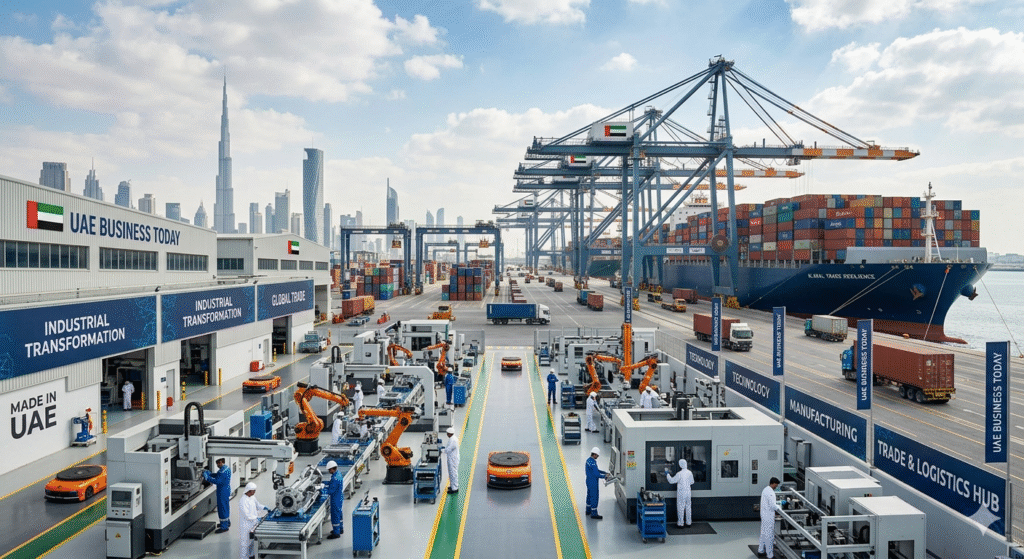
Just one month ago, the Make it in the Emirates 2026 forum concluded at the ADNEC Centre in Abu Dhabi, bringing together more than 1,200 exhibitors from across the energy, pharmaceuticals, food production, robotics, logistics, metals, and autonomous systems sectors . The event signaled a definitive shift in the UAE’s economic strategy: from decades of diversification toward the active construction of a globally competitive, technology-driven industrial ecosystem.
Today, that shift is bearing tangible fruit. As regional disruptions test the resilience of Gulf economies, the UAE has not merely weathered the storm—it has used the crisis to accelerate timelines, deepen strategic partnerships, and position itself as the most stable and agile business hub in the Middle East.
Here is a comprehensive look at UAE business today.
Part 1: The Industrial Awakening — Make it in the Emirates 2026
The fifth and largest edition of Make it in the Emirates, held from May 4-7, demonstrated that the UAE’s industrial strategy has moved decisively from ambition to execution. Organizers expect the summit to generate more than $45.7 billion in offtake agreements, reflecting unprecedented procurement and industrial demand .
Three major announcements defined the event:
The Purchase Opportunities Initiative identified approximately 5,000 products that can be manufactured domestically rather than imported. The program gives manufacturers clearer visibility into procurement demand, reducing investment risk while accelerating local production capacity .
The AED 1 billion National Industrial Resilience Fund focuses on strengthening supply chains and boosting local capacity in strategic sectors including food manufacturing, pharmaceuticals, chemicals, metals, construction materials, and advanced technologies .
The expansion of the National In-Country Value (ICV) program deepens the use of UAE-made products and services across federal entities and government-linked companies. This approach effectively turns procurement into an industrial policy tool, creating stronger incentives for multinational firms to establish manufacturing and assembly operations in the UAE .
During a visit to the summit, President Sheikh Mohamed bin Zayed Al Nahyan emphasized that the industrial sector remains “a key pillar in strengthening and diversifying the national economy,” while Sheikh Mohammed bin Rashid Al Maktoum declared that the UAE “does not wait for the future but shapes it through the ideas and efforts of its people and ambitious institutions” .
Part 2: AI Adoption — A Global Leader Emerges
Perhaps the most stunning statistic in UAE business today comes from the Microsoft AI Diffusion Report for Q1 2026: the rate of AI adoption in the UAE workforce reached 70.1 percent — nearly four times the global average of 17.8 percent . The UAE is the first economy on the planet to surpass the 70 percent mark.
Amr Kamel, General Manager of Microsoft UAE, stated that this is the result of “years of sustained focus from governments, businesses, and individuals on building the right foundations” .
The foundations are substantial. At Make it in the Emirates 2026, the Ministry of Industry and Advanced Technology (MoIAT) signed an MoU with Abu Dhabi-based Sinaha Technology to accelerate the adoption of AI, robotics, and Industry 4.0 solutions across UAE manufacturing . Sinaha has launched one of the UAE’s first intelligent warehouse deployments, built on locally engineered technologies enabling fully autonomous operations through the integration of robotics, software, and real-time decision-making .
The strategy extends beyond domestic adoption. The UAE-US AI Acceleration Partnership, launched during President Trump’s state visit to the UAE, is progressing rapidly. The UAE-US AI Campus in Abu Dhabi, the largest facility of its kind outside the United States, has a planned capacity of 5 gigawatts. The first phase, with 500 megawatts of capacity, is expected to become operational before the end of this year .
Part 3: The US Partnership — $1.4 Trillion Commitment
The deepening economic relationship with the United States was highlighted in early June when Khaldoon Khalifa Al Mubarak, Chairman of the Executive Affairs Authority, visited Washington, D.C., meeting with US Vice President JD Vance, Treasury Secretary Scott Bessent, and Commerce Secretary Howard Lutnick .
Al Mubarak’s message was clear: “The UAE-US economic relationship is built on a foundation of trust and mutual growth. We are exceeding commitments we made to the US one year ago. Despite regional and macroeconomic challenges, this partnership continues to deliver across key sectors, supporting jobs and economic opportunities defined by long-term impact” .
The UAE has committed to investing $1.4 trillion in the US economy over ten years across strategic sectors including energy, advanced manufacturing, artificial intelligence, and advanced technology . Leading UAE companies including MGX and G42 have made strategic investments across the AI value chain, including advanced semiconductors, large-scale AI infrastructure, AI laboratories, and advanced applications.
In advanced manufacturing, Emirates Global Aluminium is progressing plans to build the first new aluminium smelter in the United States in nearly 50 years, located in Oklahoma . The Abu Dhabi Investment Authority, Mubadala Investment Company, and L’Imad Holding are expanding their investment footprint in the US across key sectors.
Part 4: Economic Outlook — 5.6 Percent Growth
The Central Bank of the UAE projects the economy will grow by 5.6 percent in 2026, outpacing the Gulf Cooperation Council average of 4.8 percent . The forecast ranks the UAE second in the region behind Qatar.
Growth is driven primarily by the non-hydrocarbon sector, reflecting continued progress in economic diversification. The hydrocarbon sector is also expected to contribute, with its GDP forecast to expand by 7.3 percent in 2026, supported by higher oil production .
Despite heightened geopolitical tensions in the Middle East, S&P Global Ratings reaffirmed the UAE’s sovereign credit rating at “AA/A-1+” with a stable outlook, citing strong fiscal buffers, diversified growth drivers, and one of the world’s largest sovereign wealth portfolios. The agency estimates that the UAE government’s consolidated net asset position will reach about 184 percent of GDP in 2026 .
Part 5: Trade Resilience — Navigating Regional Disruptions
At the GLOBSEC Forum 2026 in Prague in late May, UAE Minister for Foreign Trade Dr. Thani bin Ahmed Al Zeyoudi outlined the country’s strategy to address disruptions to global trade routes . The measures implemented since the onset of recent conflicts include:
- Activation of alternative trade corridors through the UAE’s eastern ports of Fujairah and Khorfakkan
- Air freight bridges for time-sensitive pharmaceutical and food shipments
- A Green Corridor with Oman
- A new Sharjah-Dammam trade bridge
- An AED 1 billion economic support fund to ensure business continuity and provide targeted relief for SMEs
“The fundamental redesign of Gulf logistics that we were undertaking over a decade is now being compressed into years,” Al Zeyoudi said. “What this moment has done is accelerate the timelines of existing plans, and underscore the wisdom of building an open, diversified, and resilient trade architecture before it is needed” .
Al Zeyoudi affirmed that the UAE’s Comprehensive Economic Partnership Agreement (CEPA) programme—which has produced 36 agreements with partners across six continents and contributed to non-oil foreign trade reaching $1.03 trillion in 2025—remains central to sustaining growth in foreign trade .
Part 6: Real Estate Resilience — Diverging Sectors
The UAE’s real estate sector demonstrated remarkable divergence in the first quarter of 2026, according to JLL’s latest Real Estate Market Dynamics report .
Residential: Dubai’s off-plan sales increased 9.5 percent year-on-year in Q1 2026, showing relative resilience, while secondary market sales fell 8.2 percent . In Abu Dhabi, new project launches drove transaction volumes to more than double year-on-year in Q1.
While residential prices in Dubai continued to show year-on-year growth, the pace of annual appreciation moderated to 8-12 percent, down from 16-19 percent, indicating the market is gradually correcting from previous rapid appreciation cycles . Across Abu Dhabi and Dubai, a supply pipeline of around 59,000 units is forecast for the remainder of 2026.
Industrial: The industrial sector demonstrated strong fundamentals with lower sensitivity to temporary disruptions. Dubai’s industrial market recorded 12.8 percent rental growth year-on-year to Q1 2026, with average rates reaching AED 48 per sq ft, while Abu Dhabi achieved 18.2 percent growth . Demand for industrial space serving essential goods sectors—food distribution, pharmaceuticals, medical supplies, and critical commodities—is expected to maintain consistent strength.
Hospitality: The sector faced significant headwinds, with Dubai’s hotel occupancy falling 39.4 percentage points and RevPAR declining 65.6 percent in March 2026 . The government’s AED 1 billion economic incentives package is supporting hotel liquidity through various fee deferrals.
Part 7: The China Connection — Deepening Ties
Economic relations between the UAE and China continue to gain significant momentum. From June 11-12, the Abu Dhabi Chamber of Commerce and Industry led a private sector delegation of more than 40 companies to Shanghai, representing sectors including advanced manufacturing, food and agriculture, financial services, healthcare, AI and technology, infrastructure, and retail .
The data behind the mission is striking: new Chinese company memberships at Abu Dhabi Chamber increased by 85 percent year-on-year in 2025 compared to 2024 . The UAE is today home to more than 400,000 Chinese residents and over 17,000 Chinese companies.
Ali Mohamed Al Marzouqi, Director General of Abu Dhabi Chamber, said: “China remains one of the UAE’s most important economic partners and one of the world’s most dynamic and influential markets. We believe that strengthening these economic connections creates sustainable value for our companies while opening new avenues for growth, expansion, and enhanced competitiveness on a global scale” .
Part 8: The OPEC Exit — A Strategic Pivot
On May 1, 2026, the UAE officially left OPEC after more than five decades as a founding member—a decision that many observers call the “final chapter” of the alliance that once shaped the global energy market .
The paradox is that leaving OPEC doesn’t mean the UAE is giving up oil. In fact, it wants to extract more, aiming for 5 million barrels per day by 2027, with a plan to invest $145 billion before 2030 .
Natural gas, once considered a byproduct of extraction, has now become a cheap energy source to power massive AI data centers. This is Abu Dhabi’s strategic cycle: maximize oil and gas production during the remainder of the fossil fuel era, use that revenue to build AI infrastructure, and then enter the post-oil era as a technological powerhouse .
Part 9: The Data Embassy — A New Global Architecture
The UAE’s ambitions extend beyond its borders. G42, the technology conglomerate described as the “ADNOC of AI,” is advancing a “data embassy” model that allows countries to lease server space in Abu Dhabi and operate AI services under their own laws .
Talal Al Kaissi, interim CEO of Core42 (a G42 subsidiary), described it as “a modern version of the Vienna Convention but for data centers” . This is a subtle geopolitical move: the UAE is both attracting Western investment and expanding its influence southward, positioning itself as the architect of a new global technology order.
Part 10: SME Growth and Innovation
Make it in the Emirates 2026 highlighted efforts to build a more dynamic industrial startup ecosystem. A dedicated Startup Hub and pitch competition connected founders with investors, procurement leaders, and manufacturers. SMEs accounted for the majority of exhibitors at this year’s edition, signaling their increasing centrality to the country’s industrial strategy .
The AED 1 billion economic support fund announced by the UAE government is specifically designed to provide targeted relief for small and medium-sized enterprises, ensuring business continuity amid regional disruptions .
Part 11: The Workforce Transformation
The 70.1 percent AI adoption rate in the UAE workforce reflects deep structural changes in how businesses operate. Companies across sectors are integrating AI-powered manufacturing systems, industrial robotics, predictive maintenance platforms, autonomous mobility technologies, and smart factory infrastructure .
The Ministry of Industry and Advanced Technology’s Transform 4.0 initiative is helping manufacturers accelerate technology adoption, link production to market demand, and support the growth of industrial SMEs .
Part 12: The Year Ahead
As June 2026 progresses, several factors will shape the UAE’s business trajectory:
Global Stability: The UAE’s trade resilience measures have proven effective, but sustained growth depends on broader regional stabilization.
AI Infrastructure: The UAE-US AI Campus in Abu Dhabi is scheduled to become operational before year-end, representing a major milestone in the country’s technological transformation.
Industrial Localization: The Purchase Opportunities Initiative and National Industrial Resilience Fund will begin delivering tangible results as manufacturers establish domestic production capacity.
International Partnerships: The CEPA program continues to expand, with 36 agreements already in place and more under negotiation.
Conclusion
UAE business today is defined by a single word: transformation. The country that built its wealth on oil is methodically constructing a post-oil economy centered on AI, advanced manufacturing, and global trade connectivity. The 5.6 percent growth forecast, the 70.1 percent AI adoption rate, the $1.4 trillion US investment commitment, and the $1.03 trillion in non-oil foreign trade are not isolated statistics. They are evidence of a strategy that is working.
The UAE has not merely weathered regional disruptions; it has used them to accelerate existing plans, activate alternative trade corridors, and demonstrate the resilience of its economic architecture. As Al Zeyoudi told the GLOBSEC Forum: “Nothing that we have achieved in the last five years has been undone or unwound. The UAE is a bridge to high-growth markets across the Gulf, Africa and Asia, and a partner for trade, logistics, investment and technology. That role has not diminished. It has become more important” .
For businesses looking to the region, the message is clear: the UAE is not just open for business. It is actively shaping the future of business.