

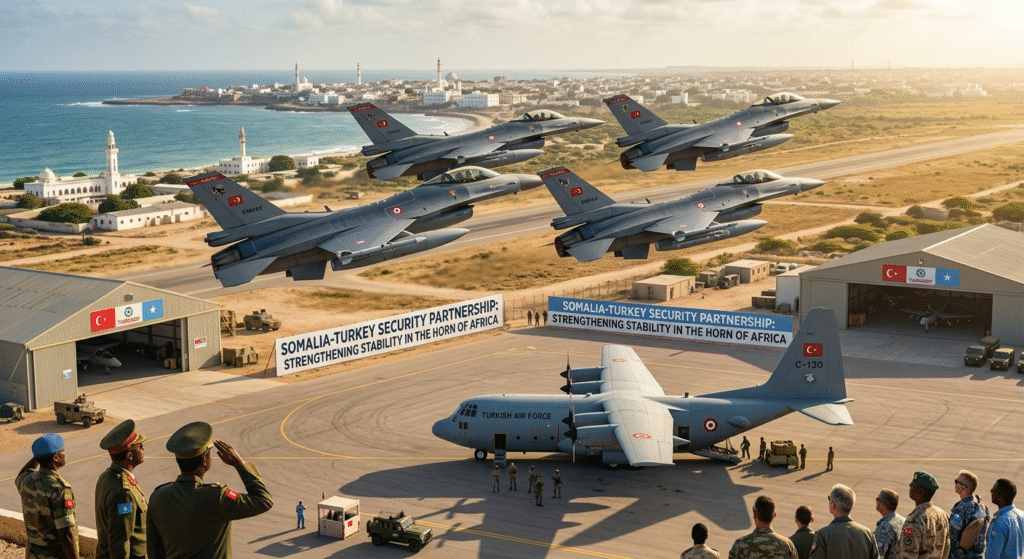
Turkey’s military involvement in Somalia has entered a transformative phase, marked by the recent deployment of F-16 fighter jets and a significant expansion of training programs. This shift represents a move from humanitarian partnership to a more assertive security role, positioning Turkey as one of the most influential foreign actors in the country’s fight against Al-Shabaab .
The last week of August 2026 has been particularly significant, showcasing the scale of this involvement. However, it has also brought to the surface local tensions over foreign airstrikes, revealing the complex realities on the ground.
A Full Spectrum of Military Engagement
Turkey’s strategy is multi-layered, combining combat power with institutional capacity building. At the top of this new capability is the deployment of manned combat aircraft.
🚀 F-16s and The Shift to “Hard Power”
The presence of the Turkish Air Force in Somalia is now unmistakable. Three F-16 Vipers, along with T129 ATAK attack helicopters and AS-532 transport helicopters, are reportedly stationed at Mogadishu’s Aden Adde International Airport . Their deployment marks a clear escalation from the previous use of drones.
While officially in support of Somalia’s fight against Al-Shabaab, analysts view the move as a strategic hardening of Ankara’s footprint . By basing these advanced jets in Mogadishu, Turkey is not only supporting counter-insurgency operations but also protecting its substantial investments in Somali infrastructure and its growing maritime energy interests . This strategic posture is further underscored by the presence of a Turkish naval task group and the oil drilling ship Çağrı Bey off the Somali coast, which the F-16s have been seen overflying .
🔥 Joint Operations and Local Concerns
Last week, this air power was reportedly put to use. According to reports, the Turkish Air Force, in coordination with Somali ground forces, conducted a large-scale operation against Al-Shabaab in the Lower Shabelle region. The operation involved F-16s striking caves and ammunition depots, with claims of about 35 terrorists killed .
However, this military action has been met with a local backlash. On August 15, protests erupted in parts of Somalia’s Southwest State, with demonstrators burning the Turkish flag . They accused Turkish warplanes of conducting airstrikes near Baidoa that damaged farmland and livestock, though these claims have not been independently verified and Turkey has not confirmed carrying out these specific strikes . The incident highlights the risks of collateral damage and the critical need for precision and community engagement.
Strengthening the Somali National Army
Turkey’s influence extends far beyond airpower; it is fundamentally reshaping the Somali National Army (SNA).
A major milestone was the graduation of 1,521 Somali soldiers on August 7, who successfully completed a grueling Commando Basic Training program in Manisa, Turkey . This group forms part of the elite Gorgor commando units, considered the most effective fighting force in the Somali army against Al-Shabaab . The program is set to continue, with a further 1,523 soldiers scheduled to begin training in Turkey starting August 17 .
To date, Turkey has trained an estimated 16,000 Somali soldiers . According to the Critical Threats Project, this includes extensive training for the Gorgor brigades, whose soldiers have become a backbone of government offensives . A new shipment of BMC anti-mine armored vehicles arrived recently for the 21st Gorgor Brigade, equipping them for ground operations in the coming days .
🤝 High-Level Coordination
These activities are being coordinated at the highest levels. On August 2, the Somali Army Chief and the Turkish TURKSOM Commander visited Baidoa for security talks with the South West State leadership, reaffirming their commitment to coordinated operations . Furthermore, the Somali Chief of Army Staff was hosted in Ankara for talks with Turkish Defence Minister Yaşar Güler on August 10, emphasizing the strength of the bilateral relationship .
A Strategic Platform in the Horn of Africa
Turkey’s recent actions are a clear declaration that it considers Somalia a strategic platform in the Horn of Africa . The relationship, which began with humanitarian aid in 2011, has evolved into a partnership that gives Ankara a direct stake in the capabilities and success of the Somali military as it prepares for a renewed offensive against Al-Shabaab . However, this deep involvement also carries risks, as the protests in Baidoa show. Turkey’s escalation of “hard power” in Somalia is a major geopolitical shift, and its future will be defined by its ability to manage not only the battlefield but also the consent of the Somali people it aims to support.
