

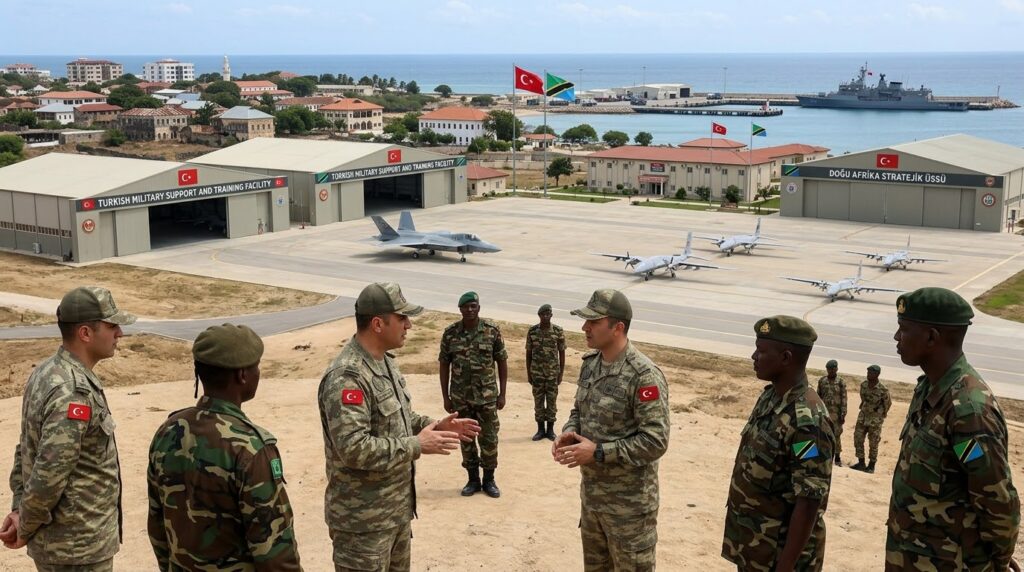
MOGADISHU/NAIROBI — Turkey’s military presence in East Africa has crossed a threshold in 2026. What began as a training mission in Somalia has evolved into a combat-enabled deployment featuring F-16 fighter jets, attack helicopters, naval task groups, and a deepening role in Somalia’s command structure. Simultaneously, Ankara has signed a new defense cooperation agreement with Kenya and positioned itself as a diplomatic broker between Somalia and Ethiopia. The result is a Turkish footprint in the Horn of Africa that is now the most extensive of any foreign power in Somalia and increasingly consequential across the wider region.
Somalia: The Center of Gravity
Somalia remains the anchor of Turkey’s East African military posture. Turkey operates Camp TURKSOM in Mogadishu, its largest overseas military base, and has trained thousands of Somali soldiers. By mid-2025, Turkey had roughly 500 troops in Somalia supporting the Somali military, alongside Bayraktar TB2 and Akinci drones used against al-Shabaab. In February 2026, Somalia took delivery of three T-129 attack helicopters from Turkey, giving the Somali military precision strike capability for the first time. The helicopters were reportedly used against al-Shabaab targets soon after arrival.
The most significant escalation came in late January 2026, when Turkey deployed F-16 fighter jets to Mogadishu. The deployment was confirmed publicly on April 12 when three Turkish F-16s performed a flyby during a parade marking the 66th anniversary of the Somali National Armed Forces. The Turkish Ministry of National Defence released video showing two F-16s flying over the Turkish oil drilling ship Çağrı Bey near Mogadishu’s port, alongside T129 attack helicopters and an AS-532 Cougar transport helicopter flying over the coastal town of Warsheikh.
The F-16 deployment coincided with the arrival of the Çağrı Bey, Turkey’s latest deepwater drillship and the first deployed outside Turkish territorial waters. Exploratory drilling is expected at the Curad-1 well-site, 370 kilometers from Mogadishu, at a depth of 7,500 meters. A Turkish naval task group accompanying the drillship includes the frigate TCG Gaziantep, corvette TCG Bartın, landing ship tank TCG Bayraktar, and support tanker TCG Yzb. Güngör Durmuş. The warships were formally welcomed at Mogadishu port in February by Somalia’s State Minister of Defense and the Commander of the Somali National Army.
Embedded in Somalia’s Command Structure
Turkey’s influence now extends into the core of Somalia’s military leadership. In early 2026, Somalia appointed Brigadier General Ibrahim Mohamed Mohamud, a Turkish-trained officer holding a master’s degree from a Turkish university and training at the Turkish Defense University, as chief of the Somali National Army. The appointment reflects Ankara’s penetration into Somalia’s defense architecture at a time when counter-insurgency operations remain ongoing.
Turkey’s Grand National Assembly approved a two-year extension of its military mission in Somalia on July 21, 2026, pushing the mandate out to July 2028. The renewal was framed as routine, but analysts noted that it confirms Ankara is settling into Somalia for the long term. A Turkish official cited the ongoing construction of a Turkish space launch facility in Somalia as a strategic dimension worth preserving. Satellite imagery has placed the facility on a roughly 350-square-mile site in the Jamaame dunes near Kismayo, with Roketsan and Baykar reportedly preparing missile tests capable of reaching the Gulf of Aden, the Strait of Hormuz, and the Arabian Peninsula.
Kenya: A New Defense Partnership
Turkey’s military engagement is not confined to Somalia. On May 5, 2026, Turkish Defense Minister Yaşar Güler and Kenyan Defence Cabinet Secretary Roselinda Soipan Tuya signed a defense cooperation agreement on the sidelines of the SAHA Expo in Istanbul. The agreement provides a framework for cooperation in military training, defense industry development, and modernization.
The deal signals a broader shift in Kenya’s defense posture away from reliance on traditional Western partners. Kenya has recently expanded defense cooperation with France, China, the Czech Republic, Zimbabwe, and Ethiopia, and in April 2026 signed a memorandum of understanding with Italy on maritime security, counterterrorism, and training. Turkey’s growing footprint in Somalia adds strategic weight to the Kenya partnership, given Nairobi’s security interests in the Horn.
Ethiopia: Diplomacy and Defense Industry Ties
Turkey has also deepened its relationship with Ethiopia, Somalia’s rival and neighbor. In February 2026, President Recep Tayyip Erdoğan visited Addis Ababa for the first time in 11 years, witnessing the signing of two major economic agreements and discussing security cooperation. The Turkish Defense Industry Agency head, Prof. Dr. Haluk Görgün, was part of the official delegation, exploring potential defense industry cooperation and technical partnerships.
Erdoğan’s visit came shortly after Turkey mediated tensions between Somalia and Ethiopia following a naval base dispute. Ethiopia’s Prime Minister Abiy Ahmed said he asked Turkey for diplomatic support in Addis Ababa’s push to secure access to the sea. Turkey’s leverage in both capitals—Mogadishu and Addis Ababa—has made it an indispensable broker in Horn of Africa diplomacy.
Strategic Ambitions and Regional Rivalries
Turkey’s military expansion serves multiple objectives. Alongside security cooperation, Ankara is positioning itself as a gatekeeper over Somalia’s emerging hydrocarbon sector. The February 2024 defense and economic cooperation framework authorized Turkey to train and equip the Somali navy in exchange for 30 percent of revenues from Somalia’s exclusive economic zone. If commercially viable reserves materialize—with estimates reaching as high as 30 billion barrels of oil equivalent—Somalia would gain its first credible pathway toward economic sovereignty since 1991. But oil infrastructure demands security, creating a feedback loop: drilling requires naval patrols, air defense, and onshore force deployment; those assets attract militant targeting; escalating attacks justify further militarization.
Turkey’s position is also being tested by regional rivals. Israel formally recognized Somaliland as an independent state in December 2025 and appointed an ambassador in April 2026, challenging Somalia’s territorial claims and Turkey’s influence in the Horn. Reports indicate Turkey is planning a military base in Laas Qoray, on the Gulf of Aden in a contested region, as a direct response to growing Israeli and Emirati presence in Somaliland. The potential for dangerous encounters between Turkish and Israeli military assets in the region is a growing concern among analysts.
A Reluctance to Fight
Despite its expanding footprint, Turkey has been careful to avoid direct combat. It has not put its own soldiers on the front line against al-Shabaab, preferring to use drones and fighter jets based in Mogadishu while Somali forces bear the ground combat burden. This caution reflects Ankara’s desire to avoid being drawn into clan warfare and to prevent conflict with Ethiopia, which maintains forces in Somalia under the African Union mission.
Turkey’s military presence in East Africa today is thus a study in calibrated ambition. It has F-16s in Mogadishu, a naval task group off the coast, a drillship exploring for oil, a spaceport under construction, and a defense pact with Kenya. It has trained tens of thousands of Somali soldiers and placed a Turkish-trained officer at the head of the Somali army. Yet it has not fired a shot in direct combat. For Ankara, the goal appears to be influence without entanglement—a foothold in one of the world’s most strategic corridors, secured through hardware, training, and diplomacy rather than blood. Whether that balance can hold as regional rivalries intensify is the question that will define Turkey’s role in the Horn for years to come.