

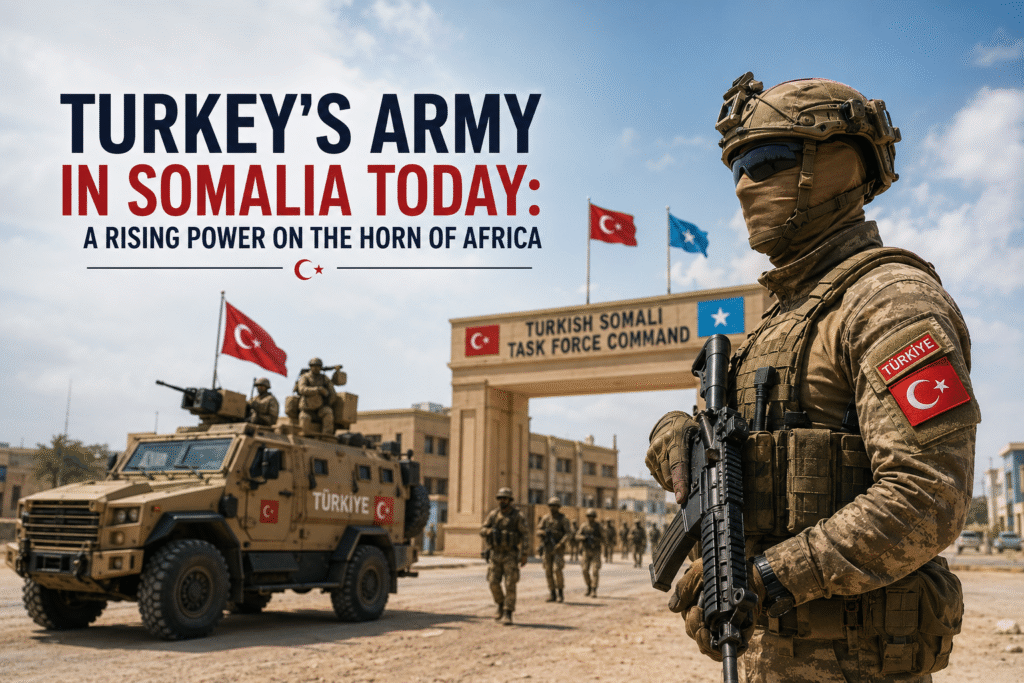
Introduction: From Humanitarian Aid to Military Powerhouse
Just over a decade ago, Turkish President Recep Tayyip Erdoğan became the first non-African head of state in nearly two decades to visit famine-stricken Mogadishu . Today, that humanitarian gesture has evolved into one of the most comprehensive military partnerships on the African continent. Turkey has become Somalia’s foremost foreign ally , operating its largest overseas military base, deploying advanced fighter jets and main battle tanks, and positioning itself as a long-term security guarantor for the fragile Horn of Africa nation. This article examines the state of Turkey’s military presence in Somalia today, covering base infrastructure, air and ground deployments, strategic objectives, and the evolving role of Turkish forces in Somali politics and security.
Part 1: Camp TURKSOM – Turkey’s Largest Overseas Military Base
The cornerstone of Turkey’s military footprint in Somalia is Camp TURKSOM, Ankara’s largest overseas military facility, located on the southern outskirts of Mogadishu . Since its establishment in 2017, the base has served as the primary training ground for thousands of Somali soldiers, particularly the elite Gorgor special forces .
Camp TURKSOM represents far more than a symbolic presence. It is a fully functional military installation designed to restructure the Somali National Army, modernize security institutions, and improve counter-terrorism capabilities . The base has trained successive generations of Somali troops who form the backbone of the government’s fight against Al-Shabaab, the Al-Qaeda affiliate that has waged a grinding insurgency against the Somali state for two decades .
Major General Sebahattin Kalkan serves as the TÜRKSOM commander, working closely with Somali defense officials to coordinate training programs and joint operations . The base’s operations are integrated with the Somali Ministry of Defence, reflecting a partnership that extends beyond simple military aid to genuine institutional capacity-building.
Part 2: The Air Component – F-16s, Attack Helicopters, and Airpower
Turkey’s military presence in Somalia underwent a qualitative leap in early 2026 with the deployment of advanced air assets. On April 12, 2026, three Turkish F-16 multirole fighters performed a flyby during a parade marking the 66th anniversary of the Somali National Armed Forces, formally confirming their presence in the country .
The deployment was accompanied by T129 attack helicopters and AS-532 Cougar transport helicopters, which also participated in the anniversary events . Video released by the Turkish Ministry of National Defence showed two F-16s flying over the Turkish oil drilling ship Çağrı Bey near Mogadishu’s port, underscoring the connection between military power and economic protection .
From a military standpoint, the presence of F-16s provides Turkey with rapid reaction and air-dominance capability in a volatile security environment, enhanced force protection for Turkish personnel and installations, expanded intelligence, surveillance, and reconnaissance (ISR) capabilities, and precision-strike options should the security situation deteriorate .
Turkish-supplied armed drones and attack helicopters have already played a role in counter-insurgency operations against Al-Shabaab, supporting Somali ground forces in ongoing military campaigns .
Part 3: Ground Forces – Main Battle Tanks and Heavy Armor
The air deployment was preceded by a significant ground force augmentation. In February 2026, a Turkish military shipment carrying M48 and M60 Patton main battle tanks arrived at Mogadishu port . Footage verified by witnesses showed the heavily armored vehicles being offloaded and moving through the capital in a heavily guarded convoy .
The tanks were deployed specifically to secure strategic installations in the Warshiikh area, approximately 60 kilometers north of Mogadishu, where Turkey is reportedly developing missile and satellite launch capabilities . The site’s location near the equator makes it strategically valuable for aerospace ballistics, and the introduction of main battle tanks signals a shift toward a more robust, independent defensive posture for Turkey’s strategic assets.
The deployment of heavy armor also responds to security threats. A series of militant attacks targeting Turkish personnel and infrastructure in recent months has demonstrated the need for enhanced force protection, particularly as Turkey’s economic and technological investments in Somalia expand .
Part 4: Naval Power – The Çağrı Bey and Maritime Security
Turkey’s military footprint extends to Somali waters. The Turkish naval task group deployed to Somalia includes the frigate TCG Gaziantep, corvette TCG Bartın, landing ship tank TCG Bayraktar, and support tanker TGC Yzb. Güngör Durmuş .
The flagship of Turkey’s maritime presence is the deepwater drillship Çağrı Bey, which arrived in Mogadishu in April 2026 – the first Turkish drilling vessel deployed outside Turkish territorial waters . The ship is expected to begin exploratory drilling at the Curad-1 well-site, approximately 370 kilometers from Mogadishu, at a depth of 7,500 meters, targeting estimated hydrocarbon reserves that could transform Somalia’s economy .
The naval deployment serves a dual purpose: protecting the Çağrı Bey and other Turkish assets from piracy and asymmetric threats while projecting Turkish naval power into one of the world’s most strategically important maritime chokepoints at the southern entrance to the Red Sea.
Part 5: Strategic Objectives – Why Turkey Is Building Up in Somalia
Turkey’s military expansion in Somalia is driven by several interconnected strategic objectives.
First, counter-terrorism and stability. Turkey is committed to supporting the Somali federal government’s fight against Al-Shabaab, which remains capable of conducting complex attacks in Mogadishu and beyond . Turkish-trained Somali forces have become a critical component of government military operations.
Second, protection of economic interests. Turkey has become a major stakeholder in Somalia’s critical infrastructure, including the Mogadishu port and airport (managed by Turkish companies), construction projects, and now offshore energy exploration . As Turkish commercial exposure increases, so does the need for credible military protection .
Third, geopolitical competition. The Horn of Africa has emerged as a theater of intensified competition involving the United States, Gulf states, Egypt, China, and regional African actors . By deploying F-16s, tanks, and warships, Turkey positions itself as a hard-power actor rather than merely a development partner.
Fourth, regional power projection. Turkey is reportedly planning to build a military base in Laas Qoray, a port city located on the Gulf of Aden that is contested by Somalia and the breakaway region of Somaliland . Such a base would serve as a direct riposte to growing Israeli and Emirati military presences in Somaliland, further along the coast .
Part 6: Defense Industrial Cooperation – ASFAT, SAHA EXPO, and Procurement
Beyond the deployment of Turkish forces, the military partnership includes substantial defense industrial cooperation. In May 2026, Somali Defense Minister Ahmed Moallim Fiqi conducted high-level negotiations with Prof. Dr. Haluk Görgün, President of the Turkish Defense Industry Agency (SSB), during the SAHA EXPO 2026 defense exhibition in Istanbul .
The discussions focused on modernizing Somalia’s military architecture and expanding its defense capabilities, including capacity-building initiatives and the exchange of strategic intelligence . The Somali delegation also visited the ASFAT exhibition center, a major state-owned Turkish defense contractor, to evaluate military platforms, technical services, and defense solutions for the Somali National Armed Forces .
This industrial cooperation represents a shift from simple military aid to sustainable capacity-building, equipping Somalia to maintain its own security over the long term.
Part 7: Training and Force Generation – Building the Somali National Army
The most enduring element of Turkey’s military presence is its training mission. Camp TURKSOM has trained thousands of Somali soldiers since 2017, with a particular focus on the elite Gorgor special forces who have become the government’s most capable fighting units .
The training program is comprehensive, covering infantry tactics, special operations, logistics, intelligence, and leadership. Turkish military personnel are involved in restructuring the Somali National Army and modernizing its security institutions .
In a May 2026 meeting in Mogadishu attended by Turkish Ambassador Alper Aktaş and TÜRKSOM commander Major General Sebahattin Kalkan, discussions focused on expanding joint military operations and accelerating troop training programs . The Somali Ministry of Defence described Turkey as a “key partner and ally” in rebuilding Somalia’s defense institutions .
Part 8: The Political Dimension – Influence, Controversy, and Denials
Turkey’s deep military involvement has inevitably raised questions about its role in Somali domestic politics. Critics have accused Ankara of using its military presence to influence specific political actors and consolidate power for the federal government at the expense of regional states .
In March 2026, during the violent ousting of a regional leader in southern Somalia who broke ranks with the government’s electoral agenda, Ankara was accused of facilitating his removal with military and fiscal support . This assertive role in Somalia’s fraught domestic politics represents precisely the kind of internal deployment that critics had long warned against .
Turkey has firmly rejected these allegations. In a May 2026 statement, the Turkish Center for Combating Disinformation described claims of political interference as “entirely unfounded” . The statement emphasized that Turkish military personnel have “absolutely no involvement” in Somalia’s electoral processes or internal political dynamics, and that Turkey’s presence is directed solely toward security, counter-terrorism, and institutional capacity-building .
Nevertheless, the perception of Turkish influence persists, particularly as the Somali government has modeled its new ruling party on Erdoğan’s own Justice and Development Party movement and as Turkish advisors have become increasingly embedded in parts of the Somali state .
Part 9: The Geopolitical Chessboard – Countering Rivals
Turkey’s military buildup in Somalia cannot be understood in isolation from regional geopolitics. The Horn of Africa has become a chessboard where multiple powers – Turkey, the UAE, Saudi Arabia, Qatar, Israel, Egypt, and China – are jockeying for influence.
Turkey’s primary rival in the region is the UAE, which has cultivated ties with Somalia’s semi-autonomous regional administrations, including Puntland and Somaliland, and has been accused of facilitating Israel’s controversial recognition of Somaliland in December 2025 .
The planned Turkish military base in Laas Qoray would position Turkey directly on the Gulf of Aden, countering Israeli and Emirati presences in Somaliland . Though direct armed conflict between Ankara and Tel Aviv remains unlikely, the theaters in which their interests diverge – from Somalia to Syria to the eastern Mediterranean – are multiplying .
Turkey has also aligned itself with Egypt and Saudi Arabia to counter Israeli and Emirati influence in the Red Sea region, forming a “regional axis” that consolidates opposition to rival powers .
Part 10: The Future – What Comes Next
As Turkey’s military presence in Somalia continues to expand, several developments bear watching.
First, the Laas Qoray base – if completed – would represent a significant escalation, placing Turkish forces directly on the Gulf of Aden and fundamentally altering the regional military balance.
Second, the space and missile facilities near Warshiikh, currently protected by Turkish main battle tanks, could transform Somalia into a launch site for Turkish aerospace projects, leveraging the country’s equatorial location for orbital launches.
Third, offshore energy production – if the Çağrı Bey discovers commercially viable reserves – will require sustained naval protection, potentially leading to a permanent Turkish naval presence in Somali waters.
Fourth, the training mission is likely to expand, with more Somali troops receiving advanced training in Turkey and more Turkish advisors embedded with Somali units.
Conclusion: A Transformation in Kind and Scale
Turkey’s military presence in Somalia has undergone a transformation in kind and scale . What began as humanitarian diplomacy and soft power has evolved into a comprehensive security partnership involving the largest overseas Turkish military base, advanced fighter jets and attack helicopters, main battle tanks, and a naval task group protecting deepwater energy exploration.
Turkey has become Somalia’s foremost foreign ally , and its military forces are deeply embedded in Somali security institutions. Whether through training Somali commandos, protecting strategic installations with tanks and jets, or projecting naval power into the Gulf of Aden, Turkish forces are shaping the security landscape of the Horn of Africa.
The challenges remain significant. Al-Shabaab continues to pose a lethal threat. Regional rivals are competing for influence. And questions about Turkey’s role in Somali politics will persist regardless of official denials.
Yet the trajectory is unmistakable. Turkey is in Somalia to stay – not merely as a humanitarian donor or development partner, but as a military power with strategic interests, advanced capabilities, and the willingness to use them. For Somalia, this partnership provides security and stability at a critical moment. For Turkey, it represents power projection, economic opportunity, and geopolitical influence on a continent where the rules of engagement are being rewritten.
