

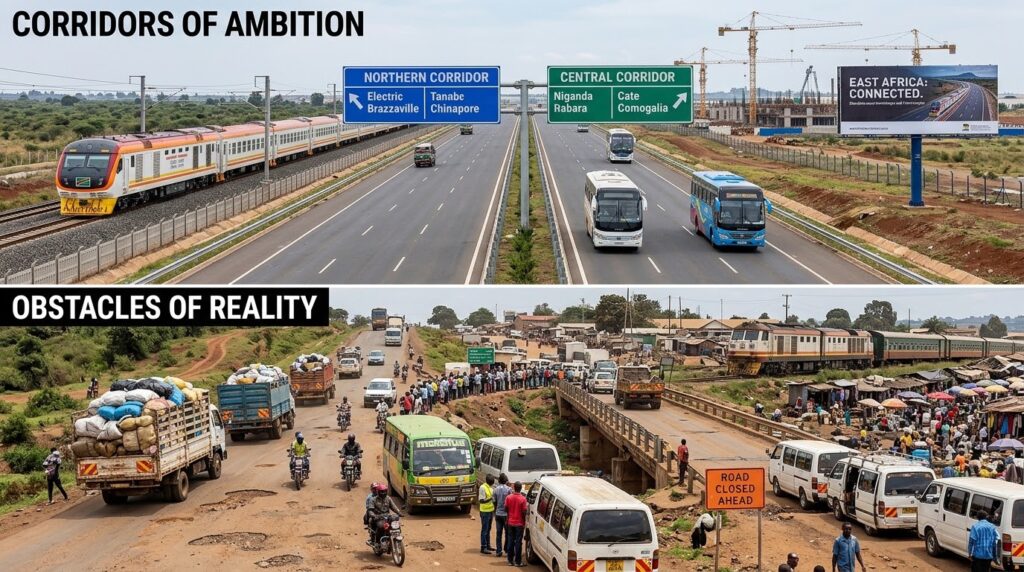
East Africa’s transport sector in September 2026 presents a paradox of extraordinary ambition and stubborn inefficiency. Across the region, governments are breaking ground on billion-dollar rail lines, expanding inland ports, and liberalizing airspace. Yet the cargo that moves along the region’s trade corridors still travels too slowly and too expensively, weighed down by fuel costs that now consume more than half of road transport budgets. Understanding transportation in East Africa today means examining both the transformative projects underway and the persistent bottlenecks that threaten their promise.
Rail: The Missing Links Are Finally Being Built
The most significant development in regional transport is the long-stalled extension of Kenya’s Standard Gauge Railway (SGR) toward the western border. After years of financing delays, construction on the Naivasha-Kisumu-Malaba line finally commenced in July 2026. The project comprises a 264-kilometre main line from Naivasha to Kisumu, an 8.69-kilometre branch to Kisumu Port, and a 107-kilometre section from Kisumu to Malaba on the Ugandan border.
The financing model represents a departure from the Chinese-loan-dependent approach of earlier SGR phases. Kenya is combining domestic revenue streams, including the Railway Development Levy, with infrastructure bonds and alternative capital sources. President Ruto has framed this as part of a broader shift away from unsustainable borrowing, stating that Kenya “cannot continue funding essential infrastructure through unsustainable borrowing”.
Uganda’s own SGR ambitions have taken a new turn. After terminating its contract with China Harbour Engineering Company in 2022, Kampala has turned to Turkish firm Yapi Merkezi, which is already constructing part of Tanzania’s SGR network. The 273-kilometre Malaba-Kampala line remains dogged by financing negotiations with export credit agencies, but the contractor change signals a determination to complete the link.
On the southern side of the region, Tanzania and the Democratic Republic of Congo used President Tshisekedi’s August 2026 state visit to commit to welding railway, road, port, and lake infrastructure into a single integrated logistics system along the Central Corridor. More than 60 percent of cargo at the Port of Dar es Salaam is destined for the DRC, and Kinshasa has now announced preparations to construct its own dry port inside Dar es Salaam to provide customs clearance and mineral certification for Congolese cargo.
Ports and Inland Logistics: Ethiopia’s Transformative Upgrade
Ethiopia’s logistics landscape shifted significantly on September 10, 2026, with the completion of the Mojo Dry Port expansion. Built by China Civil Engineering Construction Corporation, the facility now has the capacity to handle 1.6 million twenty-foot equivalent units annually, up from 520,000, while reducing cargo dwell time from as long as 60 days to just eight.
Ethiopian Prime Minister Abiy Ahmed noted at the inauguration that for a landlocked country, logistics costs remain too high, inflating import prices. The expanded dry port serves as the core hub of the Ethiopia-Djibouti trade corridor and a key supporting facility for the Addis Ababa-Djibouti railway. A second phase of expansion at Mojo includes a container terminal with a rail-mounted gantry crane, enabling rapid transfer from rail to storage.
Aviation: The Promise of Open Skies
Kenya hosted the 10th Aviation Africa Summit in Nairobi in September, where Prime Cabinet Secretary Musalia Mudavadi called for accelerated implementation of the Single African Air Transport Market (SAATM). The summit’s theme, “Breaking the Mould: Finding Solutions to the Key Challenges Hindering Africa’s Aviation Industry,” reflected a growing recognition that Africa’s air connectivity remains constrained by regulatory fragmentation.
The practical benefits of reform are beginning to materialize. Six East African nations, including Kenya, Uganda, and Tanzania, are trialing Free Route Airspace (FRA), with full operationalization expected by early 2027. Currently, flights must follow pre-determined fixed airways that are often longer than necessary, consuming more fuel than needed. FRA allows airlines to choose shorter, more direct routes based on weather conditions. The African Airlines Association estimates carriers will save significantly on fuel consumption and operational costs, potentially enabling lower fares and increased frequencies.
The timing is critical. Kenya Airways, Jambojet, and RwandAir have all seen fuel costs jump by up to 70 percent following regional conflicts, with fuel now accounting for at least 30 percent of operating costs. Jambojet has been forced to reduce flights to manage costs, while Kenya Airways has abandoned some routes entirely.
The Road Network: Corridors Under Construction
Road infrastructure remains the dominant mode of freight movement, and several major corridor projects are advancing. Kenya’s Horn of Africa Gateway Development Project (HoAGDP) is upgrading the 740-kilometre Isiolo-Mandera corridor in the country’s northeast, with the full route now fully funded. The World Bank is financing 508 kilometres, the African Development Bank the 142-kilometre Elwak-Rhamu section, and Arab development banks the 90-kilometre Samatar-Wajir section. More than 50 kilometres are already on blacktop, and the project includes 1,000 kilometres of fibre-optic cable and One-Stop Border Posts with Ethiopia and Somalia.
Kenya and Somalia have agreed to establish a Joint Technical Committee to extend this corridor into Somalia, potentially creating a new trade and digital artery across the Horn of Africa. The extension would enhance cross-border trade and regional connectivity between the two countries.
On Kenya’s coast, the Mombasa-Mtwapa Road is 55.96 percent complete, with completion scheduled for December 2027. This road forms part of the wider Multinational Bagamoyo-Horohoro-Malindi project, which will connect Kenyan ports to Tanzania’s Tanga and Dar es Salaam, strengthening the East African Community corridor.
The Persistent Challenge: Costs, Delays, and Fragmentation
Despite these investments, the region’s logistics performance remains a serious constraint on competitiveness. The Shippers Council of Eastern Africa reported in September that fuel now accounts for approximately 55 percent of road transport costs, up from 38 percent in 2021. Cargo movement between Mombasa and Kampala averaged 111 hours in July-September 2025, against a target of 72 hours; the Mombasa-Malaba section averaged 85 hours against a 40-hour target.
Customs and border procedures remain another major obstacle, with traders facing repetitive documentation, inspections, permits, and differing national requirements. The Shippers Council has called for greater harmonization, including wider use of pre-clearance, risk-based inspections, regional bonds, and more efficient One-Stop Border Posts.
Perhaps most fundamentally, the Council argues that the region needs to plan infrastructure as an end-to-end trade corridor rather than as separate projects. As CEO Agayo Ogambi put it: “The key challenge is not only infrastructure capacity, but the cost and unpredictability of moving cargo across the entire corridor”. The proposed approach would measure performance from port to road or rail, through inland logistics hubs and borders, to final destination—requiring governments to track total logistics costs, door-to-door transit times, and delivery reliability.
The Road Ahead
East Africa’s transport sector stands at an inflection point. The rail lines, dry ports, and road corridors under construction represent genuine progress toward regional integration. The liberalization of airspace and the commitment to corridor-wide planning suggest that policymakers understand the limitations of building infrastructure in isolation.
Yet the gap between ambition and execution remains wide. The fuel cost crisis, border delays, and fragmented digital systems that shippers face today are not primarily infrastructure problems—they are governance problems. The region’s ability to translate its substantial investments into tangible reductions in transport costs and travel times will determine whether East Africa becomes a competitive trade hub or remains a collection of well-intentioned but disconnected projects. The next two years, as the SGR extensions and corridor upgrades near completion, will reveal which outcome prevails.