

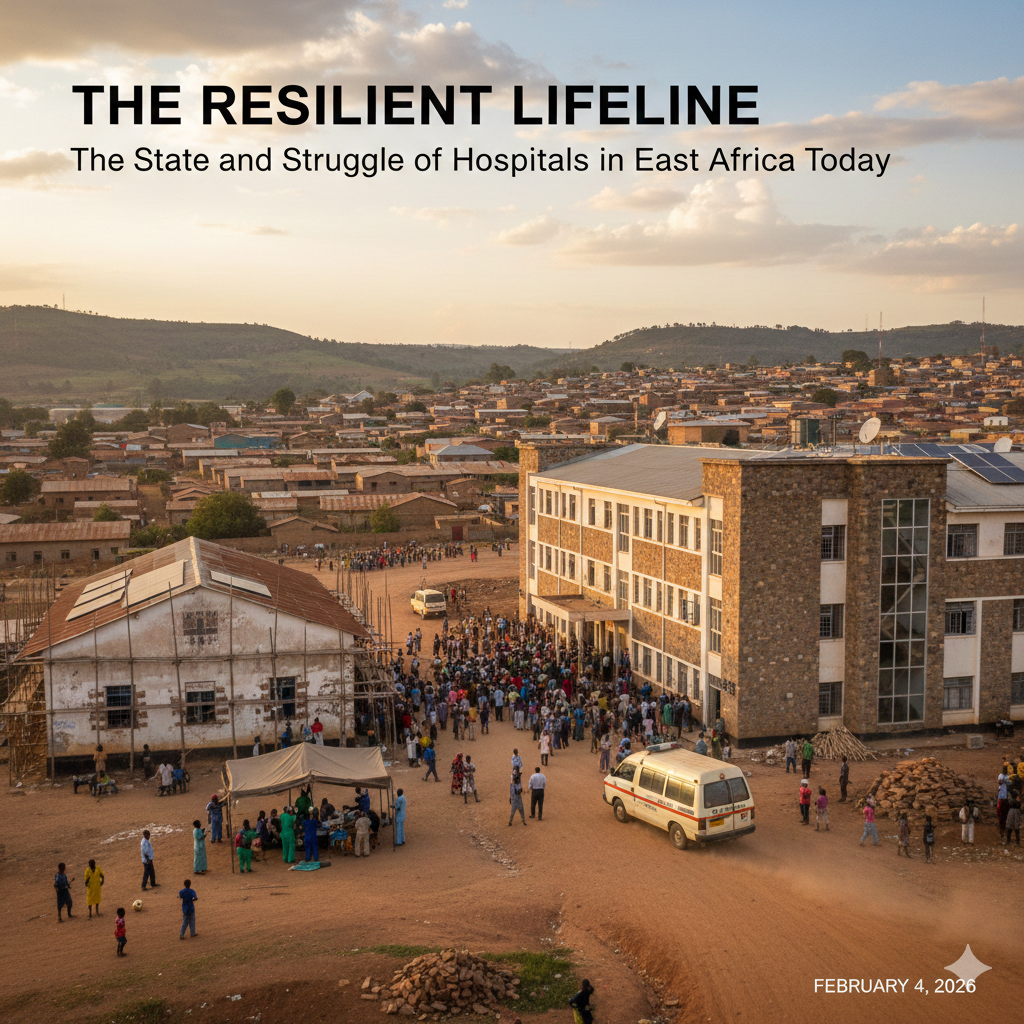
Subtitle: Navigating a Crucible of Crisis, Inequality, and Ingenuity in the Region’s Critical Care Hubs
DATELINE: NAIROBI, KAMPALA, DAR ES SALAAM – The hospital in East Africa is more than a medical institution; it is a barometer of a nation’s priorities, a stage for human drama at its most vulnerable, and a frontline in the daily battle between resilience and systemic failure. Today, across Kenya, Uganda, Tanzania, Rwanda, and Ethiopia, these critical hubs of healing exist in a state of profound duality. They are places where pioneering open-heart surgery and cutting-edge HIV research coexist with corridors crowded with patients on the floor, chronic drug stockouts, and overworked staff pushed to the brink. The story of the modern East African hospital is one of heroic endeavor strained by a perfect storm of demographic pressure, financial scarcity, and the relentless double burden of disease.
The Three-Tiered Reality: A Journey Through the System
To enter an East African hospital is to witness a stark hierarchy of access and quality, a journey through three distinct worlds of care.
At the apex stand the National Referral and Private Tertiary Hospitals—places like Kenyatta National Hospital in Nairobi, Mulago in Kampala, or the Aga Khan University Hospital network. These are the region’s medical citadels. They house MRI machines, catheterization labs, and specialist oncology wards. They are training grounds for the next generation of doctors and often the site of groundbreaking regional medical research. Yet, even here, the strain shows. Public referral hospitals are chronically overcrowded, with patients sharing beds or sleeping on mats in hallways as they wait, sometimes for days, to be seen. The private counterparts offer world-class care, but at a cost that places them firmly out of reach for the vast majority, cementing a two-tiered system where health outcomes are dictated by wealth.
Descending a level reveals the County/Regional and Faith-Based Hospitals. These facilities, such as Moi Teaching and Referral Hospital in Eldoret or Bugando Medical Centre in Mwanza, form the crucial middle layer. They manage complex cases beyond the scope of local clinics—performing Caesarean sections, treating severe malaria, and setting major fractures. Many, especially those run by religious organizations like the Catholic or Anglican churches, have a long history of service and community trust. Their challenge is one of chronic under-resourcing. They are caught between mandates they lack the full capacity to fulfill and a trickle-down of funding that rarely matches the burden they carry. Equipment often lies broken for lack of simple spare parts or technical expertise to repair it.
Finally, the foundation—and the point of first contact for most—is the District Hospital and large Health Center. This is where the rubber meets the road in public health. These facilities are perpetually overwhelmed. A single clinical officer might see hundreds of patients in a day. Basic antibiotics and analgesics are frequently out of stock. The lack of reliable water, electricity, and sanitation transforms infection control into a constant struggle. It is at this level that the abstract “health system gaps” become visceral human suffering: a mother hemorrhaging post-delivery without blood for transfusion; a child with pneumonia struggling to breathe without a functioning oxygen concentrator.
The Cross-Cutting Crises: Challenges That Bind the Region
Regardless of tier, East African hospitals are united by several systemic plagues:
- The Human Resource Desert: The most critical shortage is not of bricks or beds, but of skilled, motivated people. The region suffers a severe brain drain, with doctors, nurses, and specialists lured to Europe, North America, and the Gulf by better pay and working conditions. Those who remain face catastrophic burnout—crushing patient loads, moral injury from being unable to provide adequate care, and, in public systems, frequent strikes over poor pay and unsafe conditions. The distribution is also skewed, with urban centers hoarding talent while rural hospitals languish.
- The Stockout Syndrome: Perhaps the most demoralizing daily failure is the chronic shortage of essential medicines and commodities. Supply chains are broken, plagued by poor forecasting, bureaucratic procurement delays, corruption, and underfunding. A hospital pharmacy with empty shelves is a tragically common sight, forcing families into a desperate scramble to buy overpriced drugs from private pharmacies, if they can find them at all.
- The Financial Chokehold: Healthcare financing is the system’s failing heart. Out-of-pocket expenditures remain catastrophically high, pushing millions into poverty each year. Public health budgets are insufficient, and insurance schemes—like Kenya’s NHIF or Tanzania’s NHIF—are often plagued by limited coverage, delayed reimbursement to hospitals, and complex bureaucracies. Hospitals, especially faith-based ones that charge modest fees, operate perpetually on the financial edge, unable to reinvest in maintenance or expansion.
- The Double Burden Within the Walls: Hospital wards themselves mirror the region’s epidemiological shift. In one bed lies a patient with advanced AIDS-defining illnesses; in the next, a diabetic with a gangrenous foot. Infectious disease wards for tuberculosis and malaria remain full, while non-communicable disease (NCD) clinics for hypertension, cancer, and mental health are stretched beyond capacity. Hospitals designed for acute, episodic care are now managing lifelong chronic conditions without the necessary resources, protocols, or staff training.
Innovation and Resilience: The Counter-Narrative of Hope
Amidst the crisis, a powerful counter-narrative of innovation and resilience is being written by healthcare workers and communities.
- Task-Shifting and Team-Based Care: With doctor shortages, nurses and clinical officers are taking on advanced roles, managing antiretroviral therapy clinics, performing surgeries, and leading emergency care. This pragmatic shift is saving lives.
- Digital Health Leaps: Technology is offering bypass solutions. Telemedicine platforms connect rural hospitals with specialists in capital cities for consultations. Electronic Medical Records (EMRs), though uneven, are improving patient tracking. Drone delivery services, pioneered in Rwanda by Zipline, are ensuring hospitals receive critical blood products and vaccines on demand, revolutionizing supply chains.
- South-South Collaboration and Local Production: Partnerships within Africa are growing. Ethiopian surgeons train counterparts from neighboring countries, and regional initiatives pool procurement for better drug pricing. There is also a push, led by countries like Uganda, for local pharmaceutical production to reduce import dependence.
- The Unwavering Frontline: The ultimate resilience lies in the daily dedication of the healthcare worker who walks miles to a rural clinic, the midwife who delivers babies by flashlight during a blackout, and the community health volunteer who follows up with TB patients in their homes. Their commitment is the system’s most vital, and most undervalued, asset.
The Path Forward: Redefining the Hospital’s Role
The future of East African hospitals depends on a fundamental reimagining. They cannot be mere repositories for the sick but must evolve into anchors of integrated, community-based health systems. This requires:
- Investment in the Foundational: Governments and donors must prioritize core functionality: reliable water and electricity, essential drug supply chains, and a motivated, well-compensated workforce. A hospital cannot be digitized if it lacks power.
- True Primary Care Strengthening: Decongesting hospitals requires robust, well-staffed health centers that can manage the majority of cases. Hospitals must be reserved for true referrals.
- Domestic Financing Revolution: Sustainable, mandatory, and equitable health insurance models are required to pool risk and provide hospitals with predictable revenue.
- Embracing a Preventive Paradigm: The most sustainable way to “fix” the hospital is to reduce the burden of preventable disease through public health, health education, and addressing social determinants like poverty and malnutrition.
Conclusion: The Canary in the Coalmine
The state of East Africa’s hospitals is the most honest diagnosis of the region’s social contract. Their crowded corridors reflect population growth and unmet need. Their stockouts reveal broken logistics and misplaced priorities. The exhaustion of their staff speaks to a profound undervaluation of caregiving.
Yet, within these same walls, the determination to heal, to innovate against the odds, and to uphold human dignity persists with astonishing strength. The hospital, in all its struggle and resilience, remains both a mirror and a catalyst. Its transformation—from a place of last resort to a node in a functional, equitable, and preventive health network—is not just a medical necessity but the very foundation for the prosperous, healthy East Africa its people deserve. The prognosis is serious, but the will to heal is formidable.
