

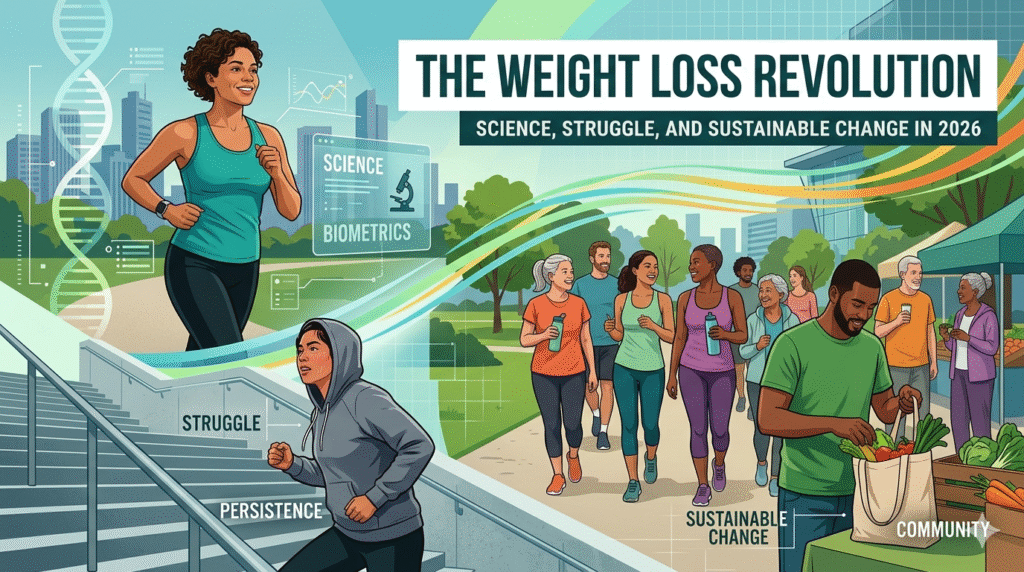
In 2026, weight loss is no longer simply about eating less and moving more. It has become a battleground of billion-dollar pharmaceuticals, personalized genetics, metabolic psychiatry, and a global reckoning with the psychological toll of diet culture. Nearly two billion adults worldwide are classified as overweight or obese, and despite a flood of apps, surgeries, and miracle supplements, the struggle remains as real as ever. This article explores the modern landscape of weight loss across twelve critical dimensions.
Part 1: The New Pharmacology – GLP-1 Agonists Change Everything
The single most disruptive force in weight loss today is the class of drugs known as GLP-1 receptor agonists. Ozempic, Wegovy, Mounjaro, and Zepbound have transformed obesity from a moral failing into a treatable medical condition. These medications, originally developed for diabetes, suppress appetite, slow gastric emptying, and produce average weight losses of 15 to 25 percent of body weight.
In 2026, an estimated 30 million Americans are taking some form of GLP-1 agonist. The global market exceeds $50 billion annually, and manufacturers cannot keep pace with demand. However, the drugs are not without controversy. Side effects include nausea, vomiting, gastroparesis, and, in rare cases, thyroid tumors. The cost remains prohibitive for many, with monthly prices exceeding $1,000 without insurance. And when patients stop taking the drugs, the weight almost invariably returns.
Part 2: The Set Point Theory – Why Your Body Fights Back
One of the most important scientific discoveries of the past decade is the set point theory of body weight. Research has shown that each person’s body has a genetically influenced weight range that it defends vigorously. When you lose weight through calorie restriction, your body responds by lowering metabolic rate, increasing hunger hormones like ghrelin, and decreasing satiety hormones like leptin.
This biological resistance explains why 95 percent of conventional diets fail in the long term. The body does not know you are trying to fit into a swimsuit. It only knows that it is starving, and it will do everything in its power to return to its set point. GLP-1 agonists work partly because they override this defense mechanism, but without them, the biological pressure to regain weight remains overwhelming.
Part 3: Metabolic Psychiatry – The Gut-Brain Connection
Emerging research in metabolic psychiatry has revealed a two-way street between mental health and body weight. Depression and anxiety increase cortisol levels, which promote abdominal fat storage. Conversely, excess body fat triggers chronic low-grade inflammation that affects neurotransmitter function, worsening mood disorders.
This creates a vicious cycle: weight gain leads to depression, which leads to further weight gain. Breaking the cycle requires simultaneous treatment of both conditions. Integrated clinics now offer combined therapy: GLP-1 agonists for weight loss alongside SSRIs or therapy for mental health. The results are promising, but access to such integrated care remains limited outside major urban centers.
Part 4: The Protein Priority – Satiety and Muscle Preservation
Amid the hype around drugs and supplements, one nutritional principle has emerged as universally accepted: protein is the most important macronutrient for weight loss. High-protein diets (30 percent or more of total calories) increase satiety, reduce cravings, and preserve lean muscle mass during calorie restriction.
Muscle preservation is critical because muscle tissue burns more calories at rest than fat. Crash diets that ignore protein often result in “skinny fat” —normal weight but with low muscle mass and a slow metabolism. The current recommendation is 1.6 to 2.2 grams of protein per kilogram of body weight daily, distributed across three to four meals. For a 90-kilogram person, that means 144 to 198 grams of protein per day—a target that requires intentional planning.
Part 5: Sleep and Stress – The Hidden Drivers
No amount of dieting can overcome chronic sleep deprivation and unmanaged stress. Studies consistently show that individuals who sleep fewer than six hours per night have significantly higher rates of obesity than those who sleep seven to eight hours. Sleep loss increases ghrelin (hunger), decreases leptin (fullness), and impairs insulin sensitivity.
Similarly, chronic stress elevates cortisol, which encourages the body to store fat—particularly visceral fat around the organs. This fat is metabolically active and associated with diabetes, heart disease, and certain cancers. Effective weight loss in 2026, therefore, includes sleep hygiene protocols and stress management techniques such as mindfulness, therapy, or even medication.
Part 6: The Fiber Factor – Feeding Your Microbiome
The trillions of bacteria living in your gut play a direct role in weight regulation. A diverse, healthy microbiome extracts fewer calories from food and produces short-chain fatty acids that reduce inflammation and improve insulin sensitivity. The single best way to feed a healthy microbiome is dietary fiber.
Most adults consume less than 15 grams of fiber daily; the recommended amount is 25 to 38 grams. Soluble fiber (found in oats, beans, apples, and citrus) forms a gel in the stomach that slows digestion and increases satiety. Insoluble fiber (found in whole grains, nuts, and vegetables) adds bulk and promotes regularity. The simplest intervention for weight loss may be the most overlooked: eat more plants.
Part 7: The Exercise Paradox – Movement for Health, Not Just Calories
Conventional wisdom holds that exercise is essential for weight loss. The scientific reality is more nuanced. Exercise alone, without dietary changes, produces modest weight loss at best—typically 2 to 3 percent of body weight over six months. This is because exercise increases appetite in many people, and because the calorie burn from a 30-minute jog can be erased by a single muffin.
However, exercise is essential for weight maintenance and overall health. Individuals who lose weight and keep it off exercise an average of one hour per day, combining cardio with resistance training. Resistance training is particularly important because it builds muscle, which raises resting metabolic rate. The message is not to abandon exercise, but to adjust expectations: exercise for health, fitness, and maintenance; diet for weight loss.
Part 8: Intermittent Fasting – Fad or Future?
Intermittent fasting (IF) remains popular in 2026, with protocols ranging from time-restricted eating (eating within an 8-hour window) to alternate-day fasting. The evidence for IF is mixed but promising. Some studies show weight loss comparable to traditional calorie restriction, with potential additional benefits for insulin sensitivity and cellular repair (autophagy).
However, IF is not superior to traditional dieting for weight loss. Any benefit comes from reduced calorie intake, not from fasting itself. Moreover, IF can be dangerous for individuals with a history of eating disorders, diabetes, or those taking certain medications. As with all dietary approaches, individualization is key.
Part 9: Bariatric Surgery – The Gold Standard
For individuals with severe obesity (BMI over 40, or over 35 with comorbidities), bariatric surgery remains the most effective treatment available. Gastric bypass and sleeve gastrectomy produce average weight losses of 30 to 35 percent of body weight, with most patients maintaining at least 20 percent loss for a decade or more.
Surgery works not only by physically restricting stomach size but also by altering gut hormones that regulate appetite and metabolism. Many patients with type 2 diabetes see complete remission within days of surgery, before significant weight loss has occurred. The risks include surgical complications, nutritional deficiencies, and the need for lifelong vitamin supplementation. For the right candidate, however, surgery is life-changing.
Part 10: The Psychology of Eating – Breaking the Habit Loop
Sustainable weight loss requires addressing the psychology of eating. Most overeating is not driven by hunger but by triggers: stress, boredom, social pressure, or habit. The habit loop—cue, craving, response, reward—operates below conscious awareness.
Breaking this loop requires identifying triggers and replacing the behavioral response. For example, instead of reaching for chips when stressed, one might take a five-minute walk, drink a glass of water, or call a friend. This is not willpower; it is skill-building. Behavioral interventions, including cognitive-behavioral therapy (CBT) and acceptance and commitment therapy (ACT), have demonstrated significant benefits for weight loss and maintenance.
Part 11: The Role of Community – You Cannot Do It Alone
Weight loss is often framed as an individual battle of will. The evidence suggests otherwise. Social support is one of the strongest predictors of success. Structured programs such as WeightWatchers (now simply “WW”), Noom, and in-person support groups provide accountability, shared experience, and practical strategies.
In 2026, digital communities have proliferated, with apps that connect users with coaches, peers, and tracking tools. However, online communities lack the accountability of in-person meetings. Research consistently shows that people who attend regular group sessions lose more weight and keep it off longer than those who go it alone.
Part 12: The Maintenance Crisis – The Longest and Hardest Phase
Losing weight is difficult. Keeping it off is exponentially harder. The body’s biological drive to regain lost weight persists indefinitely. Studies of “successful maintainers”—individuals who have lost at least 10 percent of body weight and kept it off for more than a year—reveal common strategies:
- Daily weighing (to catch small gains early)
- High levels of physical activity (60-90 minutes daily)
- Consistent eating patterns (no skipping meals)
- Immediate intervention when weight creeps up (returning to tracking or group support)
- Acceptance that maintenance is a lifelong practice, not a destination
The National Weight Control Registry, which tracks over 10,000 successful maintainers, has found that 98 percent of participants modified their food intake to maintain weight loss, and 94 percent increased their physical activity. There are no shortcuts. Maintenance is the real work.
Conclusion: A New Era of Honesty
The weight loss industry has long promised effortless transformation: pills, potions, and secrets that have never materialized. In 2026, we have more tools than ever—powerful medications, sophisticated understanding of biology, and evidence-based behavioral strategies. But we also have greater honesty about the challenge.
Obesity is a chronic, relapsing disease, not a character flaw. It requires chronic, ongoing treatment, not a one-time fix. The most successful individuals in 2026 are not those who find the perfect diet or the newest drug. They are those who accept the reality of biological resistance, build sustainable habits, seek support, and keep going—even when the scale does not cooperate. Weight loss is possible. But it requires patience, resources, and a willingness to fight biology every single day.
