

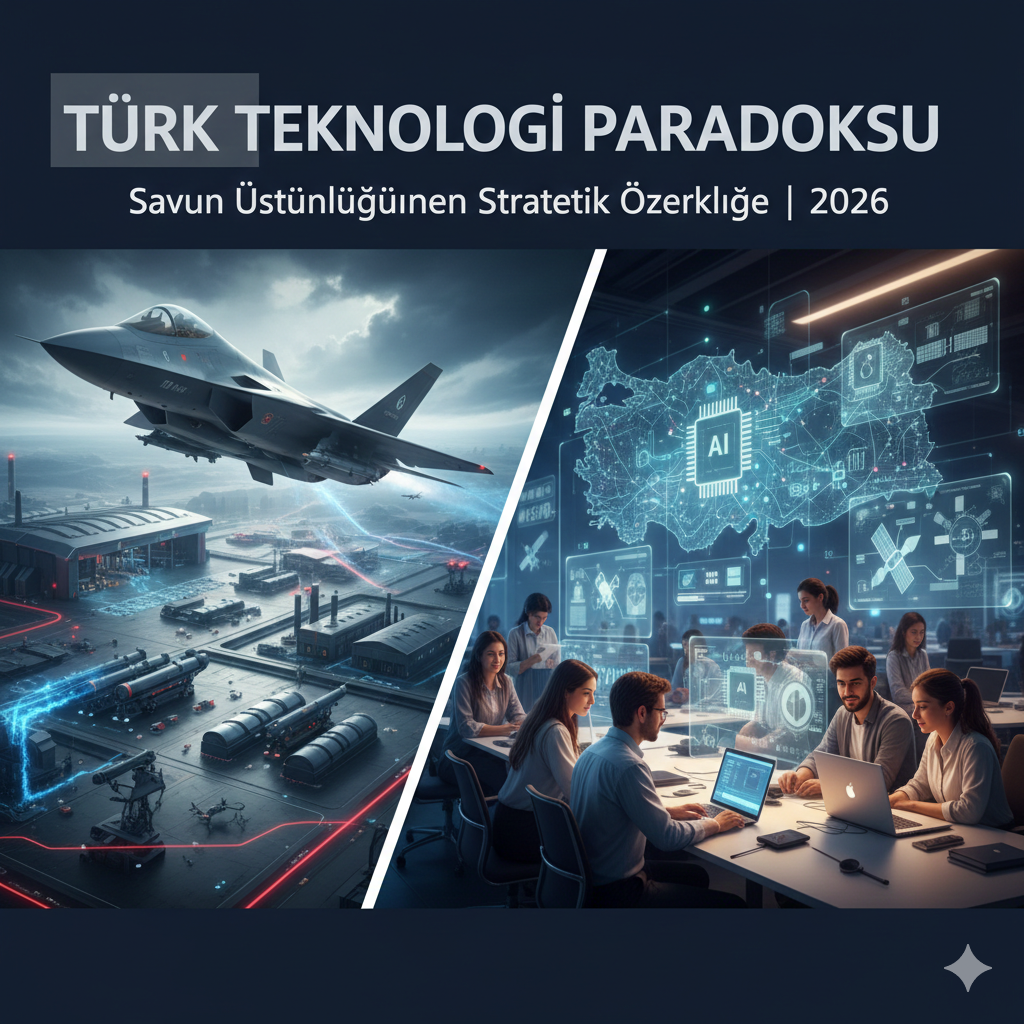
ANKARA, Turkey – In a cavernous hangar on the outskirts of Ankara this week, Haluk Gorgun stood before a machine that embodies a nation’s technological ambition. The head of Turkey’s Secretariat of Defense Industries was inspecting newly unveiled prototypes of the KAAN, the country’s indigenous fifth-generation combat aircraft. Flanking him were the full-size static test airframe and the first two flight prototypes—physical evidence that Turkey has joined an elite club of nations capable of designing and building advanced fighter jets .
The symbolism was unmistakable. “KAAN stands beyond a mere aircraft as a symbol of Türkiye’s engineering prowess and independent defense capabilities,” Gorgun declared . Yet beneath the triumphant imagery lies a more complex reality. Turkey’s technology sector in early 2026 is a study in strategic duality: world-class achievements in aerospace and defense coexist with a calculated, efficiency-driven pivot in artificial intelligence, all framed by a government determined to translate technological capability into national resilience.
The Crown Jewel: KAAN and the Defense Ecosystem
The KAAN program represents the most visible manifestation of Turkey’s technological ascent. Following the first prototype’s inaugural flight in 2024, development has accelerated dramatically. The fifth-generation jet incorporates low observability features, internal weapon bays, enhanced situational awareness, and sensor fusion capabilities designed for superiority in both air-to-air and air-to-ground missions .
But the program’s significance transcends its technical specifications. Gorgun emphasized that KAAN serves as a catalyst strengthening national infrastructure, human resources, and technological accumulation simultaneously. The domestic supply chain now encompasses more than 5,000 employees across over 300 companies operating in more than 20 cities . This industrial footprint transforms a military program into a nationwide capability-building exercise, creating expertise that can diffuse across civilian sectors.
A central program objective involves developing a domestic engine, which would further elevate Turkey’s position among elite aerospace nations. Authorities are rapidly advancing mass production preparations concurrent with ongoing testing phases, signaling confidence in the program’s trajectory toward operational service with the Turkish Air Force .
The AI Pivot: Efficiency as Strategy
If defense represents technological dominance, Turkey’s artificial intelligence strategy reflects a different imperative: survival through optimization. The global AI boom has triggered an unexpected crisis: record-high prices for random access memory (RAM), driven by the voracious hardware requirements of generative AI platforms training ever-larger models .
Cihan Sarı, secretary-general of Istanbul’s Artificial Intelligence and Technology Association, describes the situation not as temporary disruption but as “a tipping point where AI investments have hit the limits of the physical world.” Leading chip manufacturers Samsung, SK Hynix, and Micron are systematically reallocating production lines from conventional consumer RAM to high-bandwidth memory (HBM) components serving corporate data centers. The capacity required to produce one gigabyte of HBM equals that needed for three gigabytes of standard memory, dramatically constricting consumer supply while AI firms “wait at the door with cash in hand.” RAM prices have already surged more than 100 percent, with ripple effects driving inflation and elevating costs for everyday electronics .
For Turkish entrepreneurs, Sarı argues, competing head-on with multinational corporations in resource-intensive general model training is futile. Instead, he advocates a strategic pivot toward specialized, domain-specific artificial intelligence applications. “Developing small but domain-specific models that only know law, health care or production is the only way out for the Turkish tech sector,” he states . This efficiency-focused approach requires substantially less computational power while delivering targeted expertise precisely calibrated to sectoral needs.
“The winners in the coming period won’t be those with the biggest computers but those who use their resources most wisely,” Sarı concludes. “AI training won’t stop, but it’s shifting, and as Türkiye, we need to focus on the new efficiency path we can take” .
The 6G Frontier: HABTEK and Future Communications
Beyond current technologies, Turkey is positioning itself for the next communications revolution. The “6G and Beyond Communication Technologies Cluster (HABTEK),” launched under the hosting of Istanbul Medipol University, represents a coordinated effort among academia, industry, and public institutions to shape next-generation wireless standards .
Canan Ünlü Şahin, Head of the R&D Incentives Directorate General at the Ministry of Industry and Technology, articulated the ambition clearly: “Our fundamental approach is to become one of the countries that shape the 6G race rather than follow it” .
Prof. Hüseyin Arslan, Dean of the Faculty of Engineering and Natural Sciences at Medipol and Cluster Coordinator, frames communications as existential infrastructure. “Communication is not a cost but a strategic investment; indeed, beyond being a technology, it is the design of the future,” he argues. Arslan emphasizes that countries’ competitiveness, strategic independence, and digital sovereignty are directly tied to communication infrastructures, adding that even modern conflicts are shaped through these systems .
Significantly, Arslan notes that Turkey now participates in 6G standard development meetings “not to listen, but to contribute,” through contribution documents and patents . This shift from observer to active participant signals a maturing technological ecosystem capable of influencing global technical trajectories.
The State as Architect: 2026 Presidential Program
Turkey’s technological ambitions are not left to market forces alone. The 2026 Presidential Annual Program, unveiled late last year, treats artificial intelligence not merely as a sectoral innovation tool but as a core component of state capacity itself .
Gloria Shkurti Özdemir, director of the Emerging Technologies and Artificial Intelligence Research Center at Khazar University, analyzes the program as reflecting a “defensive as much as ambitious” strategy. For middle powers like Turkey, AI offers “a way to protect institutional effectiveness under conditions of uncertainty”—hedging against future shocks, economic volatility, geopolitical pressure, or administrative bottlenecks by embedding adaptive intelligence into governance machinery .
The program’s emphasis on domestic AI models, secure data infrastructures, and national compute capacity reflects awareness that digital dependency extends beyond hardware imports or software licenses to encompass data access, model architectures, cloud infrastructure, and computational capacity. The objective is not technological isolation, but avoiding dependencies that could constrain policy choices or expose critical systems to external leverage .
The Investment and Finance Office will play a pivotal role in advancing this agenda, supporting the attraction of high-quality foreign direct investment and fostering a sustainable financing ecosystem aligned with technology-oriented production .
Software Strategy and Entrepreneurial Targets
The Union of Chambers and Commodity Exchanges of Turkey (TOBB) Software Council, meeting in January, set an ambitious 2026 roadmap. Council President Ertan Barut emphasized the goal of positioning Turkey as “a reputable, reliable, and scalable software country on a global scale,” noting that the sector’s export target is approaching $6 billion .
Fourteen newly established technology-focused committees will drive this effort, with an “AI Road Show” planned for seven provinces by June to inform small and medium enterprises about artificial intelligence applications. Barut highlighted that not only AI integration but also the rise of agent-based systems that plan and execute autonomously will prove decisive, emphasizing that in software, “it is no longer just speed but also trust, compliance, controllability, and sustainability that have become criteria for market entry” .
Government targets for tech entrepreneurship are equally ambitious. The number of startups earning the Techno-Entrepreneurship Badge is projected to jump from 1,000 in 2025 to 5,000 in 2026, while the Turcorn 100 program—offering customized assistance to Turkish unicorns valued at $1 billion or more—aims to grow from 40 participating firms currently to 80 in 2026 .
The Tech Visa program, targeting startups with cutting-edge business models, expects to cover 75 startups in 2026, with R&D personnel slated to reach 4,000 over the next three years through dedicated support .
Regional Integration: The Azerbaijan Connection
Turkey’s technology strategy extends beyond its borders. Azerbaijani and Turkish companies are exploring collaboration to develop joint products and technological platforms based on artificial intelligence. Vurgun Hajiyev, Advisor to the Chairman of the Board of Azerbaijan’s Innovation and Digital Development Agency, emphasized the potential of adapting Turkish technology to the Azerbaijani market and establishing joint platforms, particularly in fintech .
“A joint approach and coordinated cooperation are essential for fostering competitive artificial intelligence products on a regional scale,” Hajiyev noted, highlighting opportunities to combine the strengths of the two nations’ technological ecosystems .
Conclusion: The Strategic Autonomy Imperative
Turkey’s technology landscape in early 2026 reveals a nation executing a coherent, multi-layered strategy. At the apex, flagship programs like KAAN demonstrate world-class engineering capability and create industrial ecosystems that diffuse expertise across the economy. In artificial intelligence, a pragmatic pivot toward domain-specific efficiency reflects strategic adaptation to global constraints. In next-generation communications, coordinated investment positions Turkey to shape, not merely adopt, future standards.
What unifies these efforts is a governing logic of strategic autonomy. The 2026 Presidential Program articulates this vision explicitly: technology is no longer an auxiliary concern but a structural component of state power, essential for preserving institutional effectiveness under conditions of uncertainty .
The challenges remain substantial—global competition for talent, supply chain vulnerabilities, and the perennial difficulty of scaling startups into sustainable enterprises. Yet Turkey’s technological trajectory suggests a nation that has learned to translate necessity into strategy, converting the imperative of independence into a coherent, if still unfolding, vision of its technological future. In the KAAN hangar and the AI labs, that future is taking shape.