

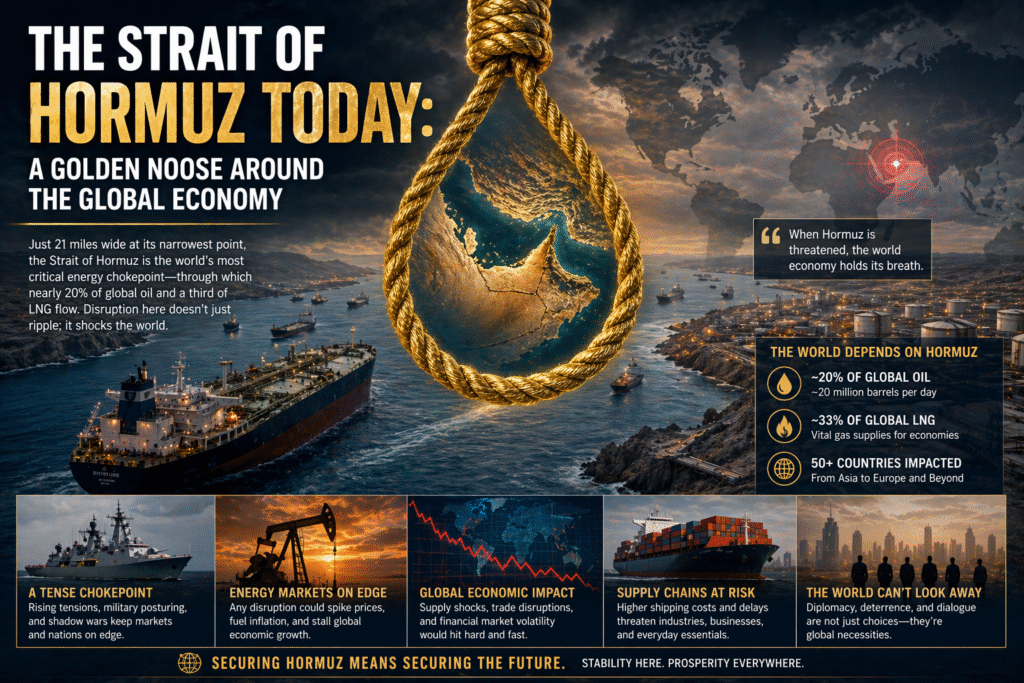
April 23, 2026 – For nearly two months, the world has held its breath over a 21-mile-wide stretch of water between Oman and Iran. The Strait of Hormuz, through which approximately one-fifth of the world’s oil passes in peacetime, has become the central battlefield—and the central bargaining chip—in the devastating war between the United States, Israel, and Iran . As a fragile ceasefire hangs by a thread, the Strait remains largely closed, its waters patrolled by Iranian gunboats and US warships, and its future uncertain. This is the state of Hormuz today.
The Leverage: Iran’s “Golden, Invaluable Asset”
Former Russian president Dmitry Medvedev recently made a blunt observation on social media that crystallized the strategic reality of the conflict. “It’s not clear how the truce between Washington and Tehran will play out,” Medvedev wrote on April 8. “But one thing is certain—Iran has tested its nuclear weapons. It is called the Strait of Hormuz. Its potential is inexhaustible” .
The remark cast the Strait not as a passive geographic feature but as an active instrument of deterrence—one that allows Tehran to raise costs and shape the rules of the game without ever crossing the nuclear threshold. Iranian security officials privately echo this view, describing the Strait as a long-prepared tool rather than a contingency plan.
“Iran prepared for years for a scenario involving the closure of the Strait of Hormuz, planning every step,” a senior Iranian security source told Reuters. “Today it is one of Iran’s most effective tools—a form of geographic leverage that serves as a powerful deterrent” .
A second Iranian source, close to the Revolutionary Guards, went further. The source described Hormuz as a sword “drawn from its sheath” that the United States and regional states could no longer ignore . Another senior Iranian official called the Strait a “golden, invaluable asset rooted in Iran’s geography—one the world cannot take away precisely because it flows from Iran’s location” .
The Closure: From Ceasefire Promise to Renewed Blockade
The current crisis began on February 28, 2026, when the US-Israeli war on Iran erupted. Iran effectively closed the Strait shortly thereafter, sending shockwaves through global energy markets . On April 8, a conditional two-week ceasefire was announced, with Iran agreeing to guarantee safe passage for maritime traffic through the Strait as a core condition .
But the reopening was brief—and contested.
On April 17, Iranian officials declared the Strait open to commercial shipping during the ceasefire, while also insisting that transit would remain conditional, coordinated, and subject to reversal if the US blockade continued . By April 18, the Islamic Revolutionary Guard Corps (IRGC) announced that the Strait was closed again. Vessel behavior shifted immediately.
According to maritime intelligence firm Windward, 35 outbound vessels reversed course over the following 36 hours, with 13 reversals occurring in the immediate aftermath of the closure announcement alone . Ships that had already committed to transit—including vessels using the safer southern corridor through Omani waters—began turning back, confirming that no route was truly safe.
The Attacks: Gunboats, Projectiles, and Seizures
The danger is not merely theoretical. Since the ceasefire began, multiple vessels have been attacked in the Strait’s waters.
On April 18, three additional vessel incidents were recorded, bringing the total number of vessels attacked since the war began to 29 . The attacks included:
- SANMAR HERALD, an India-flagged VLCC (Very Large Crude Carrier) carrying approximately 1.85 million barrels of crude, was fired upon by two IRGC gunboats approximately 20 nautical miles northeast of Oman. The vessel held prior Iranian transit clearance but came under fire without warning. It reversed course and was last observed stalled in UAE waters with its cargo undelivered.
- A container ship was struck by an unknown projectile approximately 25 nautical miles northeast of Oman, causing damage to some containers.
- JAG ARNAV, an India-flagged bulk carrier, reported a projectile splash in close proximity just three nautical miles off the Omani coast. The master immediately aborted transit and reversed course.
On April 22, the attacks intensified. The UK Maritime Trade Operations Centre (UKMTO) reported that an IRGC gunboat fired on a container ship, the Greek-flagged Epaminondas, 15 nautical miles northeast of Oman. There was no radio warning—no VHF challenge—before the gunboat opened fire, causing heavy damage to the ship’s bridge .
A second vessel, the Panama-flagged Euphoria owned by a UAE-based company, was fired upon eight nautical miles west of Iran. The master brought the ship to a halt, but the crew were safe and no damage was reported. A third ship, the MSC Francesca, was targeted approximately six nautical miles off the coast of Iran while heading south out of the Strait. Iranian media reported that the IRGC “seized” both the MSC Francesca and the Epaminondas, directing them toward the Iranian coast .
The Blockade: US Turns Back Dozens of Vessels
The United States has responded with its own naval campaign. US Central Command (CENTCOM) announced that American forces have directed 28 vessels to turn around or return to an Iranian port since the naval blockade of Iranian ports began on April 13 . The figure has climbed steadily from 25 vessels reported earlier in the week .
On Sunday, April 19, US naval forces seized the Iranian-flagged cargo ship TOUSKA in the Gulf of Oman after it reportedly refused to comply with blockade directions for over six hours. The vessel was disabled by the USS Spruance .
The United States has also broadened the enforcement framework beyond the Gulf itself. Washington has authorized the boarding, search, and seizure of Iran-linked and sanctioned vessels on the high seas worldwide. The directive targets Iranian-flagged ships, vessels with active OFAC sanctions, and Iran’s shadow fleet, while also expanding the definition of contraband to include dual-use goods such as petroleum, industrial materials, machinery, and electronics when linked to Iran’s military or war-sustaining economy .
The Traffic: A Trickle Where a Flood Once Flowed
Commercial traffic through the Strait has slowed to a relative trickle. On April 19, a selected sample showed only 15 vessels in transit over a 24-hour period—eight west-to-east and seven east-to-west . By April 21, the numbers had fallen further: just three vessels passed from the Arabian Gulf to the Gulf of Oman, while nine traversed from east to west .
The vessels that do transit are a mix of high-risk players and desperate operators. At least two of the vessels recorded in the April 19 sample—Meda and Axon I, both LPG tankers—are under US sanctions. Nova Crest remains under UK and EU sanctions for its previous involvement in the Russian oil trade .
Most crude flows have halted entirely. What continues is regional transport, specialized tankers, and the occasional passenger vessel. Notably, six cruise ships cleared the Strait during the brief reopening, including the MSC Euribia and several Mein Schiff vessels, carrying stranded passengers out of the danger zone .
The Economic Fallout: US Oil Surges as Hormuz Stalls
The closure of the Strait has profoundly distorted global energy markets. Unable to access crude oil from the Middle East through the normal chokepoint, importers have turned to alternative suppliers—particularly the United States.
Data from marine analytics firm Kpler suggests that 71 Very Large Crude Carriers (VLCCs) are headed to the US to take on cargo, compared with an average of 27 on any given day last year . “Buyers from Europe and Asia saw oil loading out of the Atlantic basin—including from the US Gulf coast—as an accessible, plentiful solution to fill the supply gap,” said David Haydon, head of US crude tanker freight pricing at Argus Media .
President Trump has seized on this dynamic, posting on Truth Social that Iran is “collapsing financially” over the closure. “Iran is collapsing financially! They want the Strait of Hormuz opened immediately,” Trump wrote, adding that the Islamic republic was “starving for cash” . Trump also claimed that Iran wanted the Strait open “so they can make $500 Million Dollars a day,” which he said Tehran would risk losing if the closure continues .
The Deceptive Flows: Iran’s Shadow Fleet Keeps Moving
Despite the blockade and the attacks, Iranian cargo continues to move. As of April 17, 177 tankers carrying Iranian cargo were on the water globally, most concentrated toward Asian and Middle Eastern destinations .
The scale of deception is staggering: 163 of these tankers are sailing under fraudulent flag registries with elevated sanctions compliance risk. Across Windward’s broader platform, 719 Iranian dark fleet tankers are tracked globally, including 72 operating under the Iranian flag .
One crude oil tanker in the dark fleet illustrates how the deception functions. The tanker reports Basrah as its destination, then appears to spoof its location midway through its Gulf voyage so that it looks anchored off Iraq while potentially loading instead at Kharg Island or via ship-to-ship transfer elsewhere. Without multi-source intelligence and behavioral analysis, a later outbound transit would appear entirely legitimate .
The Diplomatic Stalemate: Talks Stall Over the Strait
The future of the Strait is now the central obstacle to peace. Iranian leaders are refusing to re-open the waterway as long as the Trump administration maintains its blockade on Iranian ports. The United States has ruled out any easing of the blockade and further ratcheted up tensions this week by seizing several Iranian tankers in the Indian Ocean .
“Reopening the Strait of Hormuz is not possible amid a blatant violation of the ceasefire,” said Iranian parliament speaker Mohammad Bagher Ghalibaf, who led Tehran’s delegation in the first round of talks in Islamabad .
President Masoud Pezeshkian said Tehran is willing to return to talks but said the US “breach of commitments, blockade and threats are main obstacles to genuine negotiations” .
Pakistan has raced to set up fresh negotiations, but the outlook is grim. Meanwhile, Iran has reportedly received its first revenue from tolls it imposed on the Strait during the war, with the funds deposited into the Central Bank account according to deputy speaker of parliament Hamidreza Hajibabaei .
The Gulf’s Fear: “Sustainable Conflict” Instead of Peace
Perhaps the most overlooked dimension of the crisis is the anxiety of the Gulf Arab states. Officials from Saudi Arabia, the UAE, and other Gulf nations fear that the US-Iran talks will focus increasingly not on Iran’s missiles or regional proxies but on how to manage the Strait—effectively cementing Tehran’s leverage rather than dismantling it .
“What is taking shape today is not a historic settlement,” Ebtesam Al-Ketbi, president of the Emirates Policy Center, told Reuters, “but a deliberate engineering of sustainable conflict” .
“Who’s suffering from missiles and proxies?” she added. “Israel, and specifically the Gulf states. What would be a good deal for us is [addressing] missiles, proxies—and Hormuz. And it seems they don’t care about the missiles or the proxies” .
Analysts warn that such an approach would not resolve tensions so much as stabilize them at manageable levels—an outcome that may suit Washington and Tehran but risks entrenching instability for Gulf states living under the threat of Iranian missiles .
The Future: Months of Mines and a Long Recovery
Even if hostilities end and the blockade lifts, the Strait will not return to normal quickly. A Pentagon assessment has warned that it could take six months to completely clear the Strait of Iranian-laid mines . Iran may have placed 20 or more mines in and around the waterway, some floated remotely using GPS technology, making them harder to detect.
The assessment was shared with members of the House Armed Services Committee during a classified briefing. Lawmakers were told that it is unlikely such an operation would begin before the end of the war .
Conclusion: The World’s Most Dangerous Waterway
The Strait of Hormuz today is not merely a shipping lane. It is a hostage. It is a weapon. It is a symbol of how geography can become destiny when great powers clash. For Iran, the Strait is the sword it has finally drawn from its sheath—a golden, invaluable asset that no sanctions can seize and no blockade can neutralize. For the United States and its allies, it is a vulnerability that has reshaped global oil markets, driven up fuel prices, and exposed the fragility of the international order.
As the ceasefire holds by a thread and diplomats scramble in Islamabad, the world watches. Because when the Strait of Hormuz closes, the global economy gasps. And today, it is gasping still.