

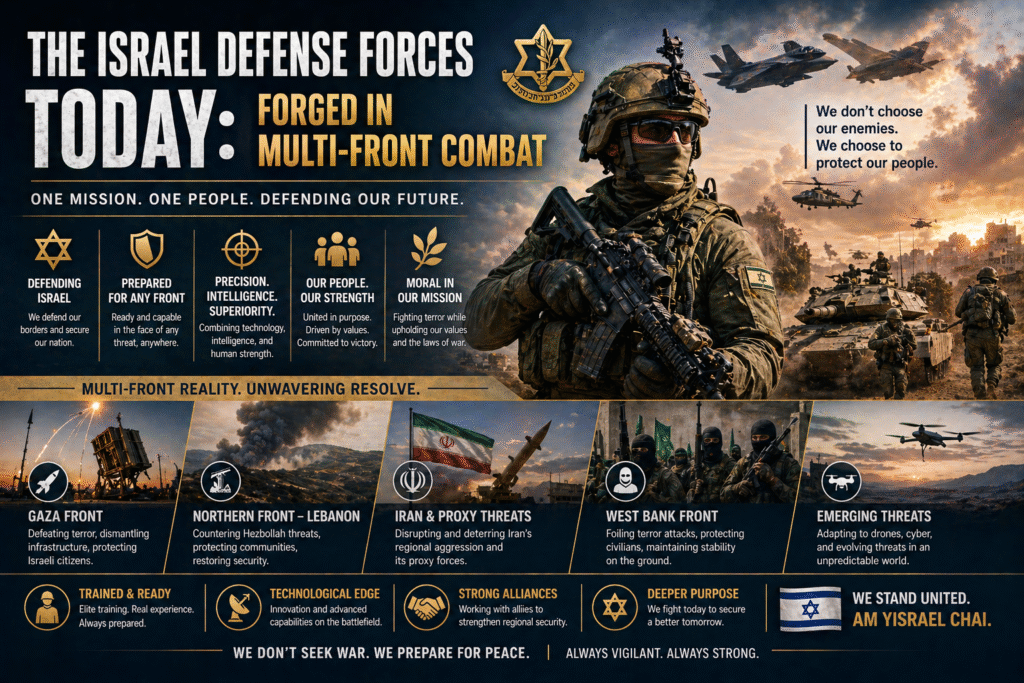
As dawn broke over the Middle East on April 27, 2026, the Israel Defense Forces (IDF) stood as a military paradox: arguably the most battle-hardened and technologically advanced force in the region, yet one stretched thinner than at any point in its history. Operating simultaneously across five fronts—Iran, Lebanon, Gaza, Syria, and the West Bank—the IDF is writing a new chapter in modern warfare, defined by artificial intelligence, autonomous systems, and a multi-layered defense architecture that has proven itself against everything from hypersonic missiles to drone swarms .
But beneath the headlines of stunning preemptive strikes and technological breakthroughs lies a quieter crisis. The same army that eliminated Iran’s Supreme Leader in a 40-second surgical strike is now warning of “10 red flags” and a potential “internal collapse” due to a deepening manpower shortage . This is the story of the IDF today: a force of extraordinary capability confronting unprecedented strain.
The Fifth Front: A Military Under Pressure
The sheer scale of the IDF’s current operational tempo is staggering. According to Chief of Staff Eyal Zamir’s recent assessment to Israel’s Security Cabinet, the military is deployed in Lebanon, Gaza, Syria, Iran, and the West Bank simultaneously . This multi-front reality has pushed the reserve system to its breaking point. Military spokesperson Effie Defrin estimates a shortage of approximately 15,000 soldiers, including 7,000 to 8,000 combat troops .
Zamir’s warning was stark and uncharacteristically public: reserve forces “will not hold” under the current pressure, and the army is heading toward “internal collapse” without urgent legislative action on conscription . More than 100,000 reservists are currently deployed, and the situation has been described as “unbearable” . The core of the crisis revolves around the exemption of ultra-Orthodox Jews (Haredim) from military service—a politically explosive issue that pits religious parties against security establishment demands for universal conscription .
For an army that prides itself on being “the most moral army in the world” and a “people’s army,” this internal fracture represents an existential threat that no missile defense system can counter.
Operation Roaring Lion: Intelligence and Precision Unleashed
Yet, even as the IDF grapples with manpower challenges, its offensive capabilities have reached new heights. The most dramatic demonstration came with “Operation Roaring Lion”—the preemptive strike against Iran that was reportedly moved forward by months following consultations with the Trump administration .
Defense Minister Israel Katz revealed that the operation was originally planned for mid-2026 but was accelerated due to “developments and circumstances—especially what happened inside Iran, the position of the U.S. president and the possibility of creating a combined operation” . The result was devastating. Maj. Gen. Shlomi Binder, head of the Military Intelligence Directorate, disclosed that the opening strike killed “more than 40 of the most important people in Iran” in only 40 seconds .
The intelligence triumph behind this operation is arguably as impressive as the strike itself. According to The Washington Post, Israel deployed an integrated mechanism combining human sources within Iran with deep cyber infiltration into government surveillance systems . Raw information—including access to security cameras, payment systems, and internet traffic—was fed into an artificial intelligence platform that analyzed the life patterns and movements of senior officials . This AI-driven approach transformed dispersed data into actionable targeting information, executed using pre-positioned explosives, attack drones, and hypersonic missiles launched from low-radar-signature fighter jets .
“We could tactically surprise them, beginning at an unexpected hour and catching our enemies mid-gatherings,” Binder said following the operation .
The Digital Army: Tzayad and the Fifth Generation
While the air force and intelligence community have garnered headlines, the IDF’s ground forces are undergoing a quieter but equally profound transformation. In February 2026, Elbit Systems was awarded contracts exceeding $100 million by the Israel Ministry of Defense to develop the fifth generation of the IDF’s digitization array .
The centerpiece of this effort is “Tzayad” (Hebrew for “Hunter”)—the next-generation digital ground army system. This platform will deliver advanced command and control capabilities to headquarters at all levels, with full multi-domain connectivity across air, sea, and land . Key capabilities include accelerated multi-service sensor-to-shooter loops, support for tactical decision-making through advanced AI tools, and increased capacity of tactical networks reaching down to frontline combat units .
Haim Delmar, General Manager of Elbit Systems C4I & Cyber, described the initiative as building “unique, world-leading capabilities in the fields of digital warfare and artificial intelligence—capabilities that will significantly enhance operational effectiveness and provide the IDF with a substantial technological advantage on the modern battlefield” .
Complementing Tzayad is the next-generation Multi-Sensor Border Defense System (MARS), which incorporates lessons learned from what officials describe as “the first digital war” . MARS will provide advanced AI-based capabilities for high-volume target detection and classification, rapid integration of a wide range of sensors and effectors, and broad multi-mission management .
Colonel S., Head of the Aderet Department in the Ground Technological Division, emphasized that these systems “constitute another significant leap in the IDF’s capabilities in the fields of C4I and digital, and represent a direct implementation of the lessons learned from combat over the past two years” .
The Shield: A Multi-Layered Defense Architecture
No assessment of the IDF would be complete without examining its air and missile defense network—arguably the most advanced and battle-tested in the world. The system operates in four layers, each designed to intercept different threats .
At the top sits the Arrow system, which intercepts ballistic threats at exo-atmospheric and upper-atmospheric altitudes. Developed jointly with the U.S. Missile Defense Agency, the Arrow has proven its capabilities during the current war, successfully intercepting numerous ballistic missiles launched from Iran and Yemen . In April 2026, the Ministerial Committee for Procurement approved a major acceleration of Arrow interceptor production, significantly increasing both production rate and stockpile . Defense Minister Israel Katz declared that “Israel has sufficient interceptors to protect its citizens,” with the acceleration designed to ensure “continued freedom of action and the sustained operational endurance we require” .
The middle layer is David’s Sling, designed to intercept rockets, missiles, cruise missiles, aircraft, and UAVs. In February 2026, the system successfully completed a complex series of tests simulating existing and emerging threats, marking “another significant technological and operational leap” in the system’s upgrade . Moshe Patel, Director of the Israel Missile Defense Organization, noted that during the war, “IMDO personnel implemented real-time modifications and adaptations that dramatically enhanced the capabilities” of these systems .
Below that sits the battle-tested Iron Dome, which continues to protect civilian populations from short-range rockets and mortars. And on the horizon is Iron Beam, the laser-based system recently delivered to the Israeli Air Force, which promises to intercept threats at a fraction of the cost of missile-based systems .
Yoav Tourgeman, CEO of Rafael Advanced Defense Systems, summarized the achievement: “Against the backdrop of ever-evolving threats, Rafael is proud to successfully conclude the advanced test series of the David’s Sling system… The system undergoes continuous upgrades and adaptations, and the current test series once again demonstrates that David’s Sling is one of the world’s leading air defense systems” .
The Ro’em Thunder: A New Era of Artillery
On the ground, the IDF has introduced a new weapon that fundamentally changes how firepower is employed. The Ro’em (Hebrew for “Thunder”) self-propelled howitzer, developed by Elbit Systems, has been deployed against Hezbollah forces and has already undergone its baptism of fire .
What makes Ro’em revolutionary is its automation. Crewed by only three soldiers—compared to the large teams required by older systems—the howitzer automates the selection of projectiles and powder charges, aims itself, and fires at a high rate of speed . With a range of approximately 40 kilometers, the system can quickly take position, open fire, and depart before enemy forces can mount a counter-battery response .
IDF Chief Artillery Officer Ehud Bibi described Ro’em as “changing the way firepower is used on the battlefield,” calling it “a historic milestone that ushers in a new era of more accurate, rapid and flexible fire” . The system has already proven effective during a fragile ceasefire in Lebanon, conducting precise defensive fire against Hezbollah anti-tank and surface-to-surface missile systems .
Conclusion: A Military at the Crossroads
The Israel Defense Forces of 2026 is a study in contradictions. It possesses the technological capacity to locate and eliminate senior Iranian officials using AI-driven intelligence, deploy fifth-generation digital warfare systems, and intercept ballistic missiles in space . It has unveiled autonomous artillery and is fielding laser-based defenses that were science fiction a decade ago.
Yet this same force warns of “unbearable” personnel shortages, “10 red flags,” and the risk of “internal collapse” . The reserve system that has always been the IDF’s backbone is eroding under the weight of multi-front commitments . The Haredi conscription crisis, which pits political survival against military necessity, threatens to break a social contract that has sustained the IDF for decades .
What emerges is a portrait of a military that has never been more capable—and never more vulnerable. The technology is world-leading. The combat experience is unmatched. But as Chief of Staff Zamir reportedly warned behind closed doors, hardware cannot replace soldiers, and no missile defense system can prevent internal collapse.
The IDF today is winning the battles that matter most—against Iran, against Hezbollah, against the immediate threats to Israel’s security. But the war for its long-term sustainability will be fought not on foreign soil, but in the Knesset, over a conscription law that will determine whether the “people’s army” can remain the people’s army. For now, the roar of the Ro’em and the silence of the Arrow tell only half the story. The other half is being written in the exhausted eyes of reservists who have been called up once too often, and in the political debates that will determine whether Israel’s best military can remain one.
