

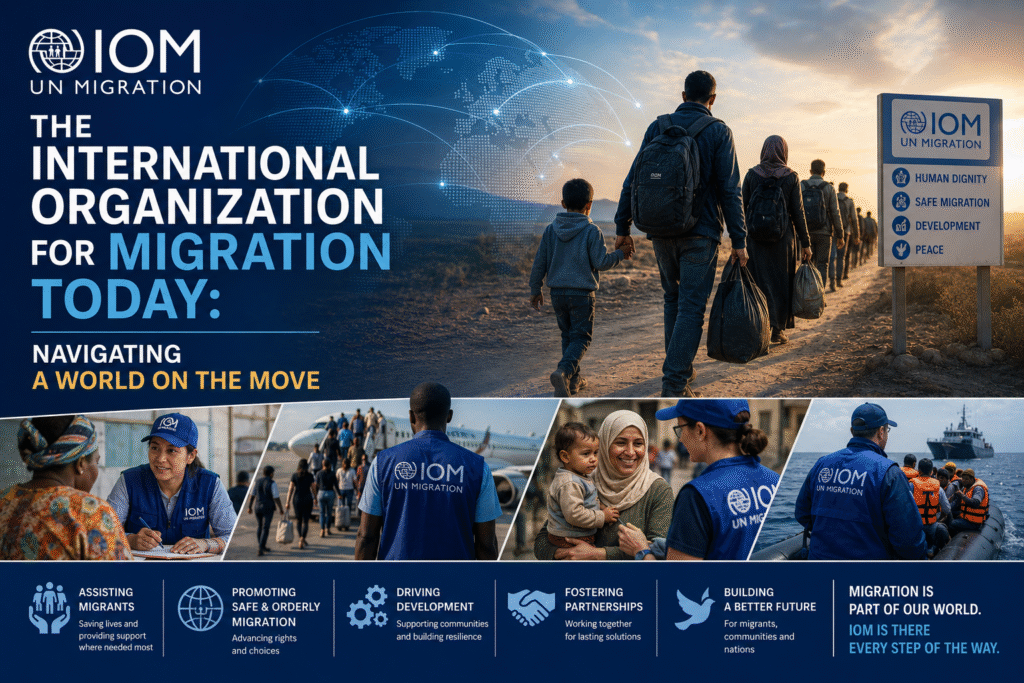
Introduction: A Global Agency at a Critical Juncture
In an era defined by unprecedented human mobility, climate-induced displacement, and complex humanitarian emergencies, the International Organization for Migration (IOM) has emerged as one of the most vital—and busiest—agencies in the United Nations system. As the leading intergovernmental organization in the field of migration, IOM today operates at the intersection of humanitarian aid, development policy, climate action, and technological innovation. With 304 million international migrants worldwide as of mid-2024 and over 120 million people displaced globally, the agency’s work has never been more urgent or more complex.
This article examines the state of IOM today, drawing on the latest developments from the past week and the agency’s most recent strategic initiatives. From groundbreaking climate mobility frameworks in Africa to AI-powered crisis response tools and large-scale humanitarian appeals for Sudan, the organization is redefining what it means to manage migration in the 21st century.
Part 1: The World Migration Report 2026 – Key Findings Released
Just days ago, on May 5, 2026, IOM released its flagship World Migration Report 2026 during the International Migration Review Forum (IMRF) week at the United Nations headquarters in New York. The report’s central finding is striking: restricting safe and regular migration pathways does not stop migration—it merely diverts it into more irregular and dangerous routes.
“Across the world, migration helps drive jobs, economic growth, stability and social cohesion,” said IOM Director General Amy Pope at the report’s launch. “Every country has the right to shape its own migration policies. The evidence shows, however, that when States cooperate at regional and global levels, migration is better managed, helping to build public trust and deliver stronger benefits for economies, communities and people on the move.”
The report reveals several critical data points. By mid-2024, international migrants constituted approximately 3.7 per cent of the world’s population, a share that has grown gradually over time. The number of international migrant workers increased by more than 30 million between 2013 and 2022. Remittances in 2024 were expected to reach an estimated USD 905 billion, including USD 685 billion flowing to low- and middle-income countries—figures that now exceed official development assistance and foreign direct investment combined.
However, the report also highlights troubling inequalities. Migration pathways have expanded more for people in higher-income countries while remaining constrained for those in lower-income contexts, reinforcing global mobility inequalities. This trend, the report warns, is slowing labour mobility and reducing the potential economic gains migration can deliver.
Part 2: Climate Mobility – IOM’s Growing Focus on Environmental Displacement
Perhaps the most significant evolution in IOM’s mandate today is its deepening engagement with climate-induced displacement. Just last week, from May 10 to 12, 2026, IOM concluded a three-day regional workshop in Johannesburg in partnership with the Southern African Development Community (SADC) Secretariat. The workshop brought together fourteen SADC Member States to strengthen collective responses to climate-related mobility across the region.
The numbers are staggering. Southern Africa currently hosts approximately 7.9 million internally displaced persons (IDPs), 1 million refugees, and 6.2 million international migrants. While conflict remains a key driver of displacement, climate impacts increasingly act as “threat multipliers,” eroding livelihoods, straining services, and prolonging displacement situations.
Yitna Getachew, IOM’s Sub Regional Director for East, Horn and Southern Africa, emphasized the urgency of implementation: “Southern Africa has a strong policy foundation through the KDMECC [Kampala Ministerial Declaration on Migration, Environment and Climate Change] and related regional commitments. The task ahead is to translate these priorities into coordinated action, sustained investment, and programmes that deliver tangible results for communities affected by climate‑related mobility.”
This workshop followed a similar symposium held in Nairobi in late March 2026, where IOM’s Climate Mobility Innovation Lab (CMIL) brought together governments, the private sector, NGOs, and technical partners to advance the Risk Index for Climate Displacement (RICD) —a foresight tool designed to identify climate displacement hotspots and guide resilience investments.
“Climate mobility is one of the defining challenges of our time,” declared Rania Sharshr, Director of IOM’s Climate Action Division. “Through IOM Climate Mobility Innovation Labs and tools like the Risk Index for Climate Displacement, IOM is committed to supporting governments and partners with data-driven solutions.”
Part 3: The Sudan Crisis – A USD 277 Million Regional Response
Amid these long-term initiatives, IOM continues to respond to acute humanitarian emergencies. The Sudan crisis, now approaching its third year since conflict erupted in April 2023, remains one of the world’s largest displacement situations. On March 31, 2026, IOM issued an urgent appeal for USD 277 million to support affected populations in Sudan and neighbouring countries throughout 2026.
The scale of the crisis is almost incomprehensible. More than 12 million people were displaced within Sudan at the peak of the conflict, with over 9 million still currently internally displaced. An estimated 33.7 million people in Sudan—the highest figure globally—require humanitarian assistance, including food, clean water, healthcare, and shelter.
The crisis has also spilled across borders. More than 1.3 million people have arrived in South Sudan, and 1.2 million in Chad. Crucially, returning nationals constitute a significant number of those arriving—over 900,000 in South Sudan and 389,000 in Chad—often arriving with little to no family ties, assets, or social networks to rely on.
“Across Sudan and the region, families are being forced into impossible choices—whether to remain displaced without basic services, or return to communities shattered by conflict,” said IOM Director General Amy Pope. “They have lost homes, livelihoods and loved ones, yet continue to hold on to hope. They need sustained, urgent international support not only to survive, but to rebuild their lives with dignity and safety.”
The 2026 response plan prioritizes strengthening data and mobility tracking systems, expanding humanitarian hubs and supply routes, enhancing cross-border operations, and greater localization of assistance. A key priority is the expansion of cross-border assistance through the inter-agency humanitarian hub in Farchana, eastern Chad, which helps deliver aid into hard-to-reach areas of Darfur and Kordofan.
Part 4: Somalia – Drought Displaces 62,000 in Early 2026
The climate-displacement connection is perhaps most visible in Somalia, where IOM reported on April 24, 2026, that 62,000 people had been displaced across five districts since the beginning of the year. Three out of every four new displacements are due to drought, representing a 22 per cent increase from the previous year—a stark indicator of the increasing severity of climate shocks.
“Drought is already forcing tens of thousands of people from their homes, and many more could be displaced in the months ahead,” warned Manuel Pereira, Chief of Mission for IOM Somalia. “When water disappears, crops fail, and livelihoods collapse, displacement becomes a last resort. Without swift action, drought will continue to uproot communities, deepen hunger and increase vulnerability across Somalia.”
According to IOM’s Displacement Tracking Matrix (DTM), nearly 125,000 more people are projected to be displaced by drought in the second quarter of 2026, even if the Gu rainy season brings normal to above-normal rainfall. Below-average rainfall during the 2025 Deyr season, compounded by an unusually harsh Jilaal dry period, has driven this surge in climate-driven displacement.
Part 5: AI and Technological Innovation – The LOCALISE Toolkit
Recognizing that traditional humanitarian response methods cannot keep pace with the scale of today’s crises, IOM has embraced technological innovation. In a groundbreaking collaboration announced on March 27, 2026, IOM partnered with Google Cloud and mapping specialists NGIS to reimagine the agency’s LOCALISE planning system.
The upgraded LOCALISE Toolkit uses AI-powered tools to dramatically accelerate humanitarian planning. What used to take weeks of analysis can now be completed in days, giving responders more time to focus on people rather than paperwork. The tool incorporates community voices and local expertise directly into the planning process, ensuring that affected populations have a genuine voice in shaping the response.
“People who are uprooted from their homes deserve timely support that protects their rights and dignity,” said IOM Director General Amy Pope. “This initiative gives our teams better tools so they can plan faster, work more closely with local communities, and make sure that help reaches people when it matters most.”
The tool will first be piloted in two locations before a global rollout. By automating the use of AI for IOM’s Displacement Tracking Matrix and gathering up-to-date images and maps of basic services like electricity, schools, hospitals, and water, teams will be able to quickly identify suitable sites and plan support based on real conditions on the ground.
Part 6: Strategic Partnerships – Australia and Japan
IOM’s work is made possible through sustained partnerships with donor governments. On March 18, 2026, IOM and the Government of Australia signed a Strategic Partnership Framework for 2026–2030, renewing a collaboration that dates back to Australia’s role as a founding Member State of IOM.
“Australia has long been a trusted partner to IOM and to migrants and communities across the region,” said Director General Amy Pope. “As displacement rises and migration grows more complex, partnerships like this matter more than ever.”
The framework focuses on six shared priorities: supporting humanitarian crisis responses, driving solutions to displacement, facilitating safe and regular migration, delivering evidence-based programmes, advancing gender equality and social inclusion, and strengthening multilateral cooperation.
Similarly, IOM continues to benefit from Japanese support. In Yemen, IOM signed an 840 million yen (approximately USD 5.3 million) agreement with the Government of Japan in March 2026 to improve living conditions for nearly 293,000 displaced persons, host communities, and migrants in Ma’rib Governorate—one of the largest concentrations of displaced people in the country.
Part 7: Peacebuilding in the DRC – A Unique Approach
Beyond emergency response and climate adaptation, IOM is increasingly involved in peacebuilding and stabilization efforts. In February 2026, the Japan International Cooperation Agency (JICA) signed a grant agreement with IOM in the Democratic Republic of the Congo for a project aimed at strengthening social cohesion and security in Tanganyika Province.
The project, valued at 1,095 million Japanese Yen, takes a holistic approach to peacebuilding. It includes training for police officers in community policing principles, construction of police stations, and support for social reintegration through vocational training for ex-combatants and displaced persons. This initiative recognizes that sustainable solutions to displacement require not just humanitarian assistance but also security sector reform and economic opportunity.
Part 8: The Road Ahead – Challenges and Opportunities
As IOM looks toward the remainder of 2026 and beyond, several challenges loom large. The funding gap for humanitarian operations continues to widen, even as needs grow. The Sudan response plan’s USD 277 million appeal represents only a fraction of what is required, and similar shortfalls exist across IOM’s global portfolio.
Climate change will only accelerate displacement pressures. The development of tools like the Risk Index for Climate Displacement is essential for anticipatory action, but such tools require sustained investment and political will to translate into meaningful protection for vulnerable communities.
Yet there are also reasons for optimism. The World Migration Report 2026 makes clear that well-managed migration can be a powerful driver of development and stability. Remittances continue to flow at record levels, diaspora communities maintain vital economic and social links across borders, and safe migration pathways—when available—support labour markets, address skills gaps, and drive innovation.
Conclusion: An Indispensable Agency for an Age of Mobility
The International Organization for Migration today is, quite simply, indispensable. Whether tracking displacement in real-time through its Displacement Tracking Matrix, deploying AI to accelerate humanitarian planning, negotiating climate mobility frameworks with regional bodies, or appealing for life-saving funds for Sudan, the agency operates at every level of the global migration landscape.
As IOM Director General Amy Pope has consistently argued, the evidence is clear: cooperation works. When states cooperate at regional and global levels, migration is better managed, public trust is strengthened, and the benefits of human mobility are shared more broadly. In a world where 304 million people live outside their country of birth and over 120 million are displaced, that message has never been more urgent—or more hopeful.
