

Introduction: One Passport, Eight Nations
For decades, the vision of a single East African passport has symbolized the promise of regional integration—a document that would allow citizens of the East African Community (EAC) to move freely across national borders, trade without friction, and live anywhere within the bloc as easily as they might move between states in the United States or the European Union. Today, that vision is steadily moving from aspiration to operational reality. With Somalia’s formal authorization to issue the EAC e-passport in February 2026, the bloc now has six active members producing the regional travel document. This article examines the state of the East African passport today, its history, its current implementation status, and what it means for the 300 million citizens of the EAC.
Part 1: The EAC e-Passport — What It Is and Why It Matters
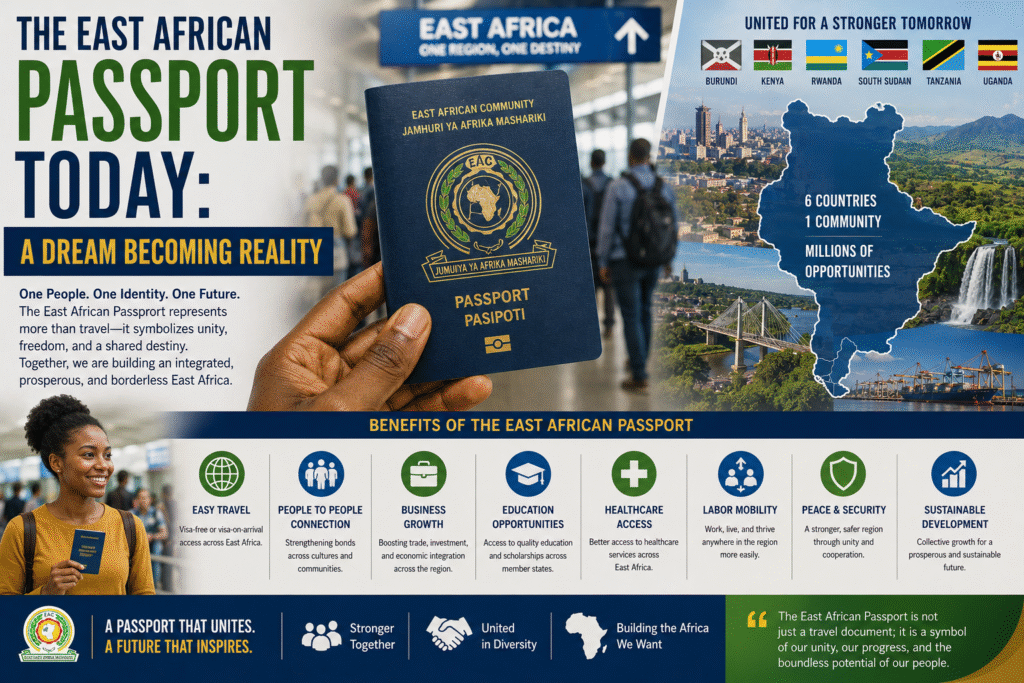
The East African Community e-Passport is a harmonized biometric travel document designed to replace the traditional national passports of EAC member states . Launched on March 2, 2016, at the 17th Ordinary Summit of the EAC, the passport was conceived as a tangible instrument of regional integration—a document that would facilitate the free movement of persons, goods, and services across the bloc’s borders .
What makes the e-Passport different from its predecessor is its embedded electronic chip containing biometric identifiers—fingerprints, facial recognition data, and other personal information . This technology is designed to reduce fraud, prevent tampering, and strengthen verification at border points. In an era of heightened security concerns, the biometric features provide both efficiency and security.
The passport comes in three categories, distinguished by color: red for diplomatic passports, green for service passports, and sky blue for ordinary passports . The colors are drawn from the EAC flag, creating a uniform visual identity that signals regional belonging rather than merely national origin.
Part 2: The Rollout — A Phased Journey Since 2017
The journey toward a common East African passport began nearly a decade ago. Kenya led the rollout, beginning issuance in September 2017 . Tanzania followed in January 2018, Burundi in May 2018, Uganda in December 2018, and Rwanda in July 2019 .
The original target was ambitious: full implementation across all member states within a few years. But as with many integration projects, delays were inevitable. Technical challenges, varying levels of immigration infrastructure, and differing national priorities slowed the process.
Somalia’s formal adoption of the e-passport system in February 2026 represents a significant acceleration of the project. With Somalia onboard, six of the eight EAC member states are now actively issuing or preparing to issue the regional passport. South Sudan and the Democratic Republic of the Congo remain in earlier stages of implementation .
Part 3: Somalia’s Historic Entry — A Milestone for the Sixth Member State
The most significant development of the past three months has been Somalia’s authorization to adopt and print the EAC e-Passport. On February 16, 2026, Somalia’s Ambassador to Tanzania and Permanent Representative to the EAC, Ilyaas Ali Hassan, formally handed over the official decision to Somalia’s Minister of Internal Security, General Abdullahi Sheikh Ismail “Fartaag,” and the Director General of the Immigration and Citizenship Agency, Mustafa Sheikh Ahmed Dhuxulow .
The authorization was granted during a ceremony in Dar es Salaam, following the signing of a bilateral migration cooperation memorandum of understanding between Somalia and Tanzania . The decision authorizes the Federal Government of Somalia to formally begin issuing the East African Community passport, effective from December 2025 .
For Somalia, this represents a significant diplomatic achievement. The country had only become the eighth member of the EAC on March 4, 2024, after depositing its instrument of ratification . In less than two years, Somalia has moved from accession to active participation in one of the bloc’s flagship integration projects.
Part 4: The Official Launch — Prime Minister Barre’s Announcement
On February 19, 2026, Prime Minister Hamza Abdi Barre announced the official launch of EAC passport issuance in Somalia. In a detailed statement, the Prime Minister described the move as one that “opens the door to the region and the wider world” .
“Joining the East African Community is a symbol of Somalia’s recovery and its active role in the region,” Barre said, adding that the new passport will facilitate the movement of people and create shared economic and social opportunities across member states .
The Prime Minister noted that the new passport will be issued to a broad cross-section of society, including citizens, students, businesspeople, and public servants . The rollout follows Somalia’s formal accession to the EAC and represents a tangible benefit of membership that ordinary citizens can see and use.
Part 5: Technical Challenges — Uganda’s Data Gap
Despite the momentum, the rollout of the EAC e-Passport has not been without technical difficulties. In Uganda, which began issuing the e-Passport in December 2018, a significant issue emerged in April 2026. According to Uganda Radio Network, the newly issued EAC e-passports lacked vital bio-data for the holders .
The passports contain a chip that should ideally carry the holder’s names, date of birth, village of origin, fingerprints, picture, height, and contacts. However, the 19,000 passports issued so far contained only a picture and scanty information on the first page . The chip, while present, had only been installed with facial recognition biometric features.
Internal Affairs Ministry Spokesperson Jacob Siminyu explained that the remaining data will be added when it is received from the National Identification and Registration Authority (NIRA). “When we get the data from NIRA we will add it onto what we have. For those who have already received by the time we renew their passports, we shall have that data,” Siminyu told URN .
Despite this data gap, the passports have been cleared by several embassies and states, including Denmark, which had refused to grant visas to some holders two weeks prior. Marcelino Bwesigye, the acting Director of Citizenship and Immigration Directorate, said the issue was never with the quality of the passport but rather with the systems of different states .
Part 6: Technical Specifications — Biometrics and Security Features
The EAC e-Passport is built on modern security architecture. The embedded electronic chip is designed to store multiple biometric identifiers, including facial recognition data, fingerprints, and other personal information . This multi-factor authentication makes the passport significantly more secure than traditional machine-readable passports.
For Somalia, the adoption of the e-Passport aligns with broader reforms to its identity and travel-document systems. Somali media reports in late 2025 cited immigration officials saying the country plans to introduce a new passport in 2026 as part of a wider modernization drive . The EAC passport complements—rather than replaces—Somalia’s national passport, providing an additional travel document recognized across the region .
The next phase for Somalia will focus on technical and administrative readiness, including upgrading immigration systems, establishing secure passport production processes, and coordinating mutual recognition protocols with partner states .
Part 7: Bilateral Foundations — The Somalia-Tanzania Migration Agreement
Somalia’s entry into the EAC passport system was preceded by a significant bilateral agreement with Tanzania. On February 16, 2026, the two countries signed a migration cooperation memorandum of understanding .
The agreement provides visa exemptions for diplomatic passport holders, faster processing timelines for ordinary visas, and structured collaboration between immigration authorities . It also introduces visa-on-arrival arrangements for holders of diplomatic and service passports and simplifies entry procedures for ordinary travellers under agreed conditions .
This bilateral framework demonstrates how integration proceeds not only through bloc-wide agreements but also through direct cooperation between member states. The Somalia-Tanzania agreement paves the way for smoother implementation of the EAC passport between the two countries.
Part 8: The Somali Passport’s Rising Global Standing
The introduction of the EAC passport coincides with notable improvements in the Somali national passport’s global standing. According to figures cited by Prime Minister Barre, Somalia moved from 111th place in global passport rankings in 2021 to 96th position today—a 15-place rise .
Somali citizens can now travel to nearly 40 countries either visa-free or with visa-on-arrival arrangements . The Prime Minister expressed hope that broader access will follow for ordinary passport holders as regional cooperation deepens, noting that several countries already grant visa-free access to Somali diplomatic passport holders .
The Prime Minister emphasized that “Somalia is not joining the global community empty-handed,” framing the move as part of a broader effort to position the country as a competitive and connected regional actor .
Part 9: Benefits for Citizens — What the EAC Passport Means for Ordinary People
For the average East African, the EAC passport represents concrete improvements in daily life. Students can travel to universities in neighboring countries without lengthy visa applications. Businesspeople can cross borders for trade and investment with minimal friction. Professionals can seek employment anywhere in the bloc under the EAC Common Market framework.
Prime Minister Barre emphasized these benefits directly, describing the development as a direct benefit to students, businesspeople, and ordinary travelers . The passport facilitates not only tourism but also trade, education, and family connections across borders.
For Somalia specifically, the EAC passport provides a pathway to greater regional engagement after decades of isolation. As Barre put it: “Joining the East African Community is a symbol of Somalia’s recovery and its active role in the region” .
Part 10: Implementation Status by Country
The current implementation status across EAC member states varies significantly.
- Kenya: Began issuing EAC e-passports in September 2017
- Tanzania: Began issuance in January 2018
- Burundi: Began issuance in May 2018
- Uganda: Began issuance in December 2018; currently experiencing data integration challenges
- Rwanda: Began issuance in July 2019
- Somalia: Authorized in February 2026; issuance effective from December 2025
- South Sudan: Still implementing the system
- Democratic Republic of the Congo: Still implementing the system
The disparity in implementation reflects the varying technical capacities and political priorities of member states. However, Somalia’s entry—just two years after joining the bloc—demonstrates accelerating momentum.
Part 11: Concerns and Criticisms — The National Identity Debate
The introduction of the EAC passport has not been without criticism, particularly in Somalia. Some citizens have expressed concern that the EAC passport should not be misconstrued as a replacement for the Somali National Passport, which must remain the primary travel document for Somali citizens .
Critics argue that the Somali passport currently faces significant international travel restrictions, and the government should prioritize strengthening its global standing so that Somali citizens can travel with greater freedom and dignity. “The introduction of an East African passport should therefore not serve as a shortcut that diminishes the importance, sovereignty, and national pride associated with carrying a Somali National Passport,” one analysis noted .
This tension—between regional integration and national sovereignty—is not unique to Somalia. Every member state must balance the benefits of free movement with the symbolic and practical importance of national travel documents.
Part 12: The Future — Toward a Single East African Travel Space
Looking ahead, the EAC passport is expected to evolve further. The next phase will focus on deepening mutual recognition between member states, ensuring that immigration systems are fully interoperable, and expanding the number of countries outside the region that recognize the EAC passport for visa-free or visa-on-arrival travel.
For Somalia, the roadmap is clear: complete technical preparations, establish secure printing processes, and coordinate recognition procedures with partner states . The country has already made significant progress, with officials stating that the passport printing process began in December 2025 .
The EAC frames harmonized travel documents as central to its integration agenda, aimed at facilitating lawful cross-border movement for work, trade, study, and family travel . As more member states fully implement the system and technical challenges are resolved, the dream of seamless East African travel inches closer to reality.
Conclusion: A Symbol of Integration in Progress
The East African passport today is both a symbol and a tool. It symbolizes the aspirations of millions of East Africans who envision a region without internal borders—where a citizen of Somalia can study in Kenya, work in Tanzania, or retire in Uganda as easily as they might move within their own country. It is also a practical tool, providing biometric security, harmonized standards, and—increasingly—recognized access across the bloc.
Somalia’s entry into the EAC passport system marks a historic milestone. Just two years after joining the community, the country has positioned itself alongside early adopters like Kenya and Rwanda, demonstrating that integration can proceed rapidly even for nations emerging from decades of instability.
The challenges remain real. Uganda’s data integration issues highlight the technical hurdles still facing some member states. Concerns about national sovereignty and passport hierarchies persist. But the direction is clear: East Africa is moving toward a single travel space, one passport at a time. For the 300 million citizens of the EAC, that journey promises greater freedom, opportunity, and connection across the region they call home.
