

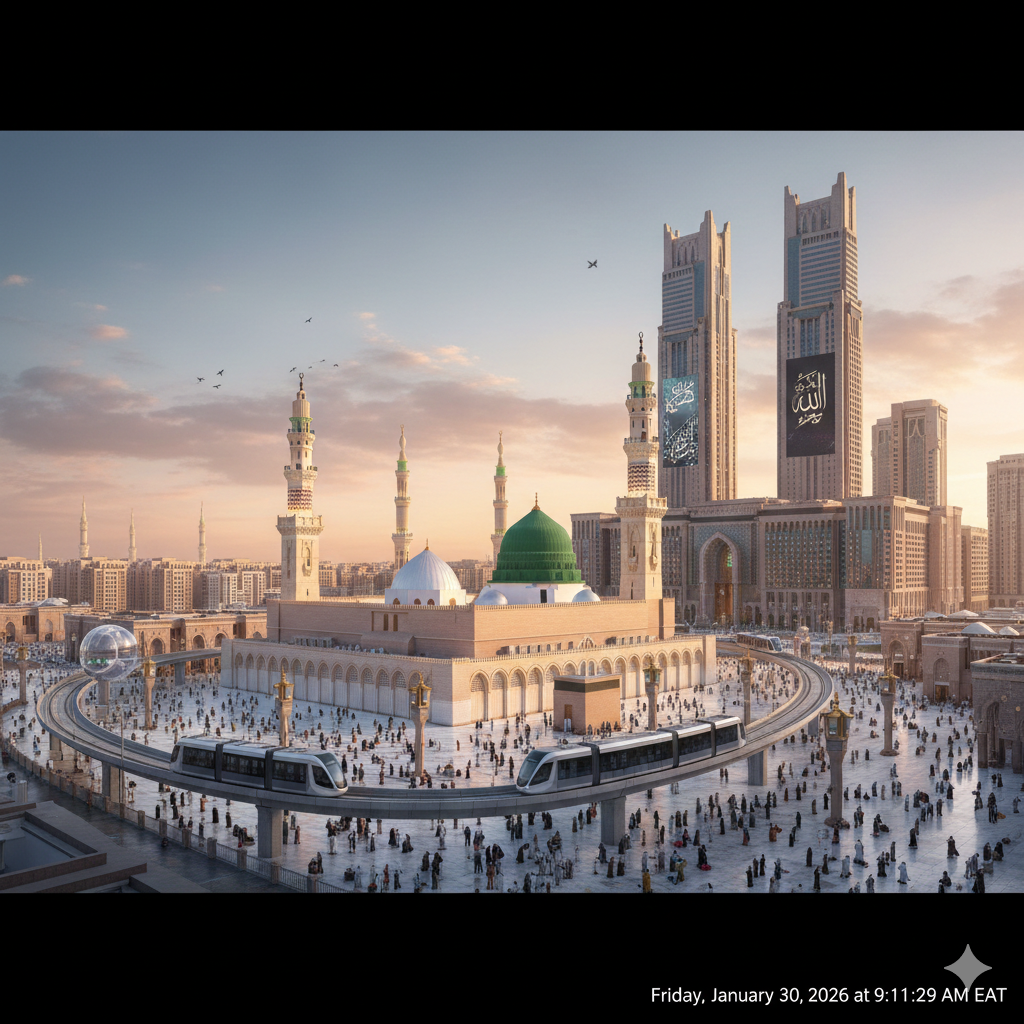
Madinah, the radiant city (Al-Madinah Al-Munawwarah), exists in a unique realm between profound historical sanctity and ambitious contemporary development. Unlike the intense, global vortex of Makkah, Madinah offers a different spiritual texture: one of peace, reflection, and deep connection to the formative history of Islam. Today, the city that gave refuge to the Prophet Muhammad (PBUH) and birthed the first Muslim community is navigating its own transformation. It strives to accommodate millions of visitors while preserving its distinct character of serenity, expanding its physical infrastructure without overshadowing the luminous spiritual legacy that defines its every corner.
The Heart of the City: The Prophet’s Sanctuary
The focal point of Madinah, and the destination of every pilgrim and visitor, is Al-Masjid an-Nabawi (the Prophet’s Mosque). Its iconic green dome marks the resting place of the Prophet Muhammad (PBUH), a site of unparalleled reverence and emotional resonance for Muslims. The mosque’s expansion over centuries, most recently in a massive project under the late King Abdullah, has been executed with a distinct philosophy compared to Makkah’s Grand Mosque.
The expansion of An-Nabawi has prioritized grace, spatial harmony, and integrated historical preservation. The famous Riwaq (arcades) and the original Ottoman qibla wall have been meticulously maintained. The new courtyards and prayer halls, capable of holding over one million worshippers, are designed with retractable umbrellas and advanced cooling systems that maintain an atmosphere of calm. The experience here is less about navigating overwhelming crowds and more about finding a quiet spot for prayer, contemplation (dhikr), or simply sitting in the blessed vicinity (Rawdah) between the Prophet’s minbar and his chamber—a space believed to be a garden from the gardens of Paradise.
The mosque’s role extends beyond ritual. It remains, as it was in the 7th century, a living community center and a global university. Circles of scholars still teach in its courtyards, and the library houses priceless Islamic manuscripts. The mosque’s architecture, with its vast, open plazas and softly lit colonnades, actively cultivates the city’s defining aura of tranquility (sakinah).
Urban Transformation: Development with a Delicate Touch
Madinah’s urban landscape is undergoing significant change, guided by the Madinah Knowledge Economic City (KEC) initiative and broader Vision 2030 goals. However, the approach is noticeably more subdued and integrated than the towering verticality seen in Makkah.
- Preserving the Historic Core: A cornerstone of modern policy is the strict preservation of the Haram Area and the historic sites within the city’s original boundaries. Unlike Makkah, skyscrapers are kept at a respectful distance from the Prophet’s Mosque. The skyline is carefully managed to ensure the green dome and minarets remain the unchallenged visual and spiritual focal point. This reflects a deep understanding that Madinah’s value lies in its historical integrity and its connection to the Seerah (the Prophet’s biography).
- The Knowledge Economic City: Located to the north of the Haram, this mega-project embodies the forward-looking vision for Madinah. It is conceived not just as a hospitality zone but as a hub for Islamic knowledge, research, and technology. It aims to host universities, research centers focused on Islamic studies and medicine, and Halal industry complexes. The goal is to transition Madinah’s economy from solely pilgrimage-based to one driven by knowledge and innovation, leveraging its status as Islam’s second-holiest city to become a center for intellectual and cultural revival.
- Logistics of Mercy: To manage the influx of visitors—which includes not only pilgrims performing Hajj and Umrah but also millions who come solely to visit the Prophet’s Mosque—the city has developed a sophisticated infrastructure. The Prince Mohammad bin Abdulaziz International Airport has been extensively expanded. A network of tunnels, automated trains, and shaded pedestrian walkways efficiently moves people between hotels, the Haram, and key sites while minimizing disruption to the city’s residential life.
The Living Tapestry: Sites of the Seerah
For the spiritually minded visitor, Madinah is an open-air museum of the Seerah. The city encourages “Ziyarah” (visitation) to these historic sites, which are meticulously maintained and equipped with multi-lingual educational resources.
- Quba Mosque: The first mosque in Islamic history, where the Prophet (PBUH) laid its first stones, remains a vibrant site of prayer.
- Mount Uhud: The site of the pivotal Battle of Uhud, now a protected national park, offers a poignant place for reflection on sacrifice and steadfastness.
- The Seven Mosques (Al-Masajid As-Sab’ah): A cluster of small mosques marking key locations from the Battle of the Trench, providing a tangible connection to the Prophet’s strategic leadership.
- The Old Date Groves (Qaswa’s Path): Efforts are made to preserve the agricultural heritage of the oasis city, with parks and palm groves offering green respite.
These sites are integrated into the urban fabric, surrounded by respectful landscaping and clear signage, allowing history to breathe within the modern city. This focus on the Seerah transforms a visit to Madinah from a purely ritual act into an educational and deeply emotional journey through the foundational moments of Islam.
The Community of the City: Hosts and Guardians
Life for Madinah’s residents is uniquely shaped by their role as custodians of the Prophet’s city. The term “Ansar” (the Helpers), originally describing Madinah’s first inhabitants who aided the Prophet and the emigrants from Makkah, still carries cultural weight. There is a palpable sense of pride and responsibility among locals in welcoming visitors and maintaining the city’s renowned peacefulness.
The economy, while still heavily geared towards hospitality, service, and religious tourism, is being gently nudged towards the knowledge sector. The presence of Taibah University and other Islamic institutions fosters a scholarly atmosphere. The seasonal rhythms of Hajj and Umrah dictate the city’s pace, but there is a stronger sense of a stable, year-round community compared to Makkah, with families and a growing middle class.
Challenges and Balance: Serenity at Scale
The primary challenge for Madinah today mirrors that of Makkah but with a different emphasis: how to scale accessibility while protecting the intangible quality of peace. The city’s leadership is acutely aware that its spiritual brand is “tranquility.” Over-commercialization, excessive noise, or chaotic overcrowding would fundamentally damage its essence.
Initiatives therefore focus on crowd management through technology—smart apps guiding visitation times to historical sites, optimized transportation to prevent congestion—and on strict urban planning regulations that forbid loud commercial activities near the Haram. The emphasis is on creating a seamless, respectful visitor experience that prioritizes spiritual reflection over consumerism.
