

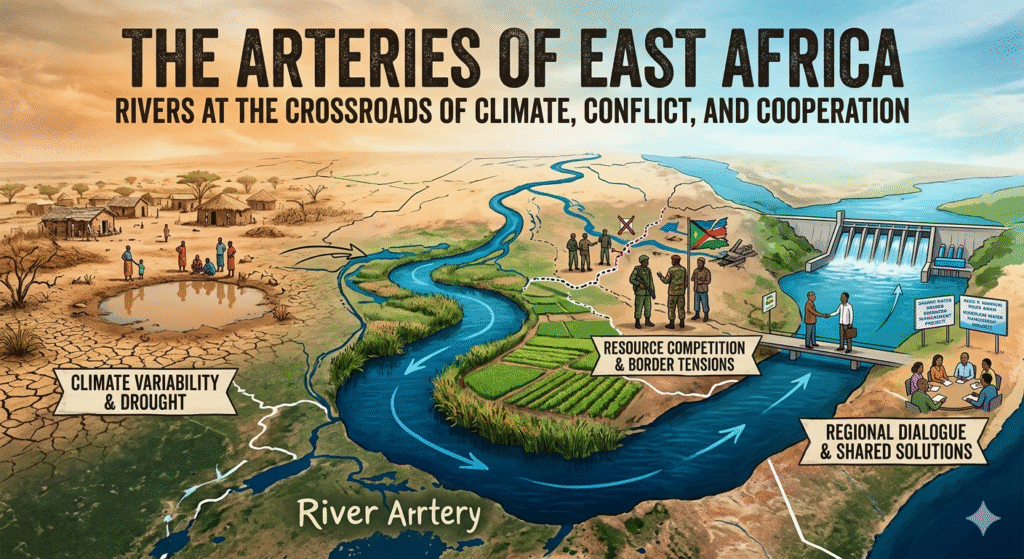
From the mist-shrouded forests of Mount Kilimanjaro to the vast expanse of Lake Victoria, the river systems of East Africa are the lifelines of the region. They nourish millions, power economies, and sustain ecosystems that have flourished for millennia. Yet today, these arteries are under siege. Climate change, political tensions, and competing demands for water are pushing the region’s rivers to a breaking point.
As new initiatives launch to strengthen transboundary cooperation and as long-simmering disputes escalate into international legal battles, the state of East Africa’s rivers has never been more precarious—or more critical to the future of 200 million people.
Part 1: The CREATES Initiative – A New Era of Cooperation
In a significant development announced in January 2026, the International Union for Conservation of Nature (IUCN) and the United Nations Environment Programme (UNEP), with support from Denmark, launched the Climate Resilient Eastern African Transboundary Water Management for Environmental Sustainability (CREATES) programme .
This multi-year initiative is designed to assist the governments of Kenya, Tanzania, and Uganda in improving transboundary water management, supporting water security, climate resilience, regional cooperation, and sustainable development. The programme forms part of Denmark’s contribution to the EU Team Europe Initiative on Transboundary Water Management .
Initially, CREATES will focus on two priority transboundary river basins: the Mara Basin, shared by Kenya and Tanzania, and the Sio-Malaba-Malakisi Basin, shared by Kenya and Uganda . Both basins face growing pressures from climate variability, rising water demand, and inadequate transboundary governance arrangements, while offering strong opportunities for cooperation and improved joint management .
The programme is implemented through a close partnership between IUCN, leading work on river basin governance and stakeholder coordination, and the UNEP-DHI centre, leading on technical components such as decision-support systems, data management, and capacity development. A joint Programme Management Unit based in Nairobi will coordinate delivery across the five-year project timeline (2025-2030) .
As Dr. Callist Tindimugaya, Commissioner of Uganda’s Ministry of Water and Environment, stated: “As one of the main beneficiaries of CREATES, the programme will be instrumental in helping us improve our transboundary water management, building resilience to climate change and ensuring tangible benefits to local communities” .
Part 2: The Nile River – A Geopolitical Powder Keg
At the heart of East Africa’s water challenges is the Nile River, the world’s longest river and a source of tension that has persisted for decades. The recent completion and inauguration of Ethiopia’s Grand Ethiopian Renaissance Dam (GERD) in late 2025 has brought long-simmering disputes to a boiling point .
The GERD, Africa’s largest hydropower project, is built on the Blue Nile—one of the Nile’s two major tributaries. For Ethiopia, the dam represents national pride, economic development, and an escape from energy poverty. For Egypt, which relies on the Nile for over 95 percent of its freshwater, it represents an existential threat .
The roots of this conflict lie in colonial-era agreements. In the early 20th century, Britain—then the colonial power in Egypt and Sudan—negotiated treaties that effectively granted Egypt a veto over upstream Nile projects. Ethiopia, which was never colonized, was not party to these agreements and has long argued that they are relics of a bygone era that violate modern international water law principles of “equitable and reasonable utilization” .
In January 2026, former U.S. President Donald Trump offered to mediate the dispute, sending a letter to Egyptian President Abdel Fattah El-Sisi expressing Washington’s willingness to restart negotiations. Egypt welcomed the intervention; Ethiopia responded cautiously, viewing the overture as a potential infringement on its sovereignty .
The GERD has already begun reshaping regional power dynamics. Ethiopia is positioning itself as East Africa’s energy hub, and as neighboring countries begin to rely on its cheap electricity, that energy trade could translate into significant political influence. Egypt, meanwhile, has warned that it will take “all possible measures” to protect its water security .
Part 3: Lake Victoria – The Legal Battle
While the Nile grabs international headlines, a different kind of water war is playing out on the shores of Lake Victoria, Africa’s largest lake and the source of the White Nile.
On June 7, 2026, five Kenyans filed a lawsuit against the Ugandan government, alleging that Kampala’s management of water releases from Lake Victoria had caused catastrophic flooding that displaced approximately 50,000 residents along the lake’s shores .
The lawsuit, backed by the Lake Victoria Basin Commission, accuses Uganda of breaching the East African Community Treaty and the Nile Basin Comprehensive Framework Agreement. The plaintiffs specifically target Eskom Uganda Ltd, the operator of the Owen Falls Dam (also known as Nalubaale Dam), which controls the flow of water from Lake Victoria into the Nile River .
The applicants claim that Eskom increases or reduces water releases “based on how much is needed to meet Uganda’s electricity demand” rather than following protocols designed to prevent downstream flooding . They also invoke agreements signed between Uganda and Egypt in 1954, which committed Uganda not to interfere with the Nile’s flow—agreements that predate the independence of most East African nations.
The Kenyan and Tanzanian governments have been named as interested parties in the case, underscoring how water management decisions in one country can have devastating consequences for neighbors downstream.
Part 4: Lake Victoria’s Volatile Water Levels
The legal dispute comes against a backdrop of dramatic fluctuations in Lake Victoria’s water levels. In May 2020, the lake reached its highest level in 50 years—13.48 meters—after excessive rainfall filled the 23 rivers that flow into it, including the Kagera, Nzoia, and Yala .
That flooding submerged homes, shops, and critical infrastructure along the shoreline across Kenya, Uganda, and Tanzania. For the approximately 40 million people who depend on the lake for food, business, and transport, the rising waters were both a blessing and a curse .
By June 2026, water levels had receded to 13.29 meters—a drop of nearly 20 centimeters from the peak. However, the Ugandan Ministry of Water and Environment reported that the reduction has “not had much impact because the lake shores and surrounding areas remain submerged” .
In response, the ministry instructed Eskom to continue releasing 2,400 cubic meters per second from Lake Victoria into the Nile at the Owen Falls Dam—a rate designed to limit flooding downstream at Lake Kyoga and Lake Albert. Eskom can release a maximum of 3,000 cubic meters per second .
The long-term trend remains concerning. In the past 100 years, Lake Victoria has maintained an average water level of 12 meters. The lowest recorded level was 10.35 meters in 1923, followed by 10.53 meters in 2005-2006. The highest—13.48 meters—was recorded in 2020, surpassing the previous record of 13.41 meters set in 1964 . Whether these extremes represent a “new normal” driven by climate change remains an urgent question for regional scientists and policymakers.
Part 5: Mount Kilimanjaro – The Source of the Pangani
Water insecurity in East Africa is not limited to the Nile Basin. Mount Kilimanjaro, Africa’s highest peak, serves as a vital water tower for the surrounding region, feeding the Pangani River—one of Tanzania’s largest rivers—which provides water for food, fuel, and building materials to millions .
But Kilimanjaro’s forests are disappearing. A UN Environment Programme (UNEP) report released in June 2026, titled Sustainable Mountain Development in East Africa in a Changing Climate, warns that climate change has already destroyed 13,000 hectares of the mountain’s forests since 1976—equivalent to cutting off a year’s supply of drinking water for one million people .
Higher temperatures have increased wildfires on the mountain and accelerated forest destruction. With fewer trees to trap water from clouds, the annual amount of dew on the mountain has fallen by an estimated 25 percent. The consequences are already visible: the town of Moshi, located in Kilimanjaro’s foothills, is experiencing severe water shortages as rivers begin to dry up, starving farmland of water in an area already struggling with dramatically reduced rainfall .
UNEP urges Tanzania to reforest Kilimanjaro’s water catchment area, invest in early warning systems, and make climate adaptation a top priority. Beyond water security, protecting the mountain’s ecosystems is also essential to safeguarding East Africa’s tourism industry, which is worth an estimated $7 billion .
The glaciers of Kilimanjaro—and those on Mount Kenya and the Rwenzori Mountains—are also disappearing. Since the 1990s, the surface area of glaciers in the region has decreased by 80 percent. The Intergovernmental Panel on Climate Change (IPCC) projects that East Africa can expect an average temperature increase of 3.2 degrees Celsius by 2080, all but guaranteeing the complete loss of these ancient ice fields within a few decades .
Part 6: Hidden Hydropower Potential
Despite the challenges, East Africa’s rivers hold immense untapped potential. The same report notes that rivers in the Nile Basin could generate 20 gigawatts of electricity. The Mau Forest—Kenya’s largest water tower—could generate a further 508 megawatts, enough to meet half of Kenya’s current capacity .
The tension here is obvious: damming rivers for hydropower can exacerbate downstream water shortages and disrupt ecosystems. Yet without electricity, East Africa cannot industrialize, create jobs, or lift its people out of poverty. The challenge for the region’s leaders is finding a balance between development and sustainability—and doing so cooperatively rather than unilaterally.
Part 7: Chinese-Built Irrigation in Tanzania – A Model for Adaptation
One promising example of sustainable water management comes from Tanzania’s Iringa Region, where a Chinese-built irrigation scheme is transforming agricultural productivity. The Mkombozi Irrigation Project, constructed by China Railway Jianchang Engineering Company (CRJE), involves approximately 78 kilometers of irrigation canals and 85 kilometers of rural roads, ultimately serving more than 8,000 hectares of farmland .
The results have been dramatic. Farmer Mashauri Julius, who for years relied on unpredictable rains, now watches water flow steadily onto his land through the newly built irrigation channel. “Before, if you harvested 10 to 15 bags of paddy per acre, it was considered good,” he told Xinhua. “Now we are reaching 30 bags, and we expect even more” .
Even before full completion, more than 70 percent of the system is operational. Once finished, the project—backed by approximately $14 million in government funding—is expected to benefit tens of thousands of farmers across multiple villages. Improved roads have enhanced connectivity, while irrigation has attracted investment in rice processing and related industries. Youth employment has also risen, with hundreds finding work in construction and farming activities .
The project serves as a model for how infrastructure development, when properly designed and implemented, can enhance water security rather than deplete it.
Part 8: The Transboundary Imperative
The common thread running through all these stories is that East Africa’s rivers do not respect national borders. The Nile flows through 11 countries. Lake Victoria touches three. The Mara River sustains the great wildebeest migration across Kenya and Tanzania. The Sio-Malaba-Malakisi Basin weaves through Uganda and Kenya.
The CREATES programme represents a recognition that no single country can manage its water resources alone. As the programme’s designers note, both the Mara and Sio-Malaba-Malakisi basins face “growing pressures from climate variability, rising water demand and inadequate transboundary governance arrangements” . Strengthening institutions, improving data-sharing, and applying nature-based solutions at the community level are essential components of any lasting solution .
Denmark’s investment in the programme, as part of the EU Team Europe Initiative on Transboundary Water Management, reflects growing international recognition that water security is not just an environmental issue—it is a matter of regional stability and human security .
Part 9: The Impact on Communities
Behind the headlines about legal battles and international negotiations are real people whose lives depend on these rivers. The flooding along Lake Victoria did not just displace 50,000 people—it destroyed homes, washed away crops, and shattered livelihoods. The water shortages in Moshi are not abstract statistics—they mean mothers walking miles to collect water, farmers watching their fields turn to dust, and children missing school because they are sick from contaminated sources.
The CREATES programme is designed with these communities in mind. By improving transboundary water management, the initiative aims to generate “tangible benefits to local communities” . That means more reliable water supplies, better flood control, healthier ecosystems, and greater resilience to the climate shocks that are becoming more frequent and severe.
Part 10: Climate Change – The Unrelenting Driver
All of these challenges are exacerbated by climate change. The IPCC projects an average temperature increase of 3.2 degrees Celsius in East Africa by 2080—a dramatic shift that will fundamentally alter the region’s hydrology .
Higher temperatures increase evaporation from lakes and reservoirs, reducing water availability. They intensify droughts in some areas and extreme rainfall in others. They fuel wildfires that destroy forest cover, reducing the ability of mountains to capture and store water. They melt glaciers that have served as natural reservoirs for millennia.
The 80 percent reduction in East African glacier surface area since the 1990s is not just a symbolic loss—it is a practical one. These glaciers once released water slowly throughout the dry season, sustaining rivers even when rains failed. Their disappearance will make East Africa’s rivers more volatile, with more severe floods and more severe droughts .
Part 11: The Economic Stakes
The economic stakes of East Africa’s water crisis could not be higher. The region’s tourism industry, worth $7 billion annually, depends on healthy ecosystems—including the rivers that sustain wildlife and the forests that draw visitors . Agriculture, which employs the majority of East Africans, depends entirely on reliable water. Hydropower, which could transform the region’s energy landscape, depends on rivers flowing at predictable volumes.
The Chinese-built irrigation project in Tanzania demonstrates what is possible: higher yields, more jobs, greater food security. But scaling such projects across the region will require massive investment and, crucially, cross-border cooperation. No single country can build its way out of a regional water crisis.
Part 12: The Path Forward
As East Africa looks toward the rest of 2026 and beyond, several priorities emerge:
Strengthen Regional Cooperation: The CREATES programme is a step in the right direction, but it covers only two basins. The Nile requires a comprehensive, legally binding agreement that balances the needs of upstream and downstream countries. The East African Community and the Nile Basin Initiative must be empowered to mediate disputes before they escalate into lawsuits or worse.
Invest in Data and Early Warning: The flooding of Lake Victoria might have been less devastating if communities had received adequate warning. Better hydrological data, shared across borders, could save lives and livelihoods.
Protect Water Towers: The forests of Mount Kilimanjaro, the Mau Forest, and the Rwenzori Mountains are not just scenic backdrops—they are critical infrastructure. Reforesting these areas must become a regional priority.
Scale Up Sustainable Irrigation: The Mkombozi project in Tanzania shows that irrigation can dramatically increase agricultural productivity. Replicating this model across the region could boost food security and reduce pressure on overstretched rivers.
Address the Nile Dispute: The GERD is not going away. Egypt, Ethiopia, and Sudan must reach a binding agreement on dam operations before the next drought turns a political dispute into a humanitarian catastrophe.
Conclusion
East Africa’s rivers are the region’s most precious resource—and its most vulnerable. From the legal battles over Lake Victoria to the geopolitical tensions on the Nile, from the disappearing glaciers of Kilimanjaro to the swelling population depending on every drop, the challenges are immense.
But there is cause for hope. The CREATES programme demonstrates that regional cooperation is possible. The irrigation project in Tanzania shows that sustainable development can work. The growing recognition of climate risks is driving investment in adaptation.
The question is whether these efforts can scale up fast enough. The rivers of East Africa have sustained civilizations for thousands of years. Whether they will continue to do so depends on the choices made today—by governments, by international partners, and by the millions of people who depend on these waters for their survival.
