

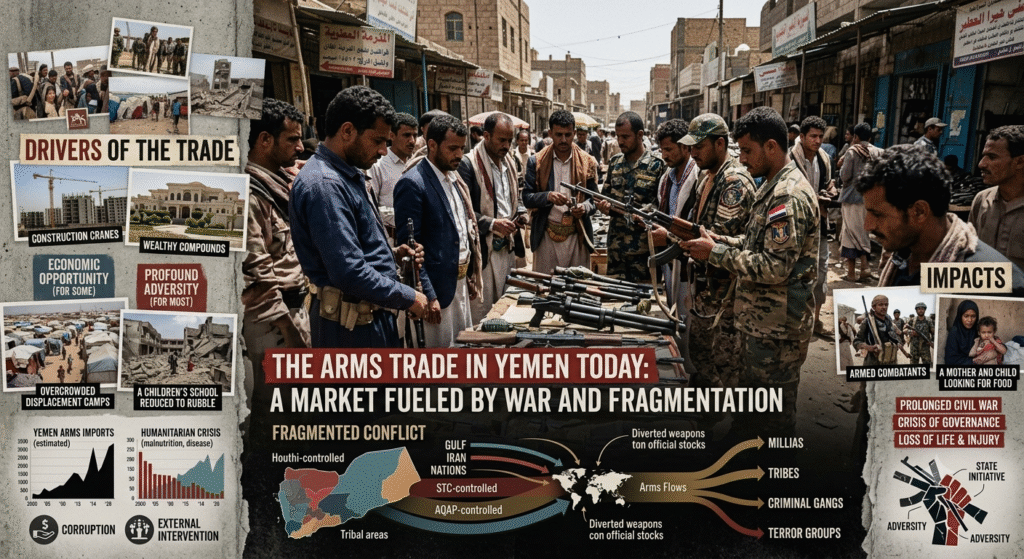
The arms trade is the engine that keeps Yemen’s conflict running, and recent developments suggest this engine is firing on all cylinders despite ongoing diplomatic efforts. As we enter the latter half of 2026, the weapons flowing into the country are not only sustaining the conflict but are changing its nature, introducing more advanced and lethal technology to the battlefield.
The Fragmented Market
Yemen’s arms market is highly fragmented, reflecting the country’s political divisions. The Internationally Recognized Government (IRG) , based in Aden, continues to rely heavily on a coalition led by Saudi Arabia and the United Arab Emirates for advanced weaponry. This flow of arms is intended to bolster the IRG’s position in the fight against the Houthi movement. However, this support comes with significant operational constraints and is often influenced by the donors’ own strategic goals in the region.
Simultaneously, the Houthi movement (Ansar Allah) has grown its arsenal substantially. While initially reliant on captured Yemeni army stockpiles and smuggled arms, they have increasingly received advanced weapons from Iran. This support has included ballistic missiles, cruise missiles, and a wide array of Unmanned Aerial Vehicles (UAVs). The Houthis’ ability to strike deep into Saudi Arabia and target shipping in the Red Sea is a direct result of this steady supply, transforming the group from a local insurgency into a regional military actor.
The Nature of the Trade
The arms trade in Yemen is a complex web of state-sponsored support, illicit smuggling, and the local manufacturing of weapons.
- State Sponsorship: The primary arms suppliers are Saudi Arabia and the UAE to the IRG, and Iran to the Houthis. This external sponsorship ensures both sides have the capacity to sustain a prolonged war of attrition. The recent push by the IRG to retake Hodeidah and cut off Houthi supply lines highlights the strategic importance of controlling the ports through which much of this weaponry is smuggled.
- Iranian Support: Recent intelligence indicates that the Islamic Revolutionary Guard Corps (IRGC) is expanding its role in supporting the Houthis. With the crisis in the Strait of Hormuz potentially limiting Iran’s maritime options, there are reports that Tehran is seeking to establish a more robust presence in the Red Sea and the Gulf of Aden to resupply its proxies. This support includes not only technology but also training and intelligence.
- Local Manufacturing: The Houthis have developed a significant domestic weapons industry, particularly for drones and missiles. This allows them to bypass some supply constraints and continuously adapt their technology based on battlefield experience. The “Sammad” and “Quds” series of drones, as well as the “Borkan” ballistic missiles, are products of this domestic development.
- Intra-Coalition Rivalries: The arms trade is also affected by the internal dynamics of the anti-Houthi coalition. Saudi Arabia and the UAE, while nominally allies, have distinct interests in Yemen. This can lead to a fragmentation of support for the IRG and, at times, create conditions where weapons end up in the hands of rival factions within the IRG camp. This fragmentation, as some reports indicate, has led to periods of infighting and may have created a recruitment advantage for terrorist groups.
Implications and Future Outlook
The continued flow of arms has profound implications. It perpetuates the cycle of violence, making a negotiated settlement harder to achieve as each side continues to invest in military solutions. The introduction of advanced weaponry, such as kamikaze drones, has also raised the military stakes significantly.
The international community, particularly through the UN, continues to impose an arms embargo on the Houthis, but enforcement remains a major challenge. The flow of weapons persists through a combination of Gulf waters and overland routes. The government forces, by contrast, are heavily equipped by the coalition but are often outmatched by the Houthis’ more innovative and aggressive use of asymmetric warfare.
The Future of the Trade: The arms trade in Yemen is likely to persist as long as the conflict remains unresolved. The recent cease-fire talks collapsed, leading both sides to prepare for another round of fighting, which includes a significant push for more and better weapons. For the Houthis, this means securing more advanced anti-ship missiles and drones to continue their strategic campaign against maritime shipping. For the IRG, it means requesting more advanced air defense systems from the coalition to counter the Houthi drone and missile threat. The new US administration’s policy on the region will be a crucial factor.
However, there is a critical long-term risk. The constant import of weapons, combined with the fragmented nature of the conflict, creates a dangerous proliferation risk. Weapons that are brought into the country for use in the civil war can easily be lost, stolen, or sold, further destabilizing an already fragile region.