

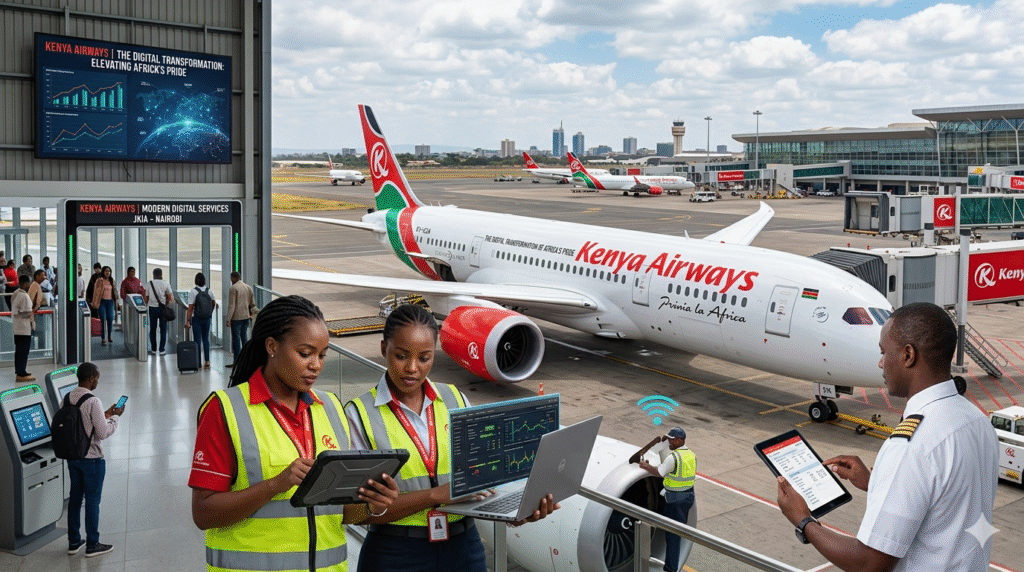
Introduction: A New Flight Path for the Digital Age
For decades, Kenya Airways has proudly carried the title “The Pride of Africa,” connecting the continent to the world through its Nairobi hub. But in 2026, that pride is increasingly defined not just by its fleet or route network, but by its technological ambition. From artificial intelligence that prices tickets in real time to green maintenance practices that could reshape Africa’s aviation landscape, the airline is undergoing a comprehensive digital transformation. This article examines the state of technology at Kenya Airways today, covering AI-driven pricing, mobile innovation, maintenance technology, talent development, and the strategic partnerships driving it all forward.
Part 1: Jupiter 5.0 – AI-Powered Pricing Takes Flight
The most significant technological development at Kenya Airways this year is the deployment of Jupiter 5.0, an artificial intelligence-driven pricing and revenue management platform launched in May 2026 . The system represents a fundamental shift in how the airline manages ticket fares across its global network.
Traditional airline pricing relies on manual analysis and delayed responses to market changes—a model ill-suited to today’s volatile environment where fuel costs, exchange rates, competitor pricing, and demand can shift dramatically within hours. Jupiter 5.0 uses advanced machine learning to analyze real-time market data and automatically adjust fares accordingly .
For travelers, this means more responsive and potentially more competitive pricing. The system can identify opportunities to discount seats quickly during periods of low demand, rewarding early or flexible booking. However, it also means prices can rise rapidly during peak periods, so timing matters more than ever .
Kenya Airways leadership has framed the rollout as part of a broader modernization strategy. The system gives the commercial team “greater speed with discipline,” enabling consistent governance over pricing decisions while reducing costly delays in fare adjustments. With the deployment, Kenya Airways joins Ethiopian Airlines and RwandAir in pioneering AI-driven pricing across the African aviation sector .
Part 2: The Digital Passenger Experience – Apps and Self-Service
While AI pricing works behind the scenes, Kenya Airways has also transformed the passenger-facing digital experience. In early 2026, the airline launched a completely revamped KQ Mobile app, designed as a “one-stop travel companion” for the modern traveler .
The new app features a completely redesigned interface that is smarter, more intuitive, and visually engaging. Key capabilities include secure flight booking, mobile check-in from anywhere, digital boarding passes that can be added to mobile wallets, real-time flight status updates, and centralized travel information . The app has been optimized for stability and performance, ensuring reliable operation even during peak usage periods .
This mobile transformation builds on earlier digital investments. In July 2024, Kenya Airways launched a revamped online booking platform estimated to reduce flight booking time by three minutes, thanks to faster page loading and a mobile-first design approach . The platform introduced a cart-centric user experience allowing customers to save searches and bookings on the go.
In September 2024, the airline added a free online self-rebooking service, allowing customers to seamlessly rebook themselves when flights are canceled or rescheduled—without waiting on hold for a contact center . This service gives passengers control to select alternative flights based on their own schedules, significantly improving the disruption management experience.
These digital investments have earned recognition. The airline has received awards including the e-commerce Leader Travel & Tourism Award (2023), Gold Winner for Best Ticketing Platform (2023 & 2024), and a nomination for the World Travel Tech Awards 2024 .
Part 3: Green Maintenance – Technology Meets Sustainability
Beyond passenger-facing technology, Kenya Airways is applying innovation to its engineering and maintenance operations. At the inaugural African MRO (Maintenance, Repair, and Overhaul) Conference in Addis Ababa in April 2026, the airline presented a case study titled “Green Maintenance: Decarbonizing the African MRO Value Chain” .
The presentation outlined a comprehensive sustainability governance framework that integrates environmental priorities directly into maintenance operations. The roadmap includes a snapshot of impacts from 2025 and a 2026 flight path focused on scaling physical infrastructure, advancing digital maintenance tools, and achieving technical operational mastery .
George Kamal, Acting CEO of Kenya Airways, framed the shift as essential for competitiveness: “Currently, a large share of aircraft maintenance for African airlines is conducted outside the continent, a trend that drives annual capital outflows, increases operating costs, and extends aircraft downtime” .
By strengthening regional capability and improving supply chain resilience, Kenya Airways’ MRO division aims to demonstrate that sustainable practices are an essential part of the modern operating model required to keep African aviation competitive.
Operating from its Nairobi base, Kenya Airways Engineering & Maintenance is an approved EASA Part-145 and KCAA-certified organization, and remains the only Embraer Authorized Service Centre in the region. Its technical services include heavy airframe checks, avionics and mechanical component repair, and non-destructive testing .
Part 4: Building the Digital Workforce – The AICAD Partnership
Technology is only as effective as the people who deploy it. Recognizing this, Kenya Airways signed a strategic Memorandum of Understanding with the Africa Institute for Capacity Development (AICAD) in February 2026 to advance digital skills and AI-driven innovation .
The agreement was signed by Kenya Airways’ Ag. Managing Director and CEO, Capt. George Kamal, and AICAD’s Executive Director, Prof. James Njiru, with Kenya Airways’ Chief Information and Data Officer, Fred Kitunga, also present .
The collaboration focuses on several key areas central to modern enterprise transformation: software engineering, data and analytics, cybersecurity, and artificial intelligence. Through the partnership, AICAD will support Kenya Airways in strengthening its internal processes using AI-driven solutions, while contributing to applied research tailored to real-world operational needs .
Crucially, the MoU goes beyond technical systems development. It creates structured opportunities for training, internships, mentorship, and hands-on industry projects, ensuring that learners gain practical exposure while contributing to live organizational challenges. For Kenya Airways, this investment in digital capability is framed as a strategic enabler of operational excellence and competitiveness .
Part 5: Data-Driven Decision Making – The Role of Analytics
Behind both Jupiter 5.0 and the digital passenger experience lies a foundational commitment to data and analytics. The appointment of Fred Kitunga as Chief Information and Data Officer signals the airline’s recognition that data is not merely an IT concern but a strategic asset .
The AI pricing platform consolidates market monitoring, scenario simulation, and pricing execution into a single automated workflow, replacing slower legacy systems. This integration allows the airline to reduce revenue loss from static fare structures and improve load factor optimization—the percentage of seats filled on each flight .
Julius Thairu, Chief Commercial and Customer Officer, articulated this philosophy: “By integrating technologically advanced solutions, we can serve our digitally inclined customers more efficiently, accelerating the shift towards online bookings, making our services more accessible to people worldwide” .
Part 6: The Strategic Context – Competing in a Global Market
Kenya Airways’ technology investments do not exist in a vacuum. The airline serves more than 50 destinations across approximately 40 countries, connecting Africa to Europe, the Middle East, Asia, and the Americas, including long-haul routes such as Nairobi to New York (JFK) and Nairobi to London Heathrow .
In this competitive landscape, technology is a critical differentiator. Dynamic pricing engines are becoming more common globally as carriers seek to capture revenue more efficiently and respond to post-pandemic travel demand. Carriers that adopt advanced pricing technologies generally seek to reduce revenue loss from static fare structures and improve operational efficiency .
Kenya’s tourism sector provides a favorable backdrop for these investments. International arrivals rose about 9 percent in 2025 to 2.7 million, with total visitors reaching nearly 7.9 million and generating approximately KSh500 billion in revenue . The government has also eased visa requirements and enhanced marketing, further boosting travel demand.
For Kenya Airways, the Jupiter 5.0 rollout is particularly timely. By enabling more competitive pricing in key markets—the United States, United Kingdom, India, Germany, France, and the Netherlands—the airline can better capture this growing demand while strengthening Kenya’s position as a tourism hub .
Conclusion: A Digital-First Future for Africa’s Pride
Kenya Airways today is a very different airline than it was five years ago. The transformation is not merely cosmetic—it is structural. Jupiter 5.0 represents a fundamental shift in how the airline manages revenue and pricing. The KQ Mobile app and self-rebooking tools give passengers unprecedented control over their journeys. The green maintenance initiative positions Nairobi as a hub for sustainable aviation technology. And the AICAD partnership ensures that the workforce has the skills to sustain this momentum.
Yet challenges remain. The rapid fare changes enabled by dynamic pricing can frustrate passengers who do not monitor fares closely. The shift to digital channels requires continuous investment in security and reliability. And the ambition to keep more African maintenance on the continent depends on building trust and capability across the region .
Nevertheless, the trajectory is clear. Kenya Airways is not merely adopting technology—it is using technology to redefine what an African airline can be. From AI-powered pricing to digital boarding passes, from green maintenance to workforce development, the airline is building a digital-first future worthy of its title: The Pride of Africa.
