

TEHRAN — June 16, 2026
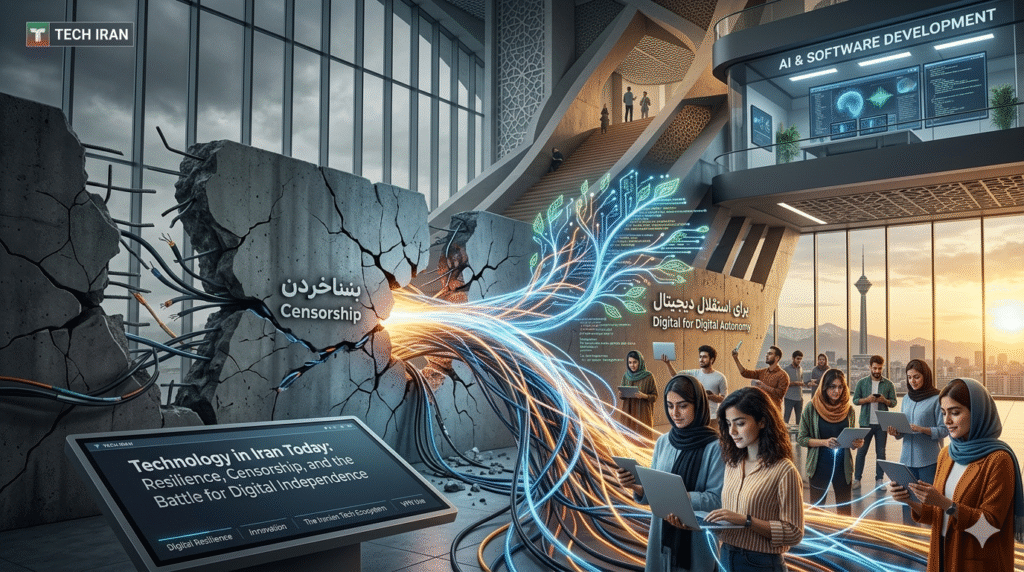
Iran’s technology sector presents a profound paradox. On one hand, it is a story of remarkable resilience—a startup ecosystem that has flourished despite crippling sanctions, a domestic manufacturing sector achieving near-total self-sufficiency, and a nation ranking among the world’s top scientific producers. On the other, it is a story of state control, pervasive censorship, and a shadow war fought in cyberspace as much as on battlefields.
From the “stealth internet blackout” that isolated millions during the recent war to the national AI platform being rebuilt after US-Israeli strikes, technology in Iran today is both a tool of state survival and a battleground for citizen rights.
Part 1: The Steel Curtain — Iran’s Digital Censorship
The most immediate technological reality for Iranians is not innovation but isolation. During the recent war with the US and Israel, Iran executed what researchers have termed a “stealth internet blackout”.
Unlike traditional shutdowns where international links are severed, this blackout preserved Iran’s global routing presence while isolating domestic users through deep packet inspection, aggressive throttling, and selective protocol blocking. Iran’s censorship apparatus operates through a multi-layered system that employs DNS poisoning, HTTP injection, TLS interception, and a strict protocol whitelist: only DNS, HTTP, and HTTPS are forwarded; all other traffic is silently dropped.
The response from citizens has been swift. During the blackout, VPN-related searches spiked by approximately 707 percent as Iranians sought workarounds. Tools like Lantern and Psiphon have become essential, though they face a constant “cat-and-mouse” battle with censors. The Iranian regime has also developed a “National Information Network” (NIN) that functions as a domestic intranet, keeping internal services operational while cutting international access.
Part 2: The Startup Paradox — Innovation Amid Seizure
Despite the restrictions, Iran’s startup ecosystem has grown into one of West Asia’s most structured innovation networks. The country is home to more than 6,000 startups across diverse sectors, with over 4,500 officially registered knowledge-based companies. Iran hosts more than 45 Science and Technology Parks, 600 Innovation and Growth Centers, and numerous innovation factories.
Tehran’s position in the Global Startup Ecosystem Index advanced by 20 spots in 2026, ranking 348 among the world’s most innovative cities. The city has approximately one startup per 100,000 people, with an annual growth rate of over 36 percent in 2025. Fintech leads Iran’s startup industry, ranking 72nd globally and 5th in the Middle East.
Flagship companies serve as evidence of the sector’s potential:
- Digikala, Iran’s answer to Amazon, was valued at $150 million by late 2014 and today serves more than 30 million users
- Snapp!, the Iranian ride-hailing platform, also serves over 30 million users
- MCI Ventures, Iran’s first mobile operator, has become a key driver of the innovation ecosystem
Yet, the story of Iranian startups is shadowed by a darker narrative of state intervention. As The Atlantic documented in a comprehensive investigation, Iran’s tech entrepreneurs built their businesses on a Silicon Valley ethos of competition and innovation. The government’s security services, however, viewed this sector as a vehicle for “Western infiltration”. Through a combination of public attacks, interrogations, arrests, and forced partnerships, the state systematically brought the industry under its control.
Part 3: Domestic Manufacturing — Oil as a Driver of Self-Sufficiency
One sector where the state’s “resistance economy” has achieved genuine success is domestic manufacturing, particularly in the oil and gas industry. The South Pars Gas Complex, Iran’s largest gas project, reported that 95 percent of required goods and equipment were sourced domestically in the first nine months of the current year.
The National Iranian Drilling Company has localized approximately 7,200 unique parts through collaboration with 400 domestic manufacturers. The commercial manager of South Pars made clear: “Supporting domestic manufacturers is a national strategy and a top priority for the complex”.
Iranian equipment exports have reached 710 million euros over the last two and a half years. More than 80 percent of equipment needed by the petroleum industry is now domestically manufactured, with only 5-6 percent of remaining needs requiring technology unavailable domestically.
The government’s “first-time contracts” mechanism—where state-owned companies must work with knowledge-based firms for technology development—has been most effectively implemented by the Oil Ministry. As the Vice President for Science and Technology noted: “The Oil Ministry has had the most outstanding performance in first-time contracts”.
Part 4: The AI Race — Rebuilding After Strikes
Iran’s artificial intelligence sector represents both ambition and vulnerability. In December 2025, Iran announced the development of its national AI platform, designed to provide AI services to researchers, industry, and government agencies.
However, the platform was damaged during US-Israeli attacks against the country. Iran is now rebuilding it with “a more resilient approach,” preserving the platform’s core while developing a strategy that “benefits from the capabilities of private sectors”.
Iran’s AI trajectory demonstrates both progress and challenges. From 2010 to 2023, the country’s share in open-source AI projects surged from nearly zero to 2,728 projects—representing 1.1 percent of total open-source AI projects and placing Iran second in the region. In high-impact open-source AI projects, Iran accounts for six percent of the total, also ranking second.
The scientific production story is more mixed. Iran’s AI ranking improved from 33 to 30 in the Nature Index, placing the country among the top 50 leaders. Yet the number of AI article submissions has decreased over the past decade, with the country now ranking fourth in the region after having been first until 2014. The decline, researchers note, is “directly affected by political and economic situations”.
Part 5: The Scientific Foundation — A Nation of Engineers
Iran’s technology ambitions rest on a deep foundation of scientific output. The country ranks among the world’s top 15 in scientific publications. Each year, thousands of engineers and scientists graduate from top Iranian universities, creating a talent pool that is among the most sophisticated in the region.
The government has invested heavily in retaining this talent through organizations like the National Elites Foundation, offering housing, grants, and research stipends. Yet “brain drain” remains a significant concern, with many top graduates leaving for Canada, Germany, or Australia in search of stable markets and global collaboration.
Part 6: International Cooperation — Finding Partners in a Sanctioned World
Despite sanctions, Iran is finding partners for technology cooperation. Vietnam is stepping up cooperation with Iran in ICT, artificial intelligence, and nanotechnology, with the Iranian Minister of Information and Communications Technology highlighting “Iran’s significant role in the Gulf region’s digital ecosystem”.
Iran has also signaled interest in technology cooperation with Russia, with the deputy oil minister stating: “Iranian specialists and companies possess expertise in many fields that can be shared with Russian counterparts, while Iranian firms also stand to benefit from Russian technologies”.
Part 7: The Digital Divide — Connectivity as a Human Right
The story of technology in Iran cannot be separated from the story of connectivity. Internet shutdowns—whether overt or stealth—have become a routine tool of state control. The “stealth blackout” of June 2025 demonstrated the sophistication of Iran’s censorship apparatus, which can now isolate citizens from the global internet without triggering the alarm bells of an official shutdown.
The research community has highlighted this as a “censorship-in-depth” model: multiple orthogonal filters working simultaneously on the same traffic, blocking everything from DNS to TLS to VPN protocols.
The Path Forward: A Divided Future
As June 2026 progresses, Iran’s technology sector faces an uncertain future. Three trajectories are visible:
Scenario One: Deepened State Control. The state consolidates its grip on the tech sector, prioritizing domestic manufacturing and AI development for regime security. Innovation continues but is confined within state-defined parameters.
Scenario Two: Sustainable Ecosystem Growth. Iran’s knowledge-based economy expands despite sanctions, with tech parks producing exportable products and AI capabilities becoming internationally competitive. The startup ecosystem continues to grow, albeit under careful state supervision.
Scenario Three: Isolation and Decline. Prolonged conflict, economic collapse, and continued brain drain weaken Iran’s scientific and technological base. AI development stalls, manufacturing declines, and the country becomes more technologically isolated.
Conclusion
Technology in Iran today is a battlefield. On one side stands a regime that has made tech self-sufficiency a pillar of its “resistance economy,” investing in AI, domestic manufacturing, and knowledge-based companies. On the other side stands a population increasingly skilled in circumvention, seeking connection to the global digital ecosystem that their government seeks to control.
The statistics tell a story of resilience: 70 percent of oil industry equipment domestic; 2,728 open-source AI projects; 45 science parks; 6,000 startups. But the qualitative experience is one of frustration: the VPN that fails during a blackout; the startup founder interrogated by security services; the researcher whose work is disrupted by sanctions.
For the Iranian people, technology offers both a path to the future and a reminder of their isolation. As one tech executive put it, “You realize that there is no running away from this thing. You’re part of it”. Whether Iran’s technology sector becomes a genuine engine of development or remains a tool of control depends, ultimately, on choices that are political, not technological.
