

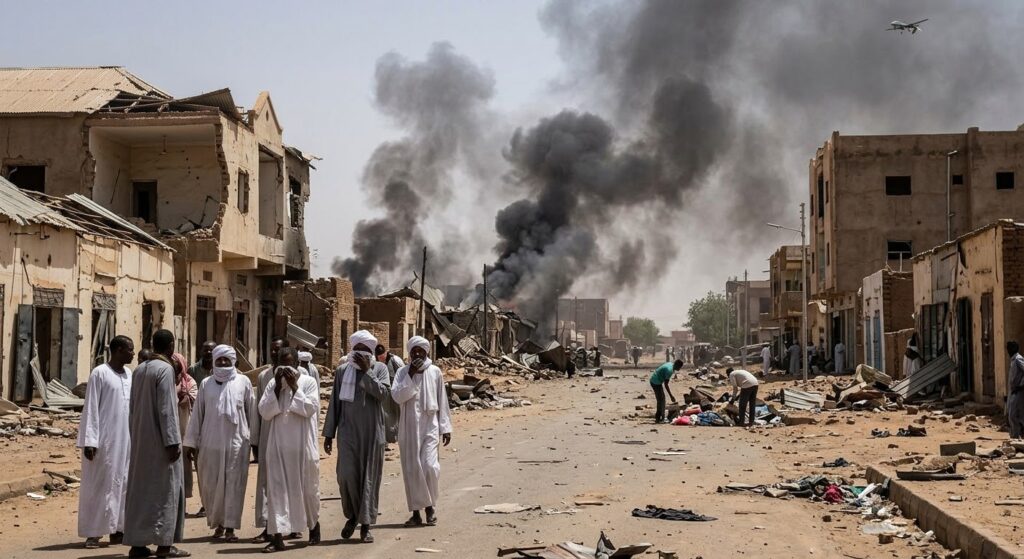
KHARTOUM/EL FASHER — Sudan’s war has entered a bloodier and more dangerous phase in October 2026. Drone strikes have become the leading cause of civilian casualties, with a single attack on a displacement camp in Blue Nile State killing at least 31 people—most of them women and children. Meanwhile, the Sudanese Armed Forces are massing for a major offensive to retake El Fasher, the North Darfur capital that fell to the Rapid Support Forces a year ago. The United Nations warns that the war shows “no signs of abating” and faces further escalation amid continued arms flows, rising drone attacks, and deteriorating regional dynamics.
Drones: The New Face of Terror
UN Under-Secretary-General for Political Affairs Rosemary DiCarlo told the Security Council on October 15 that drone strikes have become the “leading cause of civilian casualties” in Sudan this year. She listed a grim catalogue of incidents: an attack on an internally displaced persons camp in Blue Nile State, a strike on an artisanal gold mine in Red Sea State, and hits on civilian facilities in North Kordofan—including schools, a courthouse, university dormitories, and shelters housing displaced families.
The October 10 attack on Wad Madhi camp in Blue Nile State was the deadliest in recent weeks. UN Resident and Humanitarian Coordinator for Sudan Denise Brown said she was “horrified by reports of a drone strike near a camp for internally displaced people.” Preliminary information indicated at least 31 civilians killed and dozens wounded, with “the toll likely to rise further.” She stressed that “condemning these senseless killings is important, but accountability for this blatant disregard for international humanitarian law is also essential.”
A week earlier, a similar strike hit a shelter for displaced people in El Obeid, North Kordofan, causing civilian casualties. On October 1, a drone attack in El Obeid killed one child and wounded 12 others. On October 9, a drone strike in En Nuhud, West Kordofan, killed at least 12 civilians—an attack condemned by US Senior Advisor Massad Boulos.
The UN Human Rights Council voted 28-10 with 9 abstentions on October 6 to extend the mandate of the Independent International Fact-Finding Mission for Sudan for another year. The mission concluded in February that the siege and capture of El Fasher bore “hallmarks of genocide.”
El Fasher: The Next Great Battle
The Sudanese Armed Forces are preparing a large-scale military operation to retake El Fasher. According to the Sudanese News Agency, Brigadier General Abdeljabbar Babiker, deputy commander of the 6th Infantry Division, announced on October 13 that his forces had begun advancing toward the frontlines in preparation for an operation aimed at recapturing the city from the Rapid Support Forces.
At a farewell ceremony in Merowe, Major General Ibrahim Abdelhamid Ibrahim, commander of the Merowe Air Base, declared El Fasher the “next meeting point.” He vowed to continue fighting until achieving the set objectives, including “reaching Um Dafuq and securing the international border.” He said: “Our victory celebration will be held inside El Fasher.”
El Fasher fell to the RSF in October 2025 after an 18-month siege. UN investigators found that the siege and fall involved “systematic starvation, torture, killings, rape, and deliberate ethnic targeting.” UK Deputy Permanent Representative to the UN Kate Foster told the Security Council that this month marks the first anniversary of El Fasher’s fall. “As we honour the victims of El Fasher, all parties need to protect civilians, allow humanitarian access to reach those in need, and choose diplomacy over continued war,” she said.
Multiple Fronts Burning Simultaneously
In Blue Nile State, fighting has been equally intense. The SAF’s 4th Infantry Division claimed on October 2 that it had inflicted “fatal blows” on the RSF and its ally, the SPLM-North, in the Manza and Bashkarqad areas, causing “heavy losses in personnel and equipment,” destroying multiple vehicles and equipment, and forcing the attacking forces to retreat under fire.
However, RSF drones struck the residence of the Blue Nile State governor in Ed Damazin and several civilian sites, according to local sources. Air defenses intercepted some of the drones, but falling debris caused damage.
In North Kordofan, the SAF announced on October 12 that it had repelled an RSF attack on the strategic city of El Obeid, inflicting heavy losses. The army said it destroyed 12 combat vehicles and captured eight others, and that RSF fighters fled the battlefield. The RSF has maintained a siege on El Obeid for months, cutting off supply routes and periodically launching attacks.
The humanitarian situation in El Obeid remains dire. The city hosts hundreds of thousands of displaced people, and aid agencies have warned of catastrophic conditions if the siege continues.
Regional Spillover and Arms Flows
The Security Council meeting on October 15 highlighted growing concerns about the regional dimensions of the conflict. DiCarlo warned that the war “risks further escalation and spillover” amid continued arms flows, increased drone attacks, and deteriorating regional dynamics.
The conflict has drawn in external actors. The UAE has been accused of supplying the RSF with weapons and drones, while Saudi Arabia, Egypt, and Turkey have backed the SAF. The United States has imposed sanctions on both sides and on individuals and entities accused of fueling the conflict. In October, the US Treasury sanctioned two RSF commanders and a UAE-based company accused of facilitating arms shipments.
The war has also intersected with other regional crises. Sudan’s conflict has displaced millions into neighboring countries—Egypt, Chad, South Sudan, and Ethiopia—straining already fragile humanitarian systems. The Red Sea corridor, already disrupted by Houthi attacks on shipping, has become a conduit for arms flowing into Sudan, according to UN investigators.
A Humanitarian Catastrophe Beyond Comprehension
The human toll of the war continues to mount. The UN estimates that more than 12 million people have been displaced since the war began in April 2023—the world’s largest displacement crisis. More than 25 million people—roughly half the population—require humanitarian assistance. Famine has been confirmed in multiple locations, including in Darfur and Kordofan.
The 2026 Global Report on Food Crises identified Sudan as the region’s largest food crisis, with 19.5 million people facing high levels of acute food insecurity. More than 10 million people across Sudan and South Sudan face emergency levels, while over 208,000 are experiencing catastrophe—the highest phase of food insecurity.
Aid agencies have repeatedly warned that humanitarian access remains severely constrained. The SAF has restricted access to areas under its control, while the RSF has looted aid convoys and attacked humanitarian workers. At least 73 humanitarian workers have been killed since the war began, according to UN figures.
Diplomacy: A Failing Endeavour
International diplomatic efforts have yielded little. The Jeddah talks, mediated by the US and Saudi Arabia, have stalled. The African Union has appointed a special envoy, but his efforts have been overshadowed by the military dynamics. The UN Security Council has adopted multiple resolutions calling for a ceasefire and humanitarian access, but implementation has been minimal.
The “Quad” mechanism—comprising the US, UK, Saudi Arabia, and the UAE—has sought to coordinate international pressure, but the divergent interests of its members have limited its effectiveness. Russia and China have blocked more robust Security Council action, citing the need for “dialogue” and respect for Sudan’s sovereignty.
On October 15, DiCarlo reiterated the UN’s call for an immediate cessation of hostilities. “The war in Sudan is not only a tragedy for its people but a threat to regional peace and security,” she said. “The international community must act with unity and urgency.”
No End in Sight
For the people of Sudan, the approaching battle for El Fasher represents a new chapter of horror. The city’s capture by the RSF last year was accompanied by atrocities that UN investigators have characterized as genocide. A military campaign to retake it promises to be equally devastating for the civilians trapped inside.
The drone attacks that have become the signature of this war offer no safe haven. Camps for displaced people, schools, hospitals, markets—all have been targeted. The war has stripped Sudan of any semblance of normal life. And with both sides seemingly committed to a military solution, the prospect of peace remains distant.
As the Security Council meeting concluded, DiCarlo’s words hung in the air: “The parties to the conflict must understand that there is no military solution. The only path forward is a negotiated settlement that respects Sudan’s sovereignty, territorial integrity, and the aspirations of its people.” For now, those words remain unheeded—and the killing continues.