

April 20, 2026
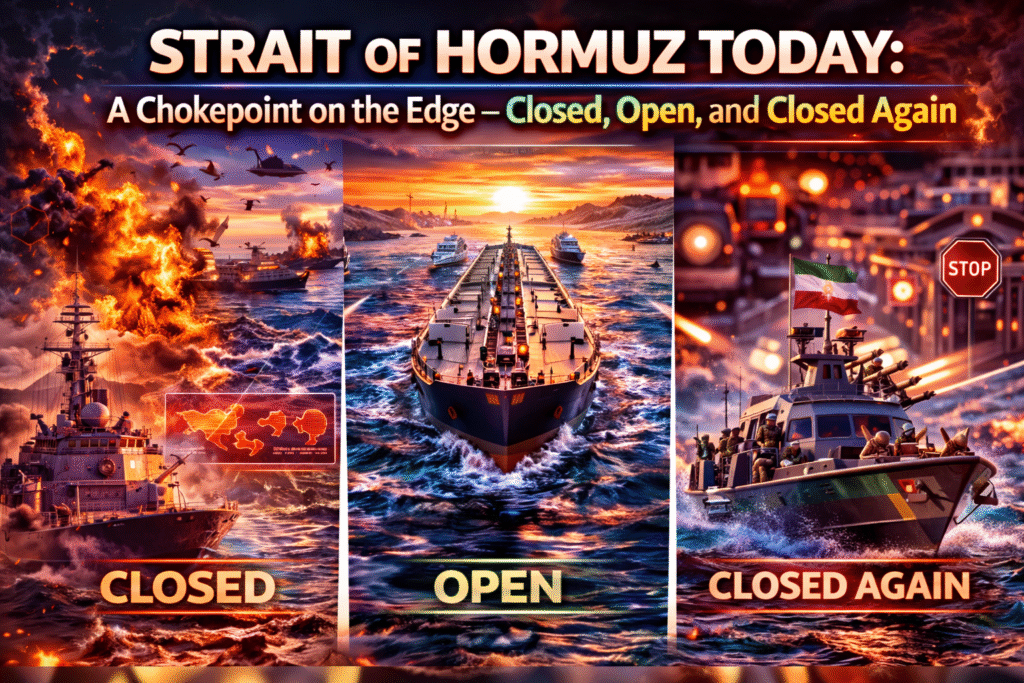
The Strait of Hormuz, the narrow waterway through which one-fifth of the world’s oil normally flows, has become the central battleground of the US-Israeli war with Iran. In the span of just one week, it has been declared closed, then “completely open,” then closed again. Tankers have been turned back, drones launched toward warships, and a US naval blockade has brought maritime trade to a near-standstill. Here is the state of the Strait of Hormuz today.
The Strategic Importance: Why This Waterway Matters
The Strait of Hormuz is a narrow channel between the Persian Gulf and the Gulf of Oman, flanked by Iran to the north and the United Arab Emirates and Oman to the south. At its narrowest point, it is only 33 kilometers (21 miles) wide.
But its physical dimensions belie its global importance. Approximately 20 percent of the world’s oil and gas supply passes through these waters. Any disruption here sends immediate shockwaves through global energy markets, affecting everything from the price of gasoline in Los Angeles to the cost of heating oil in London .
Since the war began on February 28, 2026, Iran has effectively restricted transit through the strait. The result has been the largest disruption of energy supply in modern history. According to Kpler data, more than 500 million barrels of crude and condensate have been knocked out of the global market .
The Current Status: A Standstill
As of Monday, April 20, shipping traffic through the Strait of Hormuz is virtually at a standstill. According to satellite analysis and tracking data, only three crossings were recorded in 12 hours .
The few vessels that have transited include:
- The oil products tanker Nero (under British sanctions for Russian oil activities)
- The LPG tanker Axon I (under US sanctions for Iran trading activities)
- A chemical tanker
The fact that only sanctioned vessels are moving underscores the severity of the disruption. Normal commercial traffic has all but ceased .
Ship broker Clarksons summarized the uncertainty in a note: “Recent weeks have brought several false starts, and although some form of resolution is likely at some point, the timing of any durable breakthrough remains highly uncertain” .
The Week of Whiplash: Closed, Open, Closed
The past seven days have been a masterclass in geopolitical volatility.
April 14 – First Cautious Movement: The first crude carrier to head west through the strait since the US blockade took effect entered the Gulf. The Malta-flagged VLCC Agios Fanourios I crossed the strait after waiting nearly two days in the Gulf of Oman, bound for Basrah, Iraq. The transit suggested some commercial traffic was still moving, though patterns remained erratic .
April 16 – Iran Declares the Strait Open: In a dramatic announcement, Iranian Foreign Minister Abbas Araghchi declared on X that passage for all commercial vessels through the Strait of Hormuz was “completely open” for the remaining period of the ceasefire .
The market reaction was immediate and violent. Oil prices plunged more than 10 percent. Brent crude, which had been hovering near $100, fell to $86.52 a barrel. West Texas Intermediate touched $80.56 .
Kathleen Brooks, research director at XTB, called it “the biggest development so far during the ceasefire” .
April 17 – International Summit Convened: France and the United Kingdom convened 51 countries for an international summit on the Strait of Hormuz. The meeting underlined international determination to support freedom of navigation and protect global energy security. France and the UK announced they were establishing a multinational mission to protect merchant vessels and conduct mine clearance operations .
April 18 – Iran Reverses Course: Less than 24 hours after declaring the strait open, Iran closed it again. The Islamic Revolutionary Guard Corps (IRGC) Navy announced that the strait was closed “as of this evening” because the US had refused to lift its naval blockade on Iranian ports .
Iran justified the reversal by linking the strait’s status to the blockade. “It is impossible for others to pass while we cannot,” Iranian officials signaled .
April 19 – Military Escalation: Iranian forces launched drones toward US warships in the Sea of Oman following an alleged attack on an Iranian commercial vessel. The IRGC claimed that US forces were forced to retreat after the “timely presence and rapid response” of Iranian naval units .
US Central Command (CENTCOM) meanwhile announced that the USS Spruance had fired several rounds into the engine room of an Iranian-flagged vessel, the TOUSKA, after repeated warnings were ignored. President Trump declared the vessel had been taken into “full custody” .
Iranian forces also reportedly turned back two oil tankers sailing under the flags of Botswana and Angola .
President Trump accused Iran of a “total violation” of the ceasefire agreement. “Iran decided to fire bullets yesterday in the Strait of Hormuz — A Total Violation of our Ceasefire Agreement! Many of them were aimed at a French Ship, and a Freighter from the United Kingdom. That wasn’t nice, was it?” he wrote on Truth Social .
Trump also renewed his threat to “knock out every single Power Plant, and every single Bridge, in Iran” if Tehran did not accept a US peace deal .
April 20 – The Standstill Continues: As of today, shipping data shows the strait is effectively closed. The two-week ceasefire, brokered by Pakistan and set to expire on Wednesday, is hanging by a thread .
The US Naval Blockade: A Dual Pressure Campaign
Complicating the situation is the US naval blockade on Iranian ports, announced on April 13 after weekend peace talks in Pakistan failed to produce an agreement. The blockade targets Iranian ports while theoretically allowing transit to and from non-Iranian ports—but in practice, it has sharply reduced all vessel traffic .
CENTCOM has been enforcing the blockade “impartially against vessels of all nations” entering or leaving Iranian ports. According to US military statements, zero vessels have evaded American naval forces, and 19 vessels “complied with directions from US forces to turn around and return to Iran” .
President Trump has framed the blockade as a successful pressure tactic. “Our BLOCKADE has already closed it,” he wrote, referring to the strait. “They’re helping us without knowing, and they are the ones that lose with the closed passage, $500 Million Dollars a day! The United States loses nothing” .
Iran, unsurprisingly, sees it differently. The Iranian Foreign Ministry called the blockade a “violation” of the ceasefire and an “act of aggression” against Iran. “By deliberately inflicting collective punishment on the Iranian population, it amounts to war crime and crime against humanity,” spokesman Ismaeil Baqaei said .
The Economic Fallout: Physical Oil at $150
The disruption to the Strait of Hormuz has created a bizarre and dangerous divergence in oil markets. While Brent crude futures trade around $86-100 per barrel, physical oil prices—representing real cargoes available for immediate delivery—have surged to nearly $150 per barrel .
This gap tells a story of acute supply shortage. Refiners in Europe and Asia are scrambling for non-Middle Eastern crude, driving up prices for North Sea, African, and US grades. Nigerian crude is trading at record premiums. Jet fuel prices are nearing $200 per barrel, and diesel in Europe has climbed to around $170 per barrel .
Europe is particularly vulnerable. In 2025, over 60 percent of its jet fuel imports came from the Middle East. With those supplies disrupted, industry groups warn that airports could run out of jet fuel within weeks .
The Diplomatic Front: Talks in Islamabad Hanging by a Thread
Amid the military escalation, diplomacy continues—barely.
US negotiators arrived in Islamabad on Monday evening for a second round of talks, with Pakistan acting as mediator . But Iran has made its position clear: there will be no negotiations while the US naval blockade remains in place.
Iran’s official IRNA news agency reported that Tehran’s absence from the talks “stems from what it called Washington’s excessive demands, unrealistic expectations, constant shifts in stance, repeated contradictions, and the ongoing naval blockade, which it considers a breach of the ceasefire” .
The ceasefire itself is set to expire on Wednesday, April 22. Without a breakthrough, the risk of renewed large-scale military action is high .
The International Response: A Multinational Mission
In response to the crisis, France and the United Kingdom have announced the establishment of an independent, strictly defensive multinational mission to protect merchant vessels in the region. The mission will conduct mine clearance operations and reassure commercial shipping operators .
Fifty-one countries participated in the summit convened by President Macron and Prime Minister Starmer on April 17, signaling broad international concern about the disruption to global trade .
Germany has also offered to contribute mine clearance and maritime reconnaissance assets, and the Czech Republic has offered a passive surveillance system for the strait .
But these initiatives face a fundamental obstacle: they require a sustainable ceasefire to operate. As long as the strait remains a live conflict zone, commercial shipping will stay away.
The Military Balance: Iran’s Asymmetric Threat
Even if the strait were declared open tomorrow, significant risks would remain. Analysts warn that Iran can still threaten global shipping through asymmetric means, regardless of formal blockades or declarations .
The IRGC Navy deploys what analysts call a “mosquito fleet” of fast boats, drones, missiles, torpedoes, and sea mines. These low-cost, high-volume assets can harass tankers and create chaos even without controlling the strait outright.
Security monitors report that at least 20 ships have been attacked since the conflict began. The UN’s maritime agency is currently verifying claims about mines in the waterway .
The Human Element: Seafarers in the Crossfire
Amid the geopolitics and the oil prices, it is easy to forget the human cost. Seafarers on tankers and cargo ships are navigating a war zone. Insurance costs have skyrocketed. Crews face the prospect of being caught in crossfire, detained, or worse.
When the strait briefly opened on Friday, some vessels attempted passage. Two cruise ships—Mein Schiff 4 and Mein Schiff 5—successfully transited, though TUI Cruises emphasized that all passengers had been brought home and the ships were operating with reduced crews .
For the thousands of merchant seafarers still in the region, every transit is a calculated risk.
What Comes Next: Three Scenarios
As the ceasefire deadline approaches, analysts see three possible paths:
Scenario One – Diplomatic Breakthrough: Pakistan mediates a deal that lifts the US blockade in exchange for Iran guaranteeing free passage. The strait reopens, oil prices stabilize, and commercial traffic gradually resumes. This is the optimistic scenario—but given the hardening of positions on both sides, it appears increasingly unlikely .
Scenario Two – Extended Standoff: The ceasefire expires without renewal, but neither side launches major new offensives. The strait remains effectively closed, oil prices remain elevated, and the global economy suffers a prolonged supply shock. This is the “muddle through” scenario .
Scenario Three – Renewed Warfare: Talks collapse, Trump follows through on his threat to strike Iranian infrastructure, and Iran responds by mining the strait or launching大规模 attacks on shipping. Oil prices spike past $150, and the conflict escalates into a full-scale regional war. This is the nightmare scenario .
Conclusion: The World Waits
The Strait of Hormuz today is a mirror reflecting the broader conflict: volatile, unpredictable, and dangerous. In one week, it has been open, closed, and fought over. Tankers have moved, then stopped. Diplomats have gathered, then scattered.
The stakes could not be higher. One-fifth of the world’s oil flows through these waters. The global economy is watching. And with the ceasefire set to expire in just days, the next 48 hours will determine whether the strait becomes a corridor for peace or a battleground for escalation.
For now, the waterway remains virtually still. Three ships in 12 hours. A handful of sanctioned tankers. And the world holding its breath.
Sources: Anadolu Ajansı, ABC News, Reuters, DW, The Economic Times, The Nation, Daily Sabah, Mid-day, Government of Sweden press releases
