

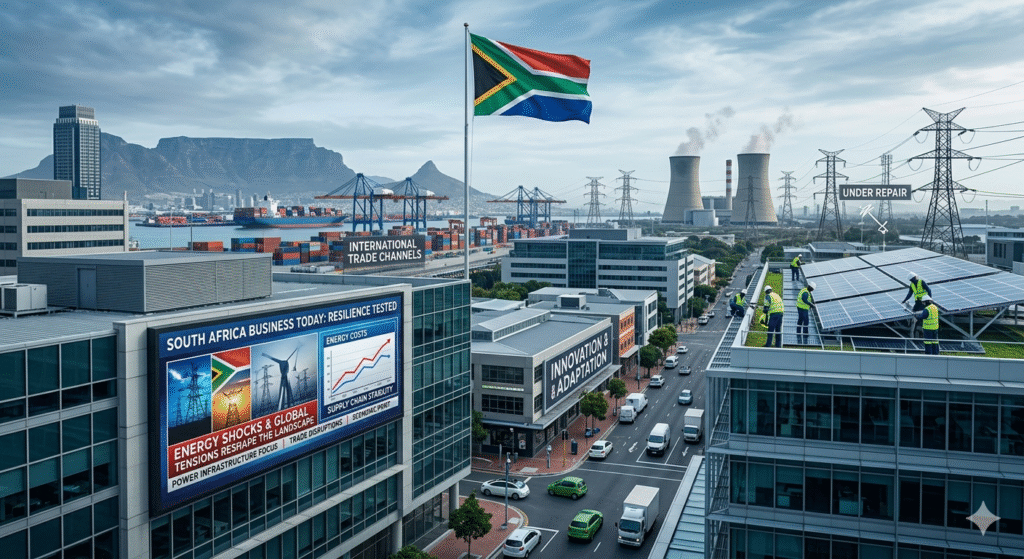
JOHANNESBURG — June 6, 2026
Just after midnight on Tuesday, the Department of Mineral and Petroleum Resources delivered a jolt to South African businesses already navigating a fragile recovery. Petrol prices would rise by R1.43 per litre from June 3, the department announced—a move driven not by local market forces but by geopolitical chaos unfolding 6,000 kilometers away in the Strait of Hormuz .
The increase marks the end of a brief reprieve. For the first four months of 2026, South African businesses enjoyed something they had almost forgotten: stability. Fuel costs were at their lowest in nearly four years. The country had gone more than 200 days without load shedding. The rand traded below 17 to the dollar for the first time since 2023. Interest rates sat at their lowest since 2024 .
That window is now closing.
Brent crude has climbed above $104 per barrel amid escalating tensions involving Iran and disruptions around the Strait of Hormuz, one of the world’s most strategically important oil routes . And this time, the government’s protective shield has been withdrawn. Temporary fuel levy relief—which had cushioned consumers from global energy volatility—has been reduced by R1.50 per litre for petrol and R1.96 per litre for diesel .
The result is a business environment caught between cautious optimism and renewed vulnerability. Here is the complete picture of South African business today.
Part 1: The Macro Picture — Growth, but Not Enough
The underlying numbers suggest reason for cautious hope. The International Monetary Fund has revised South Africa’s growth forecast upward to 1.4 percent for 2026, a slight increase from earlier projections of 1.2 percent . Swiss Re forecasts similar growth of 1.4 percent, up from 0.9 percent in 2025, supported by lower borrowing costs, moderate real wage growth, and an improving electricity supply .
Inflation has eased dramatically to 3.5 percent—down from the punishing levels of recent years—driven mainly by housing, utilities, and food costs . That has created space for the South African Reserve Bank to continue lowering interest rates, providing relief for indebted businesses and households.
President Cyril Ramaphosa, tabling the Presidency’s budget vote in Parliament on Tuesday, struck an optimistic note. “The micro-economic environment has improved. Our tax collection revenue remains strong. Public finances are in better shape, and the national debt has stabilised,” he told the National Assembly .
He pointed to international validation of this progress: “Last week, the rating agency Moody’s lifted South Africa’s rating outlook from stable to positive. This comes six months after Standard and Poor’s lifted South Africa’s credit rating for the first time in two decades” .
Yet the president’s optimism came with a sharp warning. “The effects of the surge in oil prices and other critical supplies like fertiliser are likely to undermine much of the progress that we have made in bringing down inflation and the cost of living,” Ramaphosa said. “These developments are likely in the medium term to slow down our economic growth and to hamper our efforts to create jobs” .
The fundamental problem remains: South Africa’s growth ceiling is constrained by domestic factors rather than global demand alone. Persistent electricity supply challenges, weak logistics performance, infrastructure backlogs, and policy uncertainty continue to weigh on private investment and productivity .
Unemployment stands at 31.9 percent, with youth unemployment still exceeding 46 percent—numbers that highlight persistently weak absorptive capacity across sectors . Even with improved growth, the economy is not expanding fast enough to make meaningful inroads into these structural challenges.
Part 2: The Fuel Shock — A New Energy Reality
The June fuel adjustment is not just another price increase. It signals a fundamental shift in South Africa’s energy landscape: government support is being reduced at the same time global oil markets are becoming more unpredictable .
The mechanics are revealing. Despite lower international fuel product prices and a stronger rand during the latest review period, petrol prices rose sharply because the government increased the Slate Levy from 122.70 cents to 157.74 cents per litre. The move follows a cumulative negative slate balance of $1.1 billion (R18.28 billion) recorded at the end of April .
In practical terms, consumers are gradually absorbing a larger share of the cost of global oil market volatility. That shift comes at a sensitive moment for South Africa’s economy, where transport costs feed directly into food prices, business expenses, and inflation.
This week, S&P Global Ratings warned that sustained oil prices around $100 could increase inflationary pressures, raise food and fertiliser costs, weaken consumer spending, and complicate economic management in countries such as South Africa .
There is relief for some sectors. Diesel prices will decrease by between R2.62 and R3.25 per litre, offering a break for freight operators, farmers, miners, and manufacturers—sectors that depend heavily on fuel and play a critical role in South Africa’s supply chains. Lower diesel costs may help ease some inflationary pressure later in the year, partially offsetting the impact of higher petrol prices on households .
But the warning is clear. With crude prices back above $100, tensions in the Middle East unresolved, and consumers assuming a greater share of fuel costs, South Africa may be entering a period of increased exposure to global energy shocks .
Part 3: Small Business — Cautious Stability
After years of relentless pressure, South Africa’s small and medium enterprises are entering 2026 on somewhat firmer footing. The Small Business Growth Index, the country’s first real-time barometer tracking conditions shaping small business performance, shows that around 59 percent of small businesses anticipate moderate to strong growth over the next 12 months .
That is the good news. The sobering context is that only 38 percent of businesses surveyed in 2025 believed they could survive for more than a year under cost pressures without external support . Those pressures—input costs, energy reliability, and the broader economic environment—have not disappeared. They have merely eased slightly.
More than two-thirds (70.5 percent) of small businesses expected to require additional financing within six months, largely to fund working capital, capital equipment, marketing, or refinance existing debt. Yet at least 40 percent were relying primarily on self-funding, with others turning to family and friends or informal and private lending .
The SBGI reading points to fragile stability rather than robust recovery. Growth intentions are largely domestic, with 92 percent planning to expand locally and 72 percent nationally, while 45 percent intend to export and 67 percent aim to grow their online presence .
Vignesh Subramani, Interim Managing Executive of SME Business at Absa Business Banking, describes 2026 as “less about acceleration and more about judgement.” Building working relationships with financial partners, he argues, may prove to be one of the most practical advantages available in the year ahead .
Part 4: Digital Transformation — The SME Lifeline
The most dynamic trend in South African business today is the rapid acceleration of digital adoption among small and medium enterprises. According to Xero’s State of South African Small Business 2026 report, 80 percent of small businesses have grown their revenue in the past year. Yet despite this momentum, the majority (84 percent) are prioritising steady growth and stability over aggressive expansion .
Digitalisation is the engine driving this resilience. More than eight in ten (85 percent) say digital adoption is a top or significant priority in the year ahead .
The numbers are striking: 52 percent of small businesses are using artificial intelligence daily or weekly to create content, analyze data, and automate processes. Nearly half (45 percent) are using online invoices with payment links to speed up collections—a critical advantage given that 62 percent experienced cash flow issues over the past year and 42 percent struggle with late payments .
Mobile commerce is another major driver. Smartphones captured 72.43 percent of South Africa’s e-commerce market in 2024, and this share is projected to grow at an 11.52 percent compound annual rate until 2030. The planned shutdown of 2G and 3G networks in December 2027 will accelerate upgrades to 4G and 5G devices, pushing mobile adoption even higher .
Nelson Teixeira, managing director of Operations for Sub-Saharan Africa at FedEx, emphasizes that adapting to evolving consumer expectations is vital. FedEx research shows that more than 80 percent of consumers now prioritize convenience, with home delivery favored by 81 percent, free shipping by 76 percent, and real-time tracking by 68 percent. Notably, 38 percent of consumers are willing to pay for same-day delivery .
“For small businesses, meeting these expectations can translate directly into higher conversions, reduced cart abandonment, and stronger repeat engagement,” Teixeira says .
Part 5: Export Opportunities — The AfCFTA Frontier
Perhaps the most significant long-term opportunity for South African business lies beyond its borders. Recent research by Rand Merchant Bank estimates an annual untapped export opportunity worth R1.3 trillion over the next five years—the largest of any African market .
The African Continental Free Trade Area (AfCFTA) is creating new openings for regional trade, particularly as global supply chain disruptions highlight the value of diversified markets closer to home. Social commerce is enabling even micro-businesses to reach niche communities across borders, from artisanal foods to fashion, sometimes drawing international buyers .
Teixeira says this shift is already reshaping SME strategy, with more South African brands thinking globally from day one. Logistics plays a critical role in enabling this growth by simplifying cross-border processes, managing customs complexities, and connecting small businesses to international delivery networks .
“South African entrepreneurs have never lacked ingenuity,” Teixeira says. “What will set the most successful SMEs apart in 2026 is the ability to match that ingenuity with the right digital tools, the right partners, and the confidence to pursue growth wherever it emerges” .
Part 6: Bioethanol — A Homegrown Energy Solution
Amid the anxiety over fuel prices and global energy volatility, a longer-term solution is quietly taking shape. South Africa is preparing to produce bioethanol from sorghum to reduce reliance on imported fossil fuels and cushion geopolitical risks .
Josie Rowe-Setz, managing director of Blueprint Holdings, says there is significant economic value in building a domestic bioethanol industry using locally grown sorghum and sugarcane. Countries including Brazil, India, Kenya, the United States, and Zimbabwe have established bioethanol industries, demonstrating the model’s viability. Sorghum is drought-tolerant, heat-resistant, and well-suited to South Africa’s agricultural conditions .
“We have found that production of bioethanol is a viable industry. It will give us self-reliance, national energy sovereignty, and fuel security,” Rowe-Setz says .
The government is clearing the path. Landeni Kabini, acting director-general of the Department of Mineral and Petroleum Resources, says authorities have gazetted regulations on biofuel pricing “so that the industry can take off” .
Irshaad Kathrada, CEO of the Localisation Support Fund, notes that South Africa has undergone a major shift from domestic fuel refining to imported finished fuels following the closure of its two largest coastal refineries between 2022 and 2023. The country now imports nearly three-fourths of its fuel from geopolitically exposed sources .
“We have a credible near-term alternative, one grounded in South African soil, South African farmers, and commercially proven technology,” Kathrada says. “The economics are closer to viable than most people realize, the regulatory framework is finally in place, and the localization dividend is substantial” .
Part 7: The Two-Pot Pension System — Reshaping Savings
One of the most significant structural reforms affecting South African businesses and their employees took effect in September 2024: the new “two-pot” pension system. The reform splits pension contributions into a flexible savings pot that can be accessed easily and a retirement pot that preserves two-thirds of individuals’ pension contributions until retirement .
The previous system allowed individuals to withdraw all savings when they left their job, which led to persistent low preservation rates. Only 6 percent of citizens were on track for a comfortable retirement, despite South Africa having large pension assets of an estimated $322 billion (85 percent of GDP) overall .
For the life insurance sector, the shift to a higher rate of long-term fund accumulation may in the short term dampen demand for annuity saving products. However, over the long term, it should create opportunities for insurers to offer hybrid products and engage members with more frequent touchpoints .
Swiss Re forecasts life premiums will grow by 1.7 percent (in real terms) in 2026. The non-life insurance sector is expected to see premium growth of 2 percent, with motor insurance growing by 2.5 percent as consumer spending and vehicle sales benefit from lower interest rates .
Part 8: The Xenophobia Warning — Business Fears Reputational Damage
A darker cloud hangs over South Africa’s business environment. Anti-illegal immigration marches have surged across the country in recent weeks, leaving at least three Mozambican nationals dead in Mossel Bay. The governments of Ghana and Mozambique have already opted to repatriate their citizens from South Africa, while other governments have reported South Africa to the African Union over xenophobic sentiments .
On Friday, Business Unity South Africa (BUSA) and Business Leadership South Africa (BLSA) issued a joint statement warning that violence and hostility toward foreign nationals threaten not only social cohesion but also South Africa’s economic interests and regional standing .
The organisations acknowledged that concerns about unemployment, crime, service delivery, border management, and economic inclusion are legitimate. However, they stressed that such challenges should be addressed through lawful and constructive policy interventions rather than through actions targeting migrants .
“Our future prosperity is inseparable from the economic development of the continent,” the organisations said. South African companies have extensive operations across Africa, investing billions of rand and creating jobs throughout the continent. At the same time, businesses from other African countries and beyond continue to invest in South Africa, employing thousands of local workers .
“Hostility disrupts vital corporate operations, strains diplomatic ties with regional partners, and threatens the safety of personnel and infrastructure across cross-border trade corridors,” BUSA and BLSA warned .
The business groups linked the migration debate to broader continental integration goals, arguing that Africa’s future prosperity depends on stronger economic cooperation and regional development. Achieving the African Union’s Agenda 2063 vision of an integrated, prosperous, and peaceful Africa requires the legal movement of people, ideas, capital, technology, and trade across borders .
Part 9: US Tariffs — A New Trade Headwind
Adding to the uncertainty is the United States’ introduction of a 30 percent tariff on about 5 percent of South Africa’s exports in August 2025 . While the direct impact is limited—only a fraction of South African exports are affected—the move signals a more protectionist global trading environment that could harm emerging market economies disproportionately.
The IMF has warned that policy uncertainty, both globally and domestically, continues to deter long-term investment. Reducing uncertainty through clearer policy frameworks, credible reform implementation, and institutional stability is identified as a key lever for lifting medium-term growth prospects .
Swiss Re notes that uncertainty over the impact of US tariff policy on the economy is heightened, though the direct exposure remains relatively contained .
Part 10: The Road Ahead — Reform or Stagnation
The consensus across business organisations, international financial institutions, and government is clear: South Africa’s growth ceiling is determined by domestic reform, not global conditions.
The IMF’s forecast implicitly underscores that South Africa’s growth ceiling remains constrained by domestic factors rather than global demand alone. Persistent electricity supply challenges, weak logistics performance, infrastructure backlogs, and policy uncertainty continue to weigh on private investment and productivity .
The IMF emphasizes that sustained growth will depend on reforms that improve labor market efficiency, strengthen education and skills, streamline regulation, and promote competition—areas that remain central to South Africa’s economic debate .
Without decisive progress on these fronts, South Africa risks remaining stuck in a low-growth equilibrium, even as parts of the global economy adapt and rebound .
Yet there are reasons for measured optimism. The 200-plus days without load shedding represent a genuine operational improvement. The positive rating outlooks from Moody’s and S&P signal growing international confidence. The Two-Pot pension system addresses a long-standing structural weakness. The bioethanol initiative offers a path to energy independence.
President Ramaphosa struck the right balance in his budget vote speech: acknowledging progress while warning of headwinds. “These developments are likely in the medium term to slow down our economic growth and to hamper our efforts to create jobs,” he said. “We should anticipate that conditions will be difficult for the next while” .
Conclusion
South African business today is a study in contrasts. Inflation is down, but fuel is up. Load shedding has paused, but global energy shocks have arrived. Digital adoption is accelerating, but cash flow remains a chronic struggle. Export opportunities are enormous, but xenophobic violence threatens regional relationships.
The businesses that will thrive in this environment are those embracing technology, thinking beyond borders, and building resilience into their operations. The ones that will struggle are those hoping for a return to the old normal—a normal that is not coming back.
As Nelson Teixeira put it, the businesses that stay alert to these shifts “will not only withstand a difficult year—they will find new ways to thrive” .
The foundations for recovery exist. The question is whether South Africa’s business community and its government can build on them before the next shock arrives.