

MOGADISHU — June 6, 2026
On the shimmering waters of the Gulf of Aden, a quiet revolution is underway. Towering new ship-to-shore cranes—some of the tallest on the continent—now dominate the skyline of the Port of Berbera, while 1,000 kilometers to the south, the Port of Mogadishu has just recorded the busiest month in its century-long history.
Somalia is witnessing an unprecedented maritime transformation. After three decades of civil war, lawlessness, and the notorious piracy that once choked global shipping lanes, the country’s strategic ports are suddenly the most contested real estate in the Horn of Africa. From the breakaway region of Somaliland to the federal capital, foreign powers are jostling for influence, and Somali leaders are leveraging this competition to rewrite their economic future.
Yet, this resurgence sails through troubled waters. A political firestorm erupted in January when the federal government attempted to cancel foreign port deals, sparking a constitutional crisis. At the same time, the wars in the Middle East have created a security vacuum, allowing Somali pirates to stage a dramatic comeback. Here is the complete picture of Somalia’s ports today.
Part 1: Berbera – The DP World Transformation
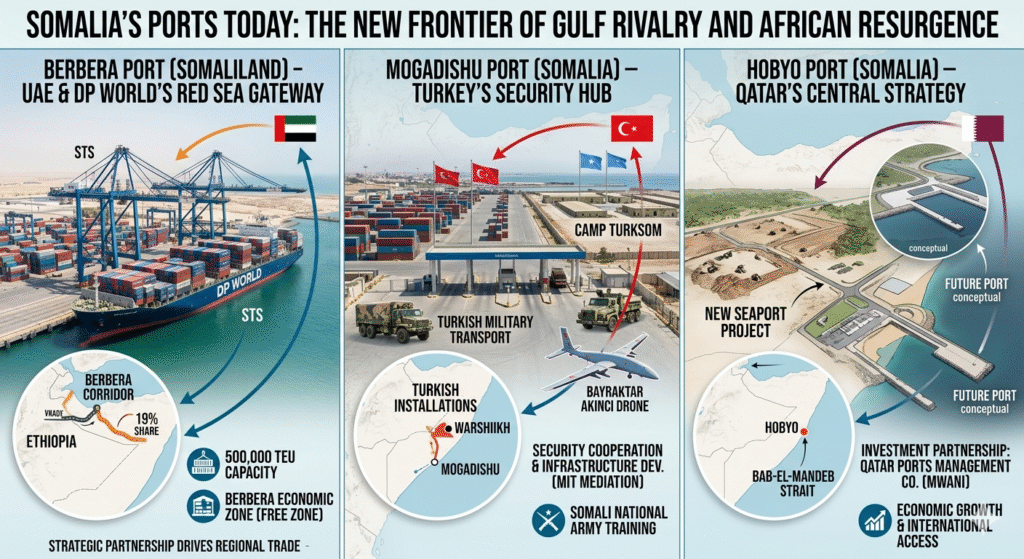
The story of Somalia’s modern maritime sector begins in Berbera, a dusty port city on the coast of the self-declared republic of Somaliland. Once a sleepy backwater known primarily for livestock exports, Berbera has been transformed by a $442 million investment from DP World, the Dubai-based logistics giant.
The difference is visible from the moment a vessel approaches the quay. Two massive cranes—tall enough to stack containers five high—now loom over a newly built 400-meter deep-water quay. Trucks line up in formation, waiting to offload cargo at a speed that was unimaginable just a few years ago.
Mohamed Atteye, a shift manager who has worked at the Berbera terminal since 2021, remembers the old days clearly. Before the refurbishment, unloading a large container ship was “a dangerous task” because dock workers relied on the ships’ own cranes. The turnover rate was abysmal. “Four years ago, the team was only able to handle seven containers an hour,” Atteye told a maritime publication recently. “Now we can do 30 per hour. So you can see the big difference, the big jump”.
The numbers tell an even more dramatic story. Before its upgrade, Berbera could handle about 150,000 standard 20-foot containers (TEUs) per year. Current capacity is roughly four times that, and upon completion of the ongoing second phase—which will extend the quay to 1,000 meters and add seven more gantry cranes—capacity will increase by an additional 300 percent. Ultimately, the port aims to handle roughly 13 times the cargo it processed in the past.
The strategic logic behind the investment is simple: Ethiopia. Landlocked Ethiopia, Africa’s second-most populous nation, has long been dependent on the port of Djibouti for over 95% of its maritime trade. DP World estimates that two-thirds of the goods shipped via Berbera—primarily wheat, processed food, machinery, and construction materials—will ultimately be destined for the Ethiopian market. The port offers Addis Ababa a desperately needed alternative trade corridor, reducing its vulnerability to the whims of any single neighbor.
Part 2: The Berbera Economic Zone – A Free Trade Vision
Beyond the dockside cranes, DP World is constructing something far more ambitious: the Berbera Economic Zone. This is not merely a port expansion but a free trade zone designed to attract light manufacturing, logistics, and assembly industries.
The vision is to create a “gateway city” where goods arrive from global markets, are processed or assembled, and then re-exported to the broader East African hinterland. For a region with chronically high unemployment, the promise of industrial jobs is a powerful lure. However, the project’s early promise was dented when Ethiopia, initially slated to buy a 19% stake, pulled out due to its economic crisis and the war in Tigray. For now, DP World holds 65% of the project, while Somaliland retains 35%.
Part 3: Mogadishu’s Record-Breaking Month
While Berbera captures headlines for its gleaming new infrastructure, the federal capital’s port has quietly achieved something arguably more significant. In January 2026, the Port of Mogadishu posted the highest cargo volume in its history, processing 21,650 TEUs and servicing 16 container vessels in a single month.
This is not just about numbers; it is about a change in function. For decades, Mogadishu served merely as a final destination for food aid and imports. Today, it is emerging as a regional transshipment hub. The Mediterranean Shipping Company (MSC) has inaugurated a direct service linking Colombo, Sri Lanka, to the Somali capital. The arrival of the MSC Silver II, which discharged transshipment cargo subsequently loaded onto the MSC Malin II, formally marks the start of transit activities at the port.
This corridor significantly reduces lead times for importers and integrates Somalia more deeply into primary Indian Ocean trade routes. Port officials attribute the efficiency surge to new management teams and heightened workforce capability—proof that even without the deep pockets of a Dubai-based multinational, the federal government can compete on the regional stage.
Part 4: The Turkish Factor – A Strategic Partnership
The resurgence of Mogadishu is closely tied to Ankara. Türkiye has been Somalia’s most steadfast international partner for over a decade, investing not only in ports but in airports, hospitals, schools, and military training. The Albayrak Group, a Turkish conglomerate, currently manages the Port of Mogadishu.
In late January 2026, a senior Turkish delegation led by Deputy Minister of Transport Durmuş Ünüvar visited Mogadishu to sign off on a new round of infrastructure projects. Somalia’s Minister of Ports and Maritime Transport, Abdulkadir Mohamed Nur, described Türkiye as a “strategic partner” and emphasized that the port plays a central role in national revenue generation.
The technical inspection conducted by the Turkish delegation focused on upgrading the container terminal and cargo handling zones. For Somalia, the relationship with Ankara offers a counterweight to the influence of Gulf powers like the UAE. For Türkiye, the port access solidifies its footprint in the Horn of Africa, a region critical to the security of the Red Sea.
Part 5: Political Earthquake – The Cancellation of UAE Agreements
If the infrastructure story is one of progress, the political story is one of confrontation. On January 11, 2026, the Somali federal government dropped a diplomatic bombshell. The Cabinet voted unanimously to cancel all bilateral cooperation agreements with the United Arab Emirates, including commitments in the ports of Berbera, Bosaso, and Kismayo.
The government cited “serious breaches of Somalia’s sovereignty, national unity and political independence,” claiming evidence that the UAE’s actions “undermined the political independence” of the state. The resolution annulled all security and defense agreements tied to the ports across the federal system.
The reaction from Somalia’s regional administrations was swift and furious.
Somaliland, which considers itself an independent nation, issued the strongest rejection. “Somalia’s daydreams change nothing,” Khadar Hussein Abdi, the Minister of the Presidency of Somaliland, posted on X. “Berbera is the birthplace of our president and the UAE is a trusted friend of Somaliland”. He added defiantly: “The UAE is here to stay, regardless of what a weak administration in Mogadishu says”.
Puntland argued that the federal government has no legal authority to interfere in agreements connected to the Bosaso port development project, describing their cooperation with the UAE as “lawful, legitimate and necessary”.
Jubbaland rejected the decision on constitutional grounds, arguing that agreements related to the port of Kismayo fall under the jurisdiction of federal member states.
The standoff remains unresolved, highlighting the fragile nature of Somalia’s federal system. While Mogadishu controls the political narrative internationally, on the ground, the regions continue to manage their own ports with foreign partners of their choosing.
Part 6: The Geography of Somalia’s Major Ports
To understand the stakes, one must understand the ports themselves:
- Berbera (Somaliland): The most modern facility, with a 1,000-meter quay under construction and 30 containers-per-hour capacity. Depth up to 12 meters. Handles bulk, break-bulk, containers, and livestock.
- Mogadishu: The busiest in terms of volume (21,650 TEUs in January 2026), now functioning as a transshipment hub. Managed by Türkiye’s Albayrak Group.
- Bosaso (Puntland): A key port for the northeastern region, central to Gulf security cooperation.
- Kismayo (Jubbaland): The southern gateway, vital for trade with Kenya and the fertile Juba Valley.
- El Maan: A smaller general cargo port near Mogadishu, handling primarily cargo and tankers.
Part 7: The Piracy Comeback – A Persistent Threat
The excitement over investment and modernization is tempered by a grim reality: Somali piracy is back. The wars in the Middle East—specifically the conflict in the Strait of Hormuz involving Israel and Iran—have forced international naval forces to redeploy their assets toward the Arabian Gulf.
This has created a security vacuum in the western Indian Ocean. According to maritime security analysts, pirate networks operating off the Somali coast are seizing new opportunities to regroup after years of relative decline. The UK Maritime Trade Operations (UKMTO) agency reported that Somali pirates are currently holding at least three vessels, including two oil tankers and a cargo ship, seized in recent weeks near Somali and Yemeni waters.
Somali MP Mohamed Dini warned of an even more alarming development: indications of coordination or potential alliances between certain pirate networks and Yemen’s Houthi group, amidst escalating maritime attacks in the Red Sea. The European Union Naval Force (Operation Atalanta) confirmed that three pirate groups are currently active in northern Somalia, comprising both maritime operatives and land-based elements providing logistical support.
This resurgence threatens the very business model that DP World and MSC are trying to establish. Insurance premiums for ships calling at Somali ports are likely to rise, potentially eroding the cost advantages of the new trade corridors.
Part 8: The Scramble for Military Bases
Beyond commercial logistics, the ports of Somalia are also at the center of a global “scramble” for military access. According to a recent report by the International Institute for Strategic Studies (IISS), the Horn of Africa is experiencing intense competition over foreign military bases.
The delicate balance between established powers (US, China) and emerging ones (Turkey, Russia) is being unsettled. Turkey already operates its largest overseas military base in Mogadishu. The UAE maintains a significant presence in Somaliland. Meanwhile, Ethiopia—desperate for guaranteed sea access—is aggressively pursuing port deals, and Russia is exploring the establishment of a naval base in the region.
However, the IISS report notes that perceptions of an imminent “tinderbox” are somewhat overstated. Instead, it argues that port politics in the region is a “multi-layered affair, with regional states seeking to manage international rivalries to enhance their diplomatic and domestic power”. In essence, Somalia and Somaliland are playing the great powers against each other to extract maximum concessions.
Part 9: The Arms Smuggling Connection
The ports are not just conduits for wheat and containers. The IISS report highlights a dense network of smuggling routes for munitions, components, and dual-use items between the Horn of Africa and Yemen. The combination of state-sponsored arms supplies (primarily from Iran) and the activities of smugglers has created a thriving illicit economy that transcends ideological divisions.
Weapons landed at unregulated ports or remote beaches in Somalia have fueled the civil war in Yemen, while also arming al-Shabaab insurgents within Somalia. The challenge for the federal government is that cracking down on smuggling risks alienating the regional clans that control the informal docks.
Part 10: The Future – Logistics Hub or Battleground?
What does the rest of 2026 hold for Somalia’s ports? The trajectory is contradictory. On the one hand, the commercial potential is immense. DP World projects a 62% reduction in port-to-port transit times within the region. Mogadishu is proving it can handle complex transshipment operations at a global standard.
On the other hand, the political fractures are widening. The federal government’s inability to control Berbera or Bosaso highlights the limits of its sovereignty. The resurgence of piracy threatens the maritime insurance market. And the influx of foreign military powers—from Turkey to the UAE to potentially Russia—risks turning the Somali coast into a proxy battlefield.
For the Somali worker on the dock in Mogadishu or the truck driver in Berbera, the calculus is simpler. The new cranes mean jobs. The free trade zone means a future beyond conflict. Whether that future arrives depends on whether Mogadishu can reconcile with its regions, whether the international community can suppress the pirates again, and whether the great powers treat Somalia as a partner rather than a chessboard.
One thing is certain: after thirty years of being known only for famine and anarchy, Somalia’s coastline is once again the most important real estate in East Africa. And the world is watching.
