

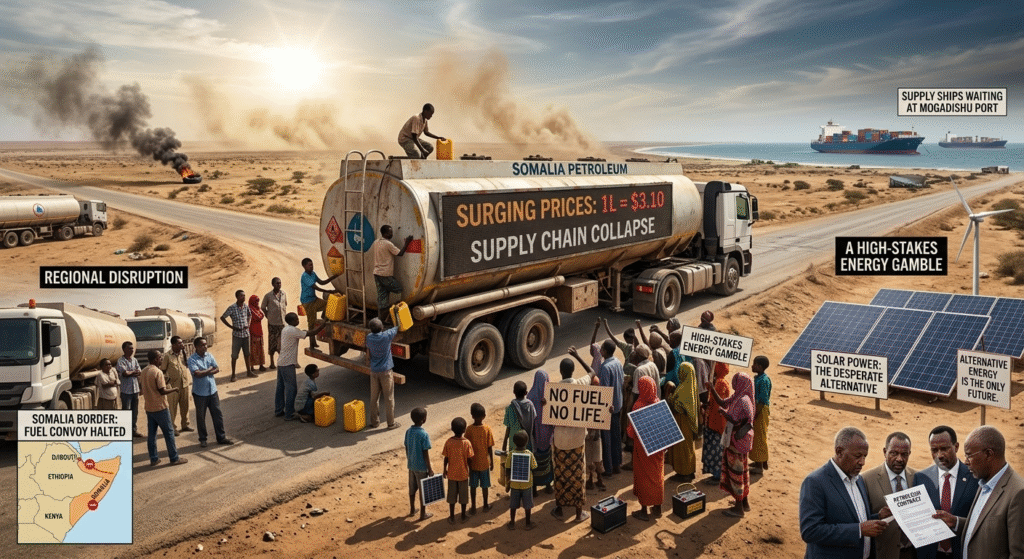
In the summer of 2026, Somalia finds itself gripped by a severe fuel crisis that is reshaping the daily lives of millions. From the capital Mogadishu to the southern port city of Kismayo, petrol prices have more than doubled in recent months, driving up the cost of food, transportation, and essential healthcare in a nation already struggling with drought and insecurity . This price shock, triggered by geopolitical turmoil far beyond its borders, threatens to reverse hard-won humanitarian gains and is forcing Somali families to make impossible choices between food, fuel, and medical care.
The Price Shock: From 65 Cents to Beyond a Dollar
The catalyst for Somalia’s current fuel crisis has been the escalation of conflict in the Middle East. The disruption of regional shipping routes, critical for fuel imports to the Horn of Africa, has sent shockwaves through Somali markets .
The numbers are stark. In Mogadishu, the price of gasoline surged by nearly 77% overnight, jumping from $0.65 to $1.15 per liter . This dramatic increase has made fuel a luxury item for many. The impact is felt everywhere. As Ali Isse, a trader in Kismayo’s Jamaame market, explained, “Everything in the world depends on fuel. Before the conflict, five litres of fuel sold for $3.80. This morning, five litres were going for $8.50. You can see the difference. This change affects everything we use” .
The consequences ripple through the entire economy. The cost of transporting food has skyrocketed, with a sack of potatoes rising from $45 to $80—a $35 increase driven almost entirely by higher fuel costs . This inflationary pressure is devastating for a population where most families already live on the edge.
Healthcare at a Breaking Point
The crisis extends beyond household budgets into life-or-death situations. For Somalia’s most vulnerable, access to healthcare has become critically endangered by the fuel price surge.
At Kismayo General Hospital, the ICRC-supported stabilization centre has already seen a 41% increase in child admissions during the first half of 2026 compared to the same period last year—all of whom were suffering from malnutrition . Mothers like Sabirin, a widow who traveled for three days on impassable roads to reach help for her severely malnourished son Hassan, represent a growing number of families who must spend days and large sums on fuel just to access basic medical care .
Médecins Sans Frontières (MSF) has warned that these rising costs could have a “devastating impact on access to basic healthcare for millions of people” . Rural health clinics, already strained by aid cuts, are increasingly inaccessible as transport costs become prohibitive. The ICRC has expanded the number of Somali Red Crescent nutrition clinics from 10 to 22, but access remains a formidable challenge .
The Geopolitical Context: What’s Driving the Surge?
The fuel crisis is directly linked to conflict in the Middle East and its impact on shipping routes . Somalia, like many East African nations, relies heavily on imports for its petroleum products. Any disruption in the Red Sea or Indian Ocean shipping lanes, exacerbated by tensions involving Iran and regional instability, immediately translates into higher prices in Mogadishu and Kismayo.
In March 2026, the price shock hit with the gasoline surge . By mid-2026, the cumulative effect of ongoing disruptions had more than doubled fuel costs . While crude oil prices on global markets remain a factor, the primary driver in Somalia is the severe bottleneck in import logistics, where the “last mile” of fuel delivery has become astronomically expensive .
A Ray of Hope: The Curad-1 Deep-Sea Gamble
Amid the grim headlines, a high-stakes energy gamble is unfolding off Somalia’s coast that could fundamentally change the nation’s economic trajectory.
Turkey’s state-owned oil company, Turkish Petroleum (TPAO), in partnership with the Somali government, is drilling the Curad-1 oil well, located about 372 kilometers northeast of Mogadishu . This is the first offshore oil well officially drilled in Somalia, and officials expect the first exploration results by the end of 2026 .
The scale of the project is extraordinary. The well is planned to reach a depth of nearly 7,500 meters, making it one of the deepest offshore oil wells in the world. The operation could take up to 288 days to complete . Demonstrating its commitment, Turkey has deployed a naval task group—including the TCG Goksu, TCG Gelibolu, and TCG Bartin—to escort and protect the drilling fleet .
For Somalia, the stakes could not be higher. Minister of Petroleum and Minerals Dahir Shire Mohamed has framed the project as a potential turning point for the country’s economy, which has long struggled with instability and limited domestic revenue. Officials say any commercial discovery could boost state income, attract foreign investment, and strengthen fiscal independence .
Security and the Future of Energy
The drilling operation is part of a broader deepening of Turkish-Somali security cooperation. Turkish President Recep Tayyip Erdogan recently asked Parliament to extend the deployment of Turkish troops in Somalia for two years . With approximately 800 Turkish troops already in Somalia, and authorization to go as high as 2,500, the Turkish military presence is a pillar of stability and a guarantor of the energy exploration project.
However, the fragile security situation remains a concern. While the drilling and naval escorts represent a bold step, the country’s peacekeeping mission, AUSSOM, faces an uncertain future after the United States confirmed it would not support UN logistical backing for the operation beyond the end of 2026 . This includes essential supplies such as fuel, food, and medical services, without which the nearly 12,000-strong force would likely collapse .
Conclusion: A Nation at a Crossroads
Somalia’s current petrol crisis is a stark illustration of the country’s vulnerability to global shocks. Conflict in the Middle East, thousands of miles away, is making it impossible for Somali families to afford food, transport, or healthcare. This is a humanitarian emergency compounded by the broader fragility of the nation’s economy and security architecture.
Yet, simultaneously, the Curad-1 drilling operation represents a monumental bet on the future. If commercially viable reserves are discovered, Somalia could one day move from being a net importer of fuel to an energy producer, reshaping its economy and geopolitical standing. Until those results are known, however, Somalia remains at the mercy of global markets, dependent on international aid, and grappling with the daily reality that for millions of its citizens, the cost of fuel is quite literally the cost of survival . The coming months will determine whether the country can navigate the immediate crisis and whether its energy gamble will pay off.