

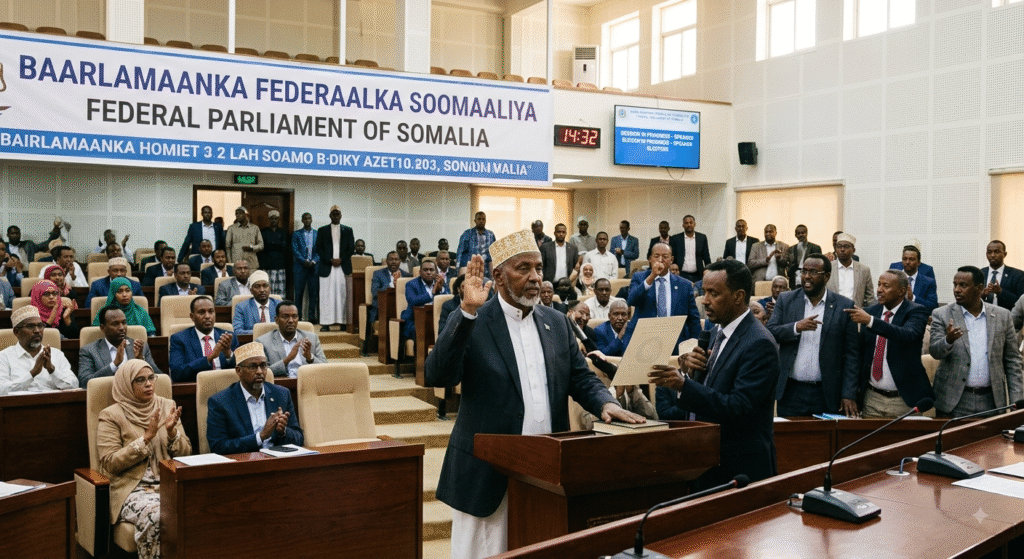
Somalia’s House of the People elected a new speaker on August 9, 2026, but the vote has done little to resolve the country’s deepening political crisis . The election of Abdulkadir Mohamed Nur—a Turkish-educated former minister—has instead exposed widening rifts between the federal government and opposition forces, raising concerns about the stability of Somalia’s fragile state institutions.
The Vote and the New Speaker
Abdulkadir Mohamed Nur, also known as Jama, secured 142 votes, defeating fellow candidate Abdulkadir Omar Maolim, who received 30 votes . The election was conducted by a parliament whose four-year term officially expired in April 2026, a fact that has become central to opposition complaints .
Nur brings extensive government experience to the role. He previously served as Somalia’s Minister of Ports and Maritime Transport (from March 2025), Minister of Defence, Minister of Justice, and as a senior adviser in the Office of the Speaker of the House . He studied international relations at Ankara University’s Faculty of Political Sciences from 2012 to 2016 . The speakership became vacant after his predecessor, Sheikh Adan Mohamed Nur Madobe, resigned on June 20 following his controversial election as president of Southwest State .
In his campaign, Nur pledged to strengthen parliamentary oversight of the executive branch . “The House of the People must closely monitor the activities of government agencies,” he said, signalling a potential shift toward greater legislative scrutiny .
A Parliament Without a Mandate
The election took place under a cloud of constitutional uncertainty. In March 2026, parliament approved amendments extending the terms of lawmakers and the president from four to five years, effectively delaying elections . The government argues these amendments provide constitutional authority for the institutions to continue operating .
Opposition figures reject this interpretation. The Somali Salvation Forum, an opposition alliance led by former President Sharif Sheikh Ahmed, argues that the government’s mandate expired in May 2026 and that it should operate only in a caretaker capacity . Lawmakers from Puntland and Jubaland boycotted the speaker election, citing expired mandates and deeper disputes over constitutional reform .
Reuters quoted analyst Samira Gaid of the Mogadishu-based Balqiis think tank noting that “the constitutional change doesn’t automatically extend the current president’s term but it is a matter of interpretation” . She added that elections slated for May would be delayed regardless because there is no agreed framework.
Allegations of Government Interference
The election process itself drew sharp criticism. Opposition figures accused the federal government of blocking rival candidates from registering and manipulating the outcome .
Yusuf Hussein Gamadid, Secretary-General of the Himilo Qaran Party, alleged that “MPs who are allied with the administration registered their candidacy, while others who independently showed interest were summoned, threatened and told they could not compete” . He described the process as “Hal Dhinac” (one-sided) .
MP Sharif Salah Sharif Salah Sayid Ali went further, stating the election had been “hijacked and turned into a one-horse race” engineered by government elements. He said he had prepared his candidacy materials, paid the $30,000 fee, and met all requirements, yet was declined participation without explanation .
Nur was widely seen as close to Villa Somalia—the state house and presidential compound . Some opposition figures also alleged Turkish backing for his candidacy, given his Turkish education .
A Deeper Constitutional Crisis
The speaker election is merely the latest manifestation of a constitutional crisis that has been building for years. The March 2026 constitutional amendments, which formally ended more than a decade under a provisional charter, were adopted by a parliamentary vote of 223 in favor—with no votes against, but with opposition lawmakers largely boycotting .
Critics argue the amendments were adopted through “non-consensual mechanisms” and “executive-led maneuvers” . An analysis from the Addis Standard noted: “In a federal, post-conflict society, constitutional legitimacy cannot be manufactured through parliamentary arithmetic or political coercion” .
Puntland, one of Somalia’s oldest federal member states, has rejected the amendments and suspended cooperation with the federal government . Jubaland has also distanced itself, with its president proceeding with his own contested state-level elections that the federal government refuses to recognize .
Analysts have warned of a “two-speed federation” in which different political actors operate under competing interpretations of constitutional authority .
What Lies Ahead
Nur’s election provides Somalia with a parliamentary leader at a critical moment. His pledge to strengthen oversight may offer a check on executive power, but the legitimacy of the institution itself remains contested. With the government’s mandate in dispute, federal-member state relations in crisis, and no agreement on electoral timing, the speaker’s ability to unify a divided parliament is uncertain.
As one governance analyst observed, “a constitution must unify a nation rather than deepen political suspicion; without trust, even technically valid reforms struggle to achieve enduring legitimacy” . Whether Somalia’s parliament can function effectively under these conditions remains an open question.