

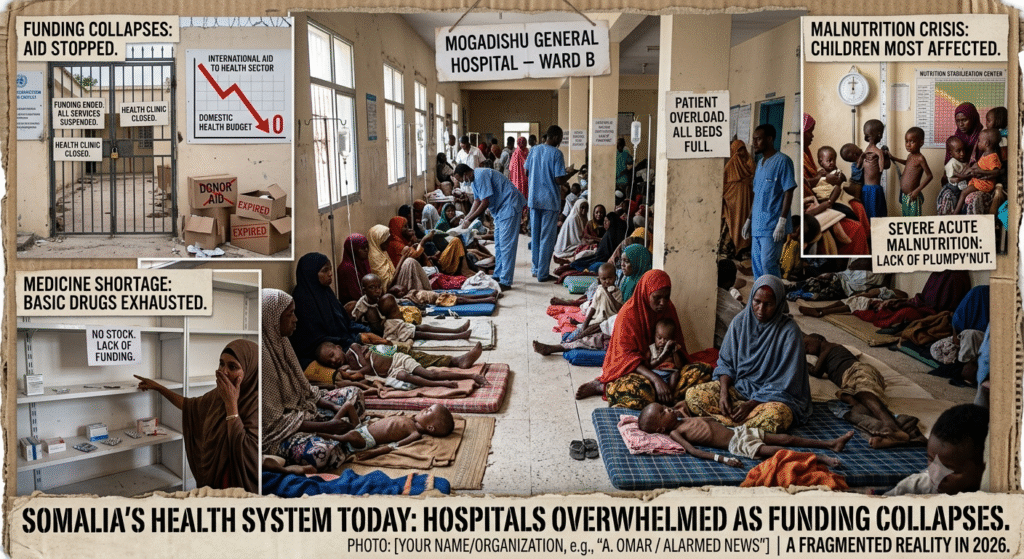
The healthcare system in Somalia is in a state of acute crisis in September 2026. Decades of conflict and drought have been compounded by a severe funding shortfall, causing a devastating collapse of the very institutions meant to save lives. The Somali Disaster Management Agency (SoDMA) has noted that the closure of approximately 700 health centers across the country—due to a decline in international donor support—has forced many patients to seek help at facilities like Banadir Hospital, which are now overwhelmed . This is not merely a problem of infrastructure but one of survival, as hospitals are being stretched to their breaking point.
🏥 A System in Collapse: The Impact of Funding Cuts
The country’s healthcare sector is reeling from “unprecedented cuts” in humanitarian aid that have decimated both preventative and emergency medical services. According to the UN Children’s Fund, funding cuts have already contributed to a 30% reduction in health and nutrition service coverage . The most visible consequence has been the closure of health facilities. As of August 2026, 205 health and nutrition facilities have already shut down, with warnings that under severe funding scenarios, as many as 618 could close nationwide .
Mothers are walking for hours in extreme heat with sick babies, only to arrive at clinics and find locked gates. Ambulances are sitting parked without fuel, and distribution centres for life-saving therapeutic food have closed . In Jubaland, the situation is so critical that CARE International has been forced to scale back support from 12 health facilities to just one remaining facility in Kismayo, and has lost 20 frontline health workers .
📈 The Malnutrition Crisis: A “Catastrophic” Surge
The health crisis is most devastatingly visible in the surge of malnutrition cases overwhelming hospitals . Across Somalia, nearly 1.9 million children are projected to suffer from malnutrition in 2026, with almost half a million facing severe acute malnutrition, the deadliest form . The collapse of community nutrition services means children are not being identified early, leading to severe complications by the time they reach hospitals.
Baidoa: A Crisis Epicenter
Baidoa Regional Hospital, supported by Médecins Sans Frontières (MSF), is a stark symbol of this catastrophe. Between March and May 2026, nearly 1,400 patients were admitted to the inpatient therapeutic feeding centre. The facility has expanded from 50 beds to 125 beds, but it is still being pushed beyond its limits, with admissions continuing to rise . Nearly one in two children under five screened by MSF in Baidoa is acutely malnourished, levels described as the highest recorded for this time of year since 2023 .
Mogadishu’s Overstretched Facilities
Banadir Mother and Child Hospital, a critical institution in Mogadishu, has been forced to become a central hub for treating malnutrition cases from across the country. The hospital’s director has confirmed that most of the patients are victims of the closure of health centers elsewhere . The Commissioner of SoDMA personally witnessed growing cases of malnutrition and increasing medical needs .
🏗️ A Glimmer of Hope: New Facilities
Amidst this dire reality, there have been efforts to expand capacity. In July 2026, Baitulmaal, an international humanitarian organization, opened the Baitulmaal Hope Hospital in the Garasballey District of Mogadishu. This new 30-bed facility includes a dedicated maternity unit supported by the Gates Foundation and is designed to provide lifesaving healthcare for internally displaced persons and underserved families .
The hospital provides adult, pediatric, and maternity outpatient consultations, skilled delivery services, and emergency obstetric surgery. Operating six days a week and equipped to serve 50–100 patients daily, it offers a vital lifeline to communities affected by conflict and displacement. However, this facility represents a small fraction of the total need in a country where 5.9 million people require humanitarian assistance .
🚑 The Future Remains Grim
The situation is expected to worsen. The combination of a record-strength El Niño, which is forecast to bring severe flooding, and the ongoing war in Iran driving up fuel and fertiliser costs, creates a “terrifying reality” for Somalia’s health system . As an MSF official stated, “children are discharged from the hospitals into the same conditions of hunger, and risk relapsing. Severe malnutrition is treatable, but too many children reach the hospital already critically ill” . The health system in Somalia is not just under pressure; it is on the verge of total collapse, and without an immediate injection of funding, the preventable deaths of thousands of children and mothers are imminent.