

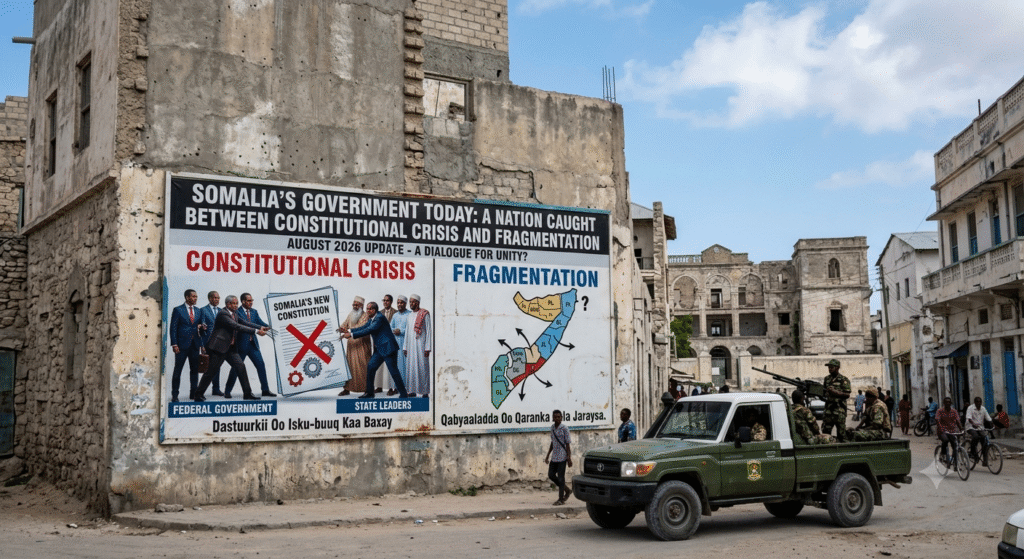
As of August 2026, Somalia’s federal government stands at its most precarious juncture since the state’s rebuilding began in 2012. The country faces a deepening constitutional crisis, an escalating confrontation between Mogadishu and powerful regional states, persistent security threats from Al-Shabaab, and a bloated bureaucracy that consumes scarce resources. These challenges have culminated in what analysts describe as a “crisis of the state itself” rather than merely a political dispute over elections .
The Constitutional Impasse: A Crisis of Legitimacy
At the heart of Somalia’s government problems lies a profound constitutional crisis. President Hassan Sheikh Mohamud’s official democratic mandate expired on May 15, 2026, yet no universally accepted roadmap exists for political transition . The government maintains that constitutional amendments provide legal authority for continuity, while the opposition rejects this interpretation entirely.
In March 2026, parliament approved a final package of constitutional amendments concluding a review process that lasted more than fourteen years . Supporters celebrated this as a historic milestone in Somalia’s state-building journey, but critics viewed it as a unilateral restructuring of the political system that dramatically expands executive authority while weakening consensus-based mechanisms.
The amendments were not technical adjustments. They represented “the most significant redesign of Somalia’s political architecture since the adoption of the provisional constitution” . The dispute is therefore not about whether reform was needed, but whether such reforms could legitimately be adopted without the consent of key political actors, opposition groups, and several federal member states.
The opposition, led by figures including lawmaker Abdirahman Abdishakur Warsame of the Somali Future Council, has proposed an alternative mechanism: establishing an interim body to oversee elections if a caretaker government cannot be formed. Warsame argues that Somalia’s provisional constitution requires a government whose term has expired to continue only in a caretaker capacity, accusing the current administration of refusing to assume that role .
The armed confrontations that shook Mogadishu in June fundamentally altered the nature of this dispute . For the first time since the constitutional crisis escalated, major political actors demonstrated a willingness to use organized armed force in pursuit of political objectives. Government forces and troops aligned with opposition figures exchanged fire in several districts of the capital, using mortars, armored vehicles, and heavy weapons in densely populated neighborhoods. As one analysis noted: “What began as a disagreement over election procedures has evolved into a struggle over constitutional legitimacy. What began as a constitutional debate has become an armed confrontation” .
Federalism Under Strain: Center vs. Periphery
The crisis extends far beyond Mogadishu. Somalia’s federal experiment, designed to distribute power and reduce clan rivalry by avoiding a “winner takes all” mentality, has instead “institutionalised fragmentation” according to political analyst Abdirashid Fidow .
Relations between the federal government and pivotal Federal Member States, most notably Puntland and Jubaland, have deteriorated to near-total estrangement . Puntland, which declared itself an autonomous state in 1998 long before the 2012 provisional constitution, sees itself as a founding entity and frequently challenges federal authority. Jubaland has similarly asserted independence, backed by its own security forces and strategic alliances with neighboring states.
The federal government’s unilateral approach has backfired. As Adam Daud Ahmed, a Horn of Africa analyst, noted: “When the rules of the game are rewritten unilaterally in the middle of a crisis, the result isn’t a stronger state, but a more divided one. Somalia is currently navigating a path where the center and the periphery are moving in opposite directions” .
This fragmentation has practical consequences. Even the president has at times been unable to visit Puntland or Jubaland because regional presidents have denied him entry . The federal government cannot convene its own member states or set foot in certain regions, yet foreign ambassadors move freely across them.
A Bloated and Unaffordable Bureaucracy
Compounding these political challenges is a governance structure the country cannot afford. Across the federal government and member states, more than 340 government institutions now exist, many with overlapping mandates and redundant structures .
Somalia’s federal government comprises 70 public institutions, while Federal Member States have replicated nearly all these structures. Somaliland operates 63 institutions, Puntland 48, Galmudug 34, Southwest 36, Jubaland 34, and Hirshabelle 32 . This duplication has profound implications: it dilutes accountability, inflates administrative costs, and fuels political competition over mandates and resources.
Financial data reinforce this picture. According to the Somali Public Agenda’s analysis of the 2025 budget, administrative spending continues to dominate public expenditure—$427.7 million, up from $382 million in 2024—accounting for 32.4% of the total budget. Alarmingly, “these administrative costs nearly match the government’s total domestic revenue, reflecting a severe fiscal imbalance that leaves minimal space for investment in essential public services” .
Security and the Shadow of Al-Shabaab
Every day spent debating constitutional legitimacy is a day not spent confronting Somalia’s most dangerous armed threat. Al-Shabaab remains resilient, and in a major setback, the group captured the strategic town of Teedaan in central Somalia in early August after intense 24-hour battles with government forces . Teedaan sits on a key road axis linking several localities in the Hiiraan region to the eastern and northern regions, and its capture could facilitate insurgent movements and generate revenue through taxation on vehicles.
This political fragmentation benefits the insurgent movement. As one analysis notes, “Political fragmentation benefits insurgent movements. It weakens command structures. It divides political leadership. It undermines public confidence in government institutions” . The irony is striking: the government argues that constitutional reform is necessary to strengthen the state, yet the political conflict generated by those reforms risks weakening the state at precisely the moment it faces severe security challenges.
The security situation is further complicated by the uncertain future of AUSSOM, the African Union force that supports Somali forces. The mission faces a critical funding shortfall and the threat of losing UN logistical support, which could lead to its collapse .
Dual Citizenship and Elite Accountability
Adding to governance concerns is the issue of dual nationality among Somalia’s political elite. In late July, President Mohamud issued an ultimatum that dual citizens holding public office must forswear their foreign nationality or vacate their posts. Deputy Prime Minister Jibril Abdirashid Haji became the first senior figure to comply, formally surrendering his Kenyan passport . While the provisional constitution does not explicitly outlaw dual nationality for public officials, the directive imposes a new litmus test for the upper echelons of power.
Conclusion
Somalia’s government today faces a convergence of crises that threaten the very foundations of the federal project. The constitutional impasse has created a legitimacy vacuum, federal-state relations have fractured, security threats are intensifying, and a bloated bureaucracy consumes resources needed for essential services. As one analyst warned: “The danger is not simply that elections may be delayed. The danger is that Somalia may lose the consensus that has prevented political disagreements from becoming open conflict. If that consensus collapses, the country will not be facing an electoral crisis. It will be facing a crisis of the state itself” . The path forward requires a genuine recalibration of federal power, inclusive dialogue, and the political will to subordinate immediate survival to long-term national continuity.
