

MOGADISHU — June 14, 2026
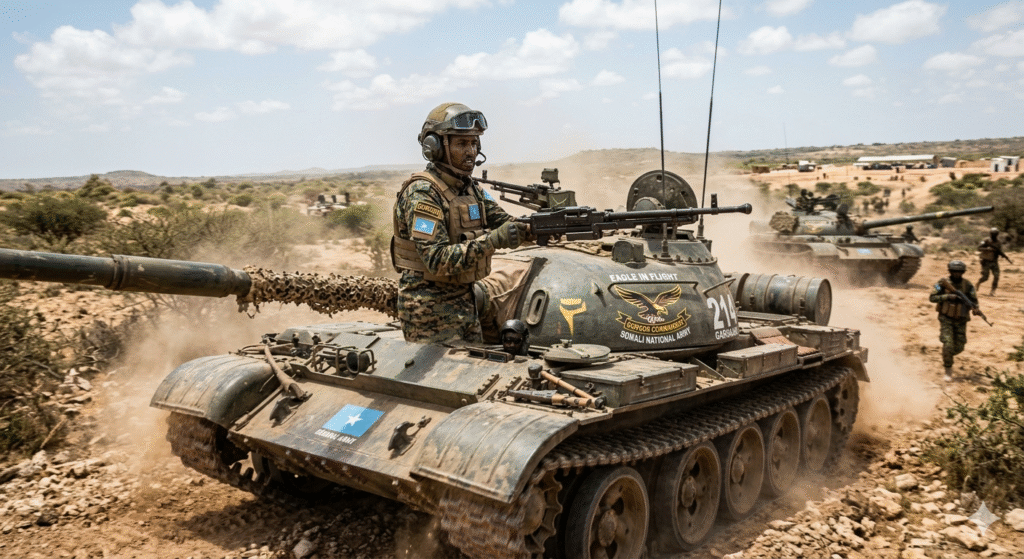
In the sun-scorched plains of Middle Shabelle, the 195th Battalion of the 19th Brigade is on the move. For the past two weeks, these elite soldiers—part of Somalia’s famed Gorgor Commando Unit—have been conducting planned operations in the areas of Jabad Carbeyd and Dabagaab, hunting militants who have terrorized rural communities for years .
But something has changed. The soldiers moving through the bush are no longer just light infantry armed with assault rifles and tactical vehicles. Among them now are 45-ton M48 Patton main battle tanks, their diesel engines rumbling across terrain that has not seen tracked conventional armor since the collapse of the Somali state in the 1990s .
The Gorgor—meaning “The Eagle” in Somali—is transforming. And as Somalia prepares to assume full responsibility for its own security with the impending drawdown of international forces, that transformation could not come at a more critical moment .
Part 1: Origins of the Eagle — A Turkish Partnership
The Gorgor Special Forces were established in 2017 through a bilateral agreement between Somalia and Turkey . Their creation represented a strategic shift in Somalia’s military development, moving away from reliance on clan-based militias toward a professional, centralized fighting force.
The training pipeline is rigorous and reflects the depth of the Turkish commitment. Gorgor commandos undergo their initial training at Camp TURKSOM, a sprawling four-square-kilometer Turkish military facility in Mogadishu that stands as Ankara’s largest overseas military base . There, Turkish Army instructors impart discipline, tactical coordination, and weapons proficiency.
The most promising soldiers then travel to Isparta, Turkey, for advanced commando training modeled on the Turkish Armed Forces’ own special operations regimen . Since the program began, Turkey has trained more than 6,000 Gorgor personnel, creating a force estimated at approximately 4,000 active soldiers as of March 2024 .
The unit’s colors—olive green and black—have become a symbol of the federal government’s determination to reclaim territory from Al-Shabaab, the Al-Qaeda-affiliated militant group that has waged a devastating insurgency for nearly two decades .
Part 2: The Armored Revolution — Tanks Return to Somalia
The most significant development in the Gorgor’s evolution came on February 14, 2026. The Turkish Navy landing ship TCG Sancaktar docked at the Port of Mogadishu and offloaded an estimated 10 to 15 M48 and M60 Patton main battle tanks .
For the first time since the fall of Siad Barre’s regime in 1991, the Somali National Army once again possessed tracked conventional armor.
The tanks are not new—they are legacy platforms previously operated by the Turkish Armed Forces. But they have been extensively modernized. The M48A5T2 variant features a 750-horsepower twin-turbo diesel engine (replacing the original, highly flammable gasoline engine), a 105 mm M68 rifled cannon (upgraded from the original 90 mm gun), and a thermal fire-control system with laser rangefinder that allows crews to acquire targets in smoke, dust, and total darkness .
A gun stabilization system enables the cannon to fire accurately while the tank is in motion—a critical capability for mobile offensive operations.
Alongside the tanks, the Gorgor have received at least 20 BMC Kirpi Mine-Resistant Ambush Protected (MRAP) vehicles, delivered in batches between 2020 and 2021, providing protection against the improvised explosive devices that remain a central element of insurgent tactics .
Part 3: Training for a New Kind of War
The introduction of heavy armor has required a corresponding evolution in training. Turkish instructors have expanded the Gorgor curriculum to incorporate armored maneuver warfare—a shift from the asymmetric counter-insurgency tactics that have defined the Somali conflict for decades .
The dual-track program now divides instruction between TURKSOM in Mogadishu and specialized commando schools in Isparta. The heavy armor component focuses extensively on operating Turkish-supplied equipment, including maintenance of diesel engines, hydraulic systems, and the complex electronics of modernized fire control systems.
This is not merely about driving tanks. Turkish instructors are embedding technical maintenance modules directly into the commando curriculum, ensuring that Somali maintenance units can service the engines and stabilization systems without constant foreign intervention .
The logistical challenge is immense. Operating 45-ton tracked vehicles requires robust supply lines for diesel fuel, specialized spare parts, and heavy maintenance equipment—areas where the underfunded Somali military has historically struggled. The training program is designed to address these vulnerabilities, but success will depend on sustained investment and institutional discipline.
Part 4: Combat Operations in Middle Shabelle
The Gorgor’s baptism by fire continues in Middle Shabelle. Over the past two weeks, the 195th Battalion of the 19th Brigade has been conducting intensified operations targeting militant hideouts in the areas of Jabad Carbeyd and Dabagaab .
According to military officials, the missions aim to strengthen security and prevent threats posed by militants hiding in parts of the region. The operations are part of a broader series of coordinated offensives in central and southern Somalia designed to weaken armed insurgent networks operating in rural areas .
On June 8, Radio Dalsan reported that Somalia’s intelligence agency had delivered a major blow to Al-Shabaab in Middle Shabelle, killing over 33 militants in coordinated operations that dismantled key hideouts and logistical networks .
The same report noted that Gorgor commandos had conducted a humanitarian operation in the region, delivering critical food aid to communities suffering from severe drought—an “incredible show of solidarity” that reflects the unit’s evolving role beyond pure combat .
Part 5: The Dual Mission — Fighting and Feeding
The humanitarian mission is not an anomaly. On May 13, 2026, the Gorgor First Unit executed a comprehensive relief operation in the Mubarak area of Lower Shabelle in direct coordination with Turkish military advisors from TURKSOM .
The joint force distributed essential food supplies—flour, rice, sugar, and cooking oil—to hundreds of vulnerable households in an area recently liberated from militant control.
Commanding Officer Lieutenant Colonel Sahid Jama Farah, who directed the distribution, emphasized that the military apparatus remains committed to both “the kinetic defense of the republic and the immediate physical welfare of its citizens” .
The operation reflects the Federal Government’s “Liberation and Stability” strategy, where the state immediately fills the administrative vacuum left by defeated insurgent groups with tangible, life-saving resources. Local leaders reported a “drastic improvement” in both absolute security and daily living conditions since federal forces secured the perimeter .
Part 6: Strategic Deployment to Gedo
The Gorgor’s reach extends beyond the traditional battlefields of Middle and Lower Shabelle. On April 25, 2026, the federal government deployed a contingent of Gorgor commandos to the strategic district of Luuq in the Gedo region, near the Ethiopian border .
Security officials confirmed that the first aircraft carrying the specialized troops landed in Luuq early that day, with additional flights scheduled to bolster troop density. The deployment marked a significant escalation in the state’s military presence in an area that has long been a focal point of both security operations and political friction.
Gedo has been a contested zone, with the federal government maintaining control over most of the province while the districts of El Wak and Doolow remain outside its primary administrative reach. The deployment of elite forces to Luuq is intended to secure strategic corridors in the border region .
However, the move has drawn criticism from political opponents, who submitted a formal complaint to the Turkish ambassador accusing Ankara of interfering in Somalia’s internal political affairs through its military support for federal forces .
Part 7: The Numbers — What the Gorgor Represent
Within the broader Somali National Army, the Gorgor stand as the clearest sign of progress. The SNA numbers approximately 32,000 personnel on paper, but only around 19,000 are de facto deployable . Cohesion remains undermined by heavy clan-based recruitment, disparities in training and equipment, and lingering problems of desertion, defections, and even infiltration by Al-Shabaab.
The Gorgor are different. As a Turkish-trained special operations unit, they represent the Somali state’s best hope for a professional, disciplined, and politically reliable fighting force . Alongside the US-trained Danab Brigade (approximately 1,700 active personnel), the Gorgor are the formations that the federal government relies on for the most sensitive and demanding operations .
Their estimated strength of 4,000 soldiers—trained by a single foreign partner with a sustained, multi-year commitment—gives them a cohesion that the broader SNA lacks.
Part 8: The Armor Challenge — Strengths and Vulnerabilities
The introduction of main battle tanks to the Gorgor arsenal brings both opportunities and risks.
The M48’s cast steel hull provides up to 178 mm of physical armor thickness, offering reliable protection against older anti-tank rounds, automatic cannons, and artillery shell fragments commonly encountered in regional skirmishes . The 105 mm main gun can destroy fortified positions and engage targets at ranges exceeding 2,000 meters.
But the legacy platforms lack modern active protection systems. This omission leaves the tanks highly vulnerable to tandem-warhead anti-tank guided missiles and heavy improvised explosive devices—both of which remain central to insurgent strategies .
The logistical burden is equally daunting. Operating 45-ton tracked vehicles requires a support infrastructure that Somalia is only beginning to build. Turkish instructors are attempting to address this by embedding technical maintenance training into the commando curriculum, but the long-term sustainability of the armored capability remains an open question.
Part 9: The Regional Context — AUSSOM and the Transition
The Gorgor’s transformation is taking place against a critical deadline. The African Union Transition Mission in Somalia (ATMIS) is scheduled to phase out its presence by mid-2026, to be replaced by the African Union Support and Stabilization Mission in Somalia (AUSSOM), which began operations in January 2025 .
The transition forces the Somali National Army to rapidly scale up its independent operational readiness. Equipped with heavy armor and mobile MRAPs, the Gorgor Commandos are expected to spearhead high-mobility offenses to clear militant strongholds in central and southern Somalia, securing wide perimeters around critical national assets .
The United States continues to provide air support, with AFRICOM reporting airstrikes in coordination with the Federal Government of Somalia on March 19 and March 27, 2026, targeting Al-Shabaab . These strikes underline a basic reality: even as the Gorgor acquire new capabilities, Somali forces are still fighting with partner-enabled airpower when operations require rapid reach or precision effects.
Part 10: The Political Dimension — Ankara’s Expanding Role
The deepening military relationship between Mogadishu and Ankara carries political implications that extend beyond the battlefield. Turkey operates its largest overseas military facility at Camp TURKSOM and has trained thousands of Somali soldiers since 2017 .
The defense partnership expanded further through high-level talks on May 18, 2026, between Somali Defence Minister Ahmed Moallim Fiqi and Turkish officials, focusing on long-term institutional modernization and the protection of emerging aerospace facilities north of the capital .
Opposition figures have accused Turkey of interfering in Somalia’s internal political affairs through its military support for federal forces. The deployment of Gorgor commandos to Gedo—a region with complex political dynamics—has intensified these criticisms .
Yet from the federal government’s perspective, the Turkish partnership is indispensable. Turkey provides not only training and equipment but also a level of sustained commitment that other international partners have been unwilling or unable to match.
Part 11: The Command Structure — Leadership and Losses
The Gorgor are currently commanded by Lieutenant Colonel Hassan Salaad Abdi . The unit has suffered significant losses in its years of combat, including Major Mohamed Abdiwahid, a notable commander killed in action .
President Hassan Sheikh Mohamud has publicly commended the Gorgor on multiple occasions, praising their role in reclaiming territory and advancing national security during the ongoing counterterrorism campaign .
The unit’s anniversary is celebrated on April 12, Somalia’s Armed Forces Day, which commemorates the establishment of the Somali National Army in 1960 .
Part 12: The Road Ahead — Can the Eagle Fly?
As June 2026 progresses, the Gorgor Commandos face a future of both promise and peril.
The promise is clear: with Turkish-supplied tanks, MRAPs, and advanced training, the Gorgor are becoming a more capable, more professional fighting force. Their integration of humanitarian operations into post-conflict stabilization reflects a sophisticated understanding of counter-insurgency doctrine. Their deployment to strategic zones like Gedo demonstrates the federal government’s determination to project power across the country.
The peril is equally evident. The logistical burden of maintaining armored vehicles may prove unsustainable. The political controversy surrounding Turkish involvement could complicate future cooperation. And the broader Somali National Army—on which the Gorgor depend for logistics, intelligence, and follow-on forces—remains fragmented, under-resourced, and vulnerable to infiltration.
The EUAA assessment that only 19,000 of 32,000 SNA personnel are de facto deployable is a sobering reminder of the gap between nominal strength and operational reality . The Gorgor may be the eagle, but an eagle cannot win a war alone.
What the Gorgor represent, ultimately, is a bet—a bet that with the right training, the right equipment, and the right international partnership, Somalia can build a professional military capable of securing its own territory and protecting its own citizens.
As the African Union mission draws down and Somalia assumes full responsibility for its security, that bet is about to be tested as never before. The Eagle is learning to fly with tanks. Whether it can stay in the air will determine the future of the Somali state.
