

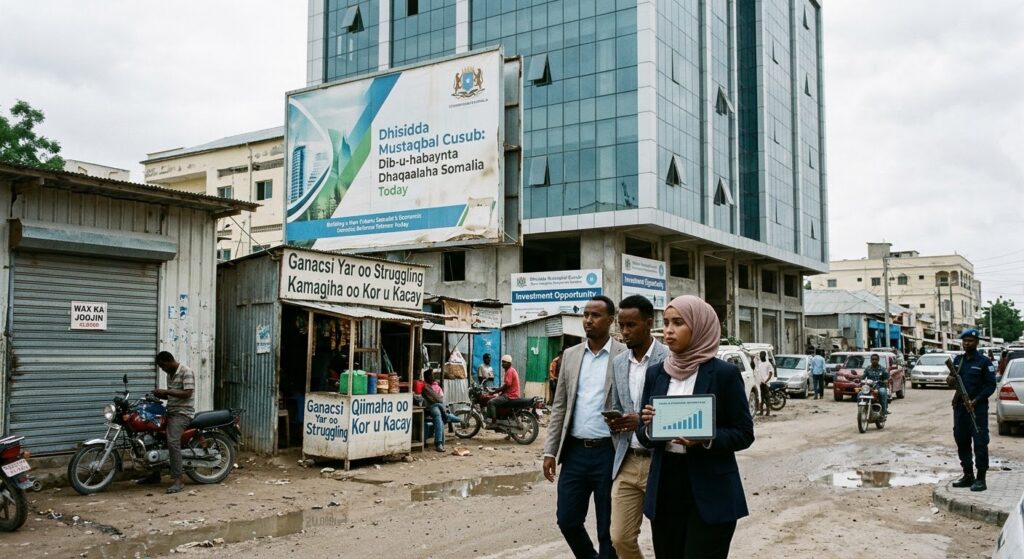
MOGADISHU — Somalia’s business community enters late 2026 with a paradox. On one hand, the country is deeper into its WTO accession process than ever before, attracting Italian investors, signing trade agreements with Washington, and launching a national development bank to finance entrepreneurs. On the other, the economy is slowing, foreign aid is contracting sharply, inflation is accelerating, and the Somali shilling is being rejected as legal tender in parts of the capital. The private sector that has kept Somalia alive through decades of conflict now faces a moment of both unprecedented opportunity and severe constraint.
The WTO Track: A Door Opening Slowly
The most concrete sign of institutional progress came in mid-October, when the World Trade Organization and the International Trade Centre conducted their first joint technical assistance mission to Mogadishu. For a week, experts from Somali ministries worked with WTO and ITC advisors on the documentation that will form the basis of the second Working Party meeting on Somalia’s accession, targeted for 2027. The sessions focused on finalizing replies to questions raised by WTO members at the first meeting in February 2025, completing accession-supporting documents, and preparing Somalia’s initial market access offers on goods and services .
The visit also addressed the intersection between WTO accession, East African Community integration, and the African Continental Free Trade Area. Somalia’s Chief Trade Negotiator, Sadiq Abdikarim Haji Ibrahim, emphasized “the importance of aligning Somalia’s EAC integration agenda with WTO accession and its participation in the AfCFTA” . The WTO process offers Somalia something it has never had: a rules-based framework for trade that could, over time, reduce the discretionary decision-making and regulatory opacity that the U.S. State Department identifies as persistent obstacles for investors .
The Investment Push: Enthusiasm Meets Reality
Somalia’s government is actively courting foreign capital. In June, President Hassan Sheikh Mohamud received a delegation of Italian business leaders at the Presidential Palace for a Somalia-Italy business and investment forum, encouraging them to explore opportunities in infrastructure, energy, fisheries, agriculture, manufacturing, and social services . In March, Somali and U.S. officials held their first formal trade and investment talks inside Somalia, focusing on critical minerals, oil and gas, and energy sector development. The two sides agreed to establish joint technical committees to follow up on the discussions .
But the legal architecture underpinning these ambitions remains thin. According to the State Department’s 2026 Investment Climate Statement, Somalia has only two bilateral investment treaties still in force—with Germany and Egypt—both dating from the 1980s and neither updated to include modern investor-state dispute mechanisms. The country has no bilateral income tax treaty with any country. Agreements with Türkiye, Qatar, and Saudi Arabia that include investment provisions have not undergone formal ratification, and their terms are not publicly disclosed . Investor protections are often governed through contract-specific provisions rather than a predictable legal framework, and institutional capacity to negotiate, enforce, and monitor such agreements is described as “limited” .
The Macroeconomic Squeeze
The business environment is being shaped by forces beyond the control of any entrepreneur or policymaker. The World Bank estimates Somalia’s real GDP growth slowed to 3 percent in 2025 and projects just 2.8 percent in 2026, with growth constrained by continued aid reductions, climate variability, global price shocks, and limited productive capacity . A later World Bank projection put the 2026 figure even lower, at 2.5 percent, citing declining external assistance and adverse weather conditions .
The aid contraction is severe. Foreign grants are estimated to have fallen by 5 percentage points to 23.1 percent of GDP in 2026, as bilateral and multilateral off-budget support dwindled . Domestic revenues are projected to rise only marginally, to 3.6 percent of GDP, leaving the government with a fiscal deficit of about 0.9 percent of GDP and little capacity to invest in the infrastructure and services that businesses need .
Inflation is accelerating. The Central Bank of Somalia projected headline inflation to rise to 5.9 percent in 2026 from 3.7 percent in 2025, driven by fuel prices that more than doubled following the Middle East conflict, generating cost-push pressures across transport, food, and utilities . The World Bank’s later projection put inflation at 7.0 percent . The Somali shilling depreciated by 1.2 percent during the first quarter, reaching an average of 31,956 shillings per dollar .
The Currency Crisis
Perhaps the most visible business problem is the near-total dollarization of the economy. In April, the Banadir regional administration directed businesses in Mogadishu to stop rejecting the Somali shilling as legal tender, after widespread reports that merchants were refusing the national currency. Business representatives told the administration that pricing instability and the practical difficulties of operating in a dual-currency environment were driving the practice. The governor promised to work with business groups to ease implementation challenges and stabilize market operations .
The structural problem is deep. Years of dollarization, combined with the dominance of mobile money systems used for salaries, remittances, and retail payments, have weakened the shilling’s role by limiting its circulation and accelerating its depreciation. Analysts note that while mobile money has improved financial inclusion in urban areas, it has also widened disparities for residents without access to smartphones, digital wallets, or stable dollar income . Stakeholders called for coordinated policy measures between government and the private sector to address liquidity constraints, stabilize pricing, and restore confidence in the national currency—a call that has been repeated for years without resolution.
The Development Finance Experiment
Amid these constraints, Somalia is attempting to build new institutions for financing its private sector. In September, the Somali Development and Reconstruction Bank convened the Somalia Development Financing Forum under the theme “Financing Somalia’s Next Chapter: From Recovery to Sustainable Development.” President Hassan Sheikh Mohamud described the Bank’s first investment as “a clear sign of the progress our country is making in rebuilding its institutions and advancing its economic development” .
The Bank’s president, Hodan Osman, articulated the gap it aims to fill: “Somalia does not lack entrepreneurs or opportunity; what is missing is the patient, structured capital that can help successful businesses grow into larger companies and industries” . The Forum also marked the formalization of partnerships under the Ramad Microfinance Program, a wholesale initiative through which SDRB provides capital and institutional support to accredited microfinance institutions—Asal, Maal, and Himilo—to expand Shariah-compliant financing for micro, small, and medium-sized enterprises .
The model is sensible in theory: use a public development bank to channel capital through existing microfinance institutions rather than building new delivery mechanisms from scratch. But the scale of the challenge is enormous. Somalia’s private sector has survived without formal banking infrastructure, without enforceable contracts, and without reliable electricity or roads. Whether a nascent development bank can meaningfully expand access to capital while the broader economy contracts remains an open question.
The Diaspora and the Long Game
The Commerce Minister, Gamal Mohamed Hassan, traveled to Nairobi in late October for the third Global Somali Entrepreneurship Forum, where he delivered remarks on “Unlocking Somalia’s Private Sector Potential.” Somalia’s ambassador to Kenya, Jabril Ibrahim Abdulle, called on organizers to hold the fourth edition of the forum inside Somalia, saying it would “showcase Somalia’s growing business potential” . The request reflects a genuine ambition: to shift the narrative from a country that exports its entrepreneurs to one that attracts them back.
For now, the Somali business community operates in a space defined by contradictions. The WTO accession process is moving forward, but the legal framework for investment remains incomplete. Foreign delegations are visiting Mogadishu with enthusiasm, but the macroeconomic environment is deteriorating. A development bank is making its first investments, but inflation and currency instability are undermining the purchasing power that businesses depend on. The private sector has kept Somalia functioning through decades of state collapse. Whether it can thrive in an era of shrinking aid and slowing growth is the question that will define the country’s economic future.