

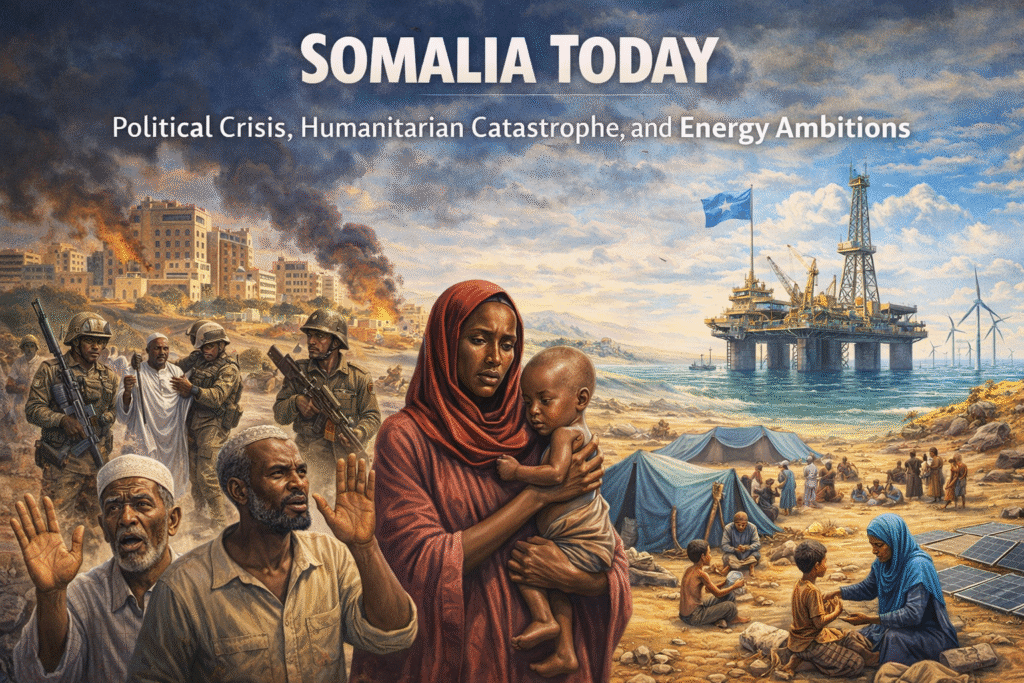
As Somalia enters April 2026, the nation stands at a precipice. A deepening political crisis in the Southwest State threatens to unravel fragile federal structures, while a staggering humanitarian emergency affects over 6.5 million people. Yet amid the turmoil, there are glimpses of strategic ambition—from energy exploration to youth empowerment—that hint at a different possible future. This is the complex reality of Somalia today.
The Baidoa Crisis: Federal Forces Move In
The most immediate flashpoint is the strategic city of Baidoa, the interim capital of Southwest State, approximately 245 kilometers northwest of Mogadishu. On March 31, Somali federal forces entered and took full control of the city—a move that prompted the immediate resignation of regional leader Abdiaziz Hassan Mohamed Laftagareen after more than seven years in office .
The crisis had been brewing for weeks. Laftagareen had just been re-elected for another five-year term in an election the federal government declared illegal. The Southwest State administration had previously severed ties with Mogadishu over bitter disputes regarding constitutional changes and alleged federal interference in regional elections . The federal government maintained that the regional leadership’s mandate had expired, setting the stage for confrontation.
Prime Minister Hamza Abdi Barre has sought to calm fears of instability. Speaking at the “Daaci 2026” youth awards ceremony in Mogadishu on March 30, he confirmed that government forces are firmly in control of Baidoa’s security and dismissed rumors of impending “retaliation” against political opponents . “The mandate will be returned to the people,” Barre stated, pledging that the community would have the ultimate say in electing their regional leadership through a fair process .
However, the situation remains volatile. A series of social media posts by Ports and Maritime Transport Minister Abdulqadir Mohamed Nur—who is widely believed to be backed by Villa Somalia for a potential Southwest presidency bid—has drawn sharp criticism. Political analysts describe the minister’s detailed posts about troop movements as provocative, arguing they risk undermining the neutrality of the national armed forces while the minister pursues political office .
The stakes extend far beyond Somalia’s borders. Kenya had been preparing to reopen its border with Somalia in April 2026—a milestone nearly 15 years in the making after the 2011 closure linked to al-Shabaab attacks. The planned crossings at Mandera-Bulahawa, Liboi-Harhar/Dobley, and Kiunga-Ras Kamboni were expected to offer hope for economic revival and the reconnection of families separated by years of restricted movement . That reopening is now hanging by a thread as the political crisis unfolds just across the frontier.
International Calls for Restraint
Regional and international bodies have responded with alarm. The African Union has called for urgent dialogue, warning that the standoff risks destabilizing not just Somalia but the wider Horn of Africa—a region already fragile and highly prone to security shocks . The Chairperson’s statement urged all parties “to exercise maximum restraint and avoid actions that could lead to escalation” .
The Intergovernmental Authority on Development (IGAD), the eight-nation Horn of Africa bloc, echoed these concerns. In a statement issued on March 29, IGAD expressed concern over rising tensions and emphasized that the widening rift between the central government and federal member states “should be resolved through inclusive dialogue and established national mechanisms” . The bloc, which has long played a mediation role in Somalia’s state-building efforts, indicated it “stands ready to facilitate dialogue and reconciliation efforts” .
On March 31, Somali President Hassan Sheikh Mohamud convened a meeting with ambassadors accredited to Somalia, including Qatar’s Ambassador HE Dr. Abdullah bin Salem Al Nuaimi, to brief them on the latest political and security developments in the region . The meeting underscored the diplomatic community’s intense focus on Somalia’s trajectory.
The political fragmentation extends beyond Southwest State. Both Puntland and Jubbaland have aligned with the federal government on this issue, deepening a nationwide political rift that analysts warn could pull Somalia further apart . The crisis coincides with broader tensions, as several regional states have rejected recent federal constitutional amendments, raising fears that internal infighting could undermine the long-running military offensive against al-Shabaab militants .
A Humanitarian Catastrophe Unfolds
While political tensions dominate headlines, a humanitarian crisis of staggering proportions continues to unfold. According to the latest Integrated Food Security Phase Classification (IPC) analysis, a staggering 6.5 million people in Somalia are facing high levels of acute food insecurity from February to March 2026—nearly double the population classified in IPC Phase 3 (Crisis) or above in August 2025 . This includes more than 2 million people in IPC Phase 4 (Emergency), one step away from famine .
The deterioration is driven by worsening drought, rising food prices, and insecurity across central, southern, and parts of northern Somalia . Crop failures, livestock losses, milk shortages, and rising food prices have reduced household food access and dietary diversity, leading to inadequate child nutrition . The situation is compounded by a 27 percent reduction in humanitarian assistance in January 2026 compared to the previous year .
The malnutrition figures are devastating. Between January and December 2026, an estimated 1.84 million children aged 6 to 59 months will suffer from acute malnutrition, including 483,000 cases of severe acute malnutrition requiring emergency treatment . Compared with the same period in 2024, acute malnutrition rates have risen by 7 percent, and severe acute malnutrition by 4 percent .
The health infrastructure is buckling under the strain. Funding shortages have forced the closure of 125 severe acute malnutrition treatment sites and 360 moderate acute malnutrition treatment points . Immunization coverage, vitamin A supplementation, and deworming rates have fallen, increasing disease and malnutrition risks. Compounding these challenges, inadequate water supply and poor sanitation conditions persist, with open defecation rates high during the rainy season, significantly increasing the risk of water contamination and disease transmission .
The World Food Programme (WFP) has issued stark warnings that food aid could cease entirely without new funding. In February, the agency revealed that without fresh funding, food distributions could face drastic cuts as early as May. The WFP received only 50 percent of the funding it needed in the previous fiscal year, leading to reduced rations and fewer beneficiaries . With more than 7 million Somalis—approximately half the country’s population—projected to experience acute food insecurity, the warning carries life-or-death consequences.
Youth, Technology, and Moral Leadership
Against this backdrop of crisis, Somalia’s Prime Minister struck a different note at the “Daaci 2026” awards ceremony in Mogadishu—an initiative aimed at encouraging young Somalis to promote religious values and community service under the theme “Somalis telling their own story” .
Prime Minister Barre praised the youth for reclaiming the national narrative and called on them to leverage technology for social good. “Every individual, whether a merchant, journalist, politician, or cleric, can draw closer to God through their professional work while building a virtuous society,” he told the gathering .
Despite the celebratory tone, Barre was blunt about what he termed the “existential threats” facing the Horn of Africa nation. He identified tribalism, corruption, terrorism, foreign interference, and cultural erosion as the primary challenges currently undermining Somali unity, urging the youth to use social media as a tool for “enlightenment and moral growth” rather than conflict .
The Prime Minister’s emphasis on youth comes at a critical juncture. Somalia has one of the youngest populations in the world, with more than 70 percent of citizens under the age of 30. How this generation navigates the tensions between traditional structures and digital engagement will shape the country’s trajectory for decades.
Energy Ambitions on the Horizon
Amid the political and humanitarian crises, there are signs of strategic investment in Somalia’s future. Türkiye is set to accelerate hydrocarbon exploration and drilling activities off the Somali coast in April 2026, leveraging its advanced energy fleet .
The Çağrı Bey drillship is scheduled to start operations at the Curad-1 well in Somali waters by the end of April. This follows the departure of its twin, the Yıldırım, a seventh-generation ultra-deepwater drillship, for the Black Sea in January. With these additions, Türkiye’s number of drillships rises to six, placing the country fourth globally in terms of fleet size when combined with seismic vessels .
The exploration builds on a bilateral energy cooperation framework between Somalia and Türkiye that has been developing over recent years. For Somalia, the prospect of commercially viable offshore hydrocarbon reserves represents a potential pathway to economic transformation—if stability can be secured and revenues managed transparently.
Outlook
Somalia today presents a stark duality. On one hand, a federal system is being tested by the same centrifugal forces that have undermined state-building for decades. The Baidoa crisis has exposed deep fissures between Mogadishu and federal member states, with regional and international actors scrambling to prevent escalation into armed confrontation.
On the other hand, the foundations for a different future are being laid—however tentatively. Youth engagement initiatives, strategic energy partnerships, and ongoing counter-terrorism operations all point to a country that continues to build despite the odds.
The immediate priorities are clear. The 6.5 million people facing acute food insecurity cannot wait for political solutions. The 483,000 children at risk of severe malnutrition cannot be held hostage to funding shortfalls. The 45,000 people already displaced from Baidoa need shelter, food, and security .
Whether Somalia’s leaders choose dialogue over confrontation, and whether the international community steps up with the resources needed to avert catastrophe, will determine whether April 2026 is remembered as a moment of crisis averted or an opportunity squandered. For now, the nation watches, waits, and hopes.
