

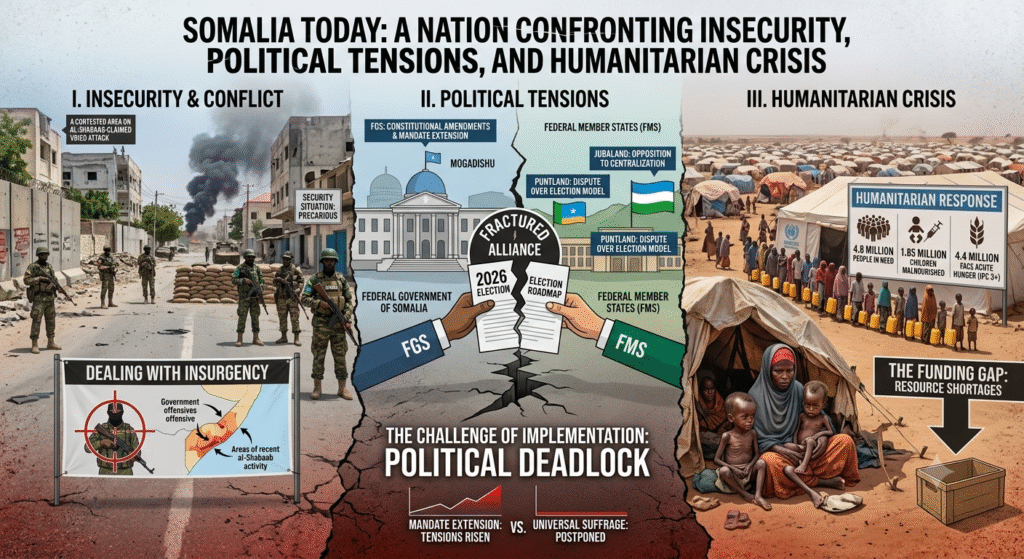
Somalia faces a critical moment in August 2026. The fragile federal government is grappling with a complex web of challenges: an escalating security crisis as Al-Shabaab makes tactical gains, intensifying political fragmentation between Mogadishu and regional states, a stubborn humanitarian emergency, and a push for economic reform. While the government projects confidence, the country’s structural weaknesses are increasingly apparent.
The Security Front: Al-Shabaab’s Resurgence
The security situation has deteriorated significantly. In a stark setback for government forces, the Al-Qaeda-affiliated Al-Shabaab captured the strategic town of Teedaan in the central Hiiraan region after intense fighting on August 2-3 . The group claims to have killed 41 soldiers and seized military vehicles and weapons .
Teedaan’s location on a key road axis linking Hiiraan to the eastern and northern regions makes its capture highly significant. Control of this area could facilitate insurgent movements and generate revenue through taxes on vehicles using the route . This success contradicts President Hassan Sheikh Mohamud’s recent parliamentary declaration that Al-Shabaab is experiencing its most difficult period and that “their influence is declining” .
The insurgents have also demonstrated their capacity to strike international forces directly. On July 31, Al-Shabaab launched a pre-dawn car bomb and gun attack on a camp housing Burundian peacekeepers near Ceel Baraf, approximately 160 kilometers northeast of Mogadishu . The attack triggered heavy fighting, with AU helicopter gunships deployed in response and casualties reported on both sides . The peacekeeping mission, AUSSOM, now faces an uncertain future with the potential loss of UN logistical support at the end of 2026 .
Political Fragmentation: The Galkayo Crisis and Federal-State Tensions
The security crisis is compounded by deepening political fractures. The most visible manifestation is the confrontation between the federal government and the semi-autonomous Puntland state.
Heavy fighting erupted in Galkayo on August 5 when Puntland forces seized the headquarters of the Puntland Security Force (PSF), a former Puntland force that later aligned with the federal government . Residents reported heavy weapons fire, including mortars, forcing civilians to flee from frontline neighborhoods . Puntland President Said Abdullahi Deni described the operation as “a planned security action” targeting forces operating outside the regional command structure, ordering all federal-affiliated armed units in the region to surrender their weapons to Puntland authorities .
Former President Sheikh Sharif Sheikh Ahmed condemned the violence, accusing President Hassan Sheikh Mohamud of political responsibility and alleging that the federal government was “using the Somali National Army to pursue political objectives instead of concentrating on the fight against al-Shabab” . He warned that continued political confrontation could undermine national unity and security .
This confrontation highlights the broader failure of Somalia’s federal experiment to achieve genuine power-sharing. As one analysis notes, the federal structure was designed to avoid a “winner takes all” mentality, but has instead “institutionalised fragmentation.” The relationship between Mogadishu and regional states like Puntland and Jubaland is at its lowest point in years.
The Constitutional Impasse
These federal-state tensions are rooted in a deeper constitutional crisis. The government’s democratic mandate expired on May 15, 2026, and no universally accepted electoral roadmap exists for the transition . In March, parliament approved a final package of constitutional amendments that critics argue dramatically expands executive authority while weakening consensus-based mechanisms.
Opposition figures, including lawmaker Abdirahman Abdishakur Warsame of the Somali Future Council, have rejected the government’s claim to continued legitimacy, arguing that the provisional constitution requires an expired government to operate only in a caretaker capacity . Warsame’s political alliance has proposed establishing an interim body to oversee elections, warning that allowing a government to remain beyond its mandate “without a caretaker arrangement undermines the legitimacy of state institutions” .
A Deepening Humanitarian Crisis
Against this backdrop of violence and political instability, the humanitarian situation remains dire. The Somali Disaster Management Agency (SoDMA) has warned that the country continues to face “extensive humanitarian needs,” with particular concerns about the continuing impact of drought and the anticipated risks associated with a strong El Niño forecast to intensify from August .
A week-long nationwide feedback report from Radio Ergo shows a region divided by climate fate :
- Southern regions like Bay and Lower Jubba reported good harvests of watermelons and vegetables, with some farmers doing well and preparing for the next season .
- Northern and central regions told a very different story. Callers from Berbera, Togdher, Mudug, and Galgadud reported severe water shortages, livestock deaths, and reliance on salty or brackish water. Drought has extended for more than four years in some areas .
- Middle Shabelle and Lower Jubba reported constant river flooding, inundating farms and destroying crops .
- Galkayo callers reported displacement and hardship following the recent fighting .
SoDMA Commissioner Mahamuud Moallim has called on the international community to scale up support as his agency warns of a potential desert locust outbreak following anticipated El Niño rains .
A Glimmer of Economic Reform
Amid these pressing crises, the government continues to pursue long-term economic reforms. The Somali Cabinet has approved a draft Rules of Origin Law, designed to help Somali businesses gain preferential tariff access under regional and continental trade agreements .
Trade and Industry Minister Jamaal Mohamed Hassan stated that the law will establish the legal framework for issuing Certificates of Origin, enabling Somali traders to benefit from Somalia’s membership in the East African Community and the African Continental Free Trade Area (AfCFTA) . The minister said the reforms are intended to attract investment, create employment opportunities, and reduce Somalia’s reliance on imported products .
In a separate move, Prime Minister Hamza Abdi Barre has directed cabinet ministers to use only Somali passports for official travel, reinforcing national identity after diplomatic disputes with Kenya over travel documents . The government is also rolling out a new third-generation electronic passport designed to improve document security .
Conclusion
Somalia today is a nation caught between competing forces. The government is attempting to project authority through institutional reforms and economic development initiatives, yet it struggles to assert control over its territory or maintain cohesion among its federal partners. The convergence of a resurgent Al-Shabaab, the deepening rift with Puntland, and a looming constitutional crisis raises the specter of a state increasingly fragile and fragmented. As the opposition has warned, the danger is not simply that elections may be delayed—it is that the consensus preventing political disagreements from escalating into open conflict may finally collapse.