

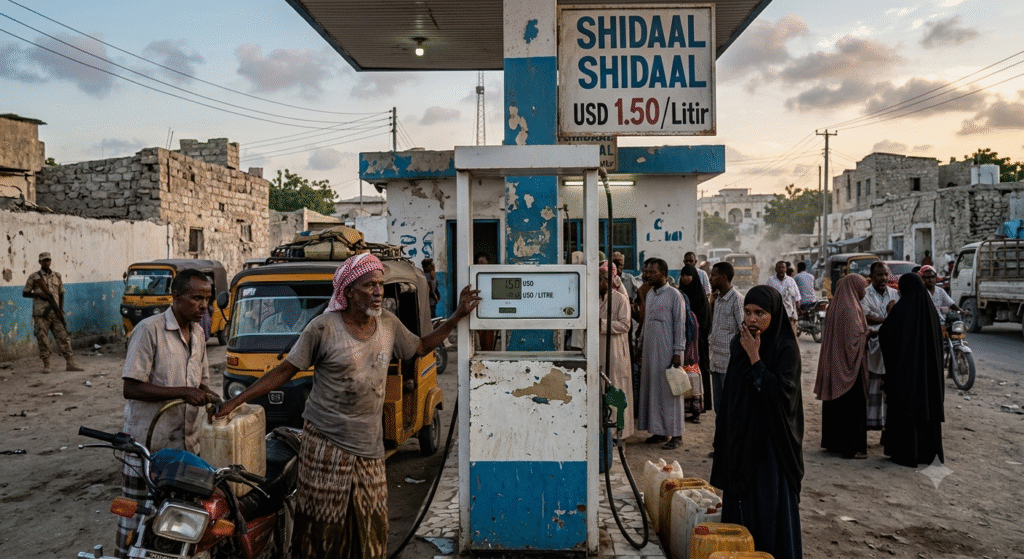
MOGADISHU — July 10, 2026
The price of petrol in Somalia today stands at approximately $1.50 per litre—more than double the $0.60 it cost just five months ago . For a nation with one of the world’s lowest GDP per capita, this is a catastrophe measured in every litre pumped, every meal not eaten, and every hospital visit foregone.
The cause is a 150% surge in global oil prices following the outbreak of war between the United States, Israel, and Iran on February 28, 2026 . The conflict closed the Strait of Hormuz—through which one-fifth of the world’s crude oil once passed—and sent shockwaves through every fuel-importing economy. Somalia, which imports nearly all of its petroleum products, felt the impact within days .
The Price Shock: From 60 Cents to $1.50
Government figures show that fuel prices in Mogadishu, the Somali capital, have risen from about $0.60 to $1.50 per litre . The surge occurred within “a matter of days” of the Iran conflict escalation, according to the Somali National Bureau of Statistics, with domestic fuel prices climbing by over 100% almost overnight .
The impact has been devastating and cascading. As the Food and Agriculture Organization (FAO) warned on June 8, “the sharp rise in fuel prices is driving inflation in food, transport, utilities, and services, significantly increasing logistics costs” .
A Crisis Multiplication Effect
For a country already reeling from five consecutive failed rainy seasons and the threat of El Niño flooding, the fuel price shock has been catastrophic. The FAO identified the convergence of drought, rising fuel prices, and potential floods as a “triple threat” that is rapidly escalating Somalia’s humanitarian crisis .
Gordon Dudi, FAO Food Security Cluster Coordinator, explained that “the exorbitant fuel price rises are driving inflation in food, transport, utilities, and services, significantly raising logistics costs. The cost of staple foods and essential commodity prices have surged, further eroding household purchasing power” .
The impact is measurable across all sectors:
- Transport costs: In the drought-stricken Mudug region, transport costs have risen by up to 50%, forcing families to forgo healthcare .
- Water prices: In areas hardest hit by drought, the price of a jerrycan of water has risen from $0.06 to $1.50—an increase of over 2,000% in just one year .
- Healthcare access: Médecins Sans Frontières warns that the rising costs are making it “more expensive, challenging, and time-consuming for people to seek lifesaving health care” .
- Fertilizer imports: Somalia imports 30% of its fertilizers from Western Asia. The crisis struck during the agricultural input purchasing period for the Gu season, the main rainy season, and the impact on 2026 harvests is “now largely irreversible” .
The Economic Toll: Growth Slows to 2.8%
Somalia’s economy is projected to grow by just 2.8% in 2026—the third consecutive year of slowing growth, down from 4% in 2023 and 2024 . According to the World Bank, weak growth will be constrained by “continued aid reductions, climate variability, global price shocks, and limited productive capacity” .
Inflation is expected to reach 6% this year, up from 3.7% last year, driven by global commodity price volatility and Somalia’s heavy reliance on imported food and fuel . The reduction of aid to Somalia has had “significant social consequences, with food insecurity increasing and poverty reduction stalling” .
Between April and June 2026, an estimated 5.5 million people in Somalia were projected to experience severe acute food insecurity, with close to 1.6 million in emergency levels .
A Future of Oil Independence?
Amid the crisis, there is a glimmer of long-term hope. Turkey has launched offshore oil exploration in Somali waters, with the Turkish drillship Çağrı Bey arriving off the Somali coast. Ankara has announced that the first oil is expected to be extracted within 10 months .
The agreement gives Turkey 90% of the revenue from oil extracted in Somali territorial waters . For Turkey, this represents a strategic solution to its chronic energy deficit. For Somalia, it promises to transform the country from an aid-dependent state to a net energy exporter, providing the independent capital to finance the Somali National Army and modernize infrastructure .
As geopolitical analyst Abdiqani Abdullahi Ahmed of SONNA wrote: “When the drillship strikes its target, Somalia will not just extract oil; it will extract absolute economic sovereignty” .
The Immediate Emergency
For the 5.5 million Somalis facing acute food insecurity, however, future oil wealth offers no relief from today’s prices. The FAO has warned that “a constrained global funding environment and shifting donor attention have combined to reduce operational efficiency and increase the risk of scaled down assistance” .
The humanitarian community has called for urgent support. The message from MSF is clear: non-governmental organizations and the international community must step up their response to the crisis .
Conclusion
Somalia’s petrol crisis is not an isolated economic shock. It is the intersection of global conflict, climate vulnerability, and structural import dependence. The $1.50 per litre that Somalis pay today represents a devastating burden—one that is multiplying the impacts of drought, undermining healthcare access, and pushing millions closer to famine.
The oil exploration agreement with Turkey offers a distant promise of sovereignty and stability. But for today’s consumers, for the families skipping meals, and for the sick unable to afford transport to clinics, the price is paid in lives.
