

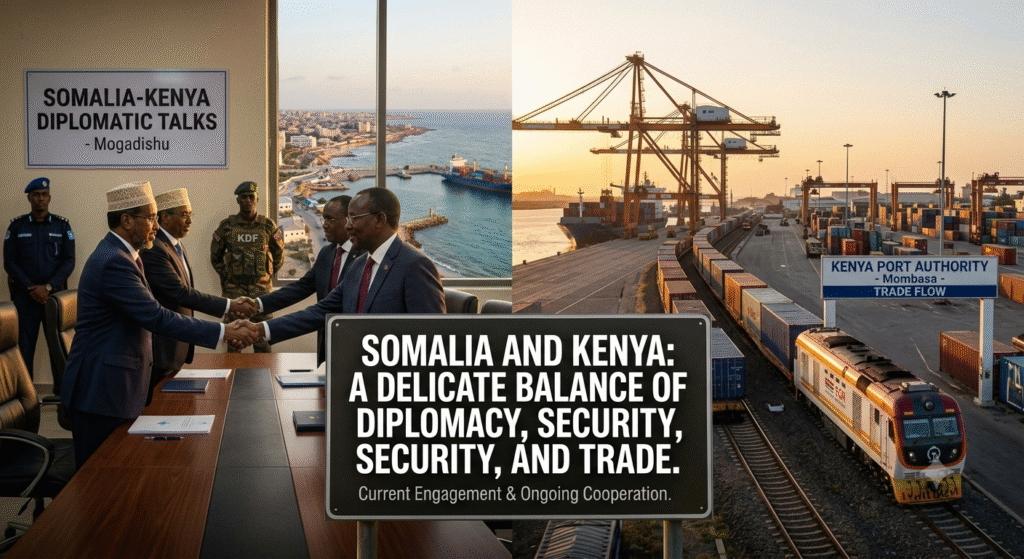
As of July 2026, the relationship between Somalia and Kenya has entered a new phase. After several years of diplomatic tensions, both nations are attempting to rekindle cooperation, but this effort is constantly tested by severe security threats and internal political complications. Recent actions paint a picture of two countries that are deeply intertwined—economically, socially, and security-wise—yet frequently at odds over how to manage their volatile border .
A Diplomatic Earthquake: The Deportation of Somalia’s Deputy PM
The most dramatic recent action unfolded just days ago, when Kenya deported Somalia’s Deputy Prime Minister, Jibril Abdirashid Haji. In a highly unusual move, Haji was detained at Jomo Kenyatta International Airport (JKIA) on arrival and promptly put on a flight back to Mogadishu .
Kenyan authorities accused the senior Somali official of undermining regional security and possessing a fraudulently acquired Kenyan passport . Sources suggested he was allegedly linked to a plan to airlift weapons to the border to arm clan militias and disrupt the local administration . This accusation is particularly serious, given Somalia’s ongoing internal conflicts and the porous nature of the shared border. Haji’s ties to the Southwest State, where a power struggle recently ousted a president, also raised red flags for Kenyan intelligence . This action, while a powerful statement from Nairobi, risks straining the bilateral relationship just as both sides are making overtures to strengthen economic ties .
The Unforgiving Security Reality: Al-Shabaab’s Cross-Border Offensive
While the political deportation grabbed headlines, the most devastating recent actions have been carried out by Al-Shabaab. The militant group has launched a series of increasingly bold attacks inside Kenya, demonstrating that the security situation remains the most critical factor in the bilateral relationship.
Just days ago, Al-Shabaab killed five Kenyan security personnel in a complex ambush in Mandera county. A Special Operations Group patrol came under fire, and a reinforcement team was then struck by a roadside bomb that destroyed an armored vehicle . This was part of a surge in attacks along Kenya’s northern frontier, with another recent assault killing several officers and destroying telecom infrastructure at the Abakaile trading centre in Garissa .
These attacks have caused a political backlash in Kenya. Abakaile MCA Hajir Dahiye is now calling on the government to review its security policy towards Somalia’s Jubaland State. He argues that lasting peace along the border is impossible as long as Al-Shabaab controls significant territories across the frontier, especially in Middle Jubba . This internal Kenyan pressure could force Nairobi to adopt a more aggressive stance, potentially creating new friction with the Jubaland administration or the Somali federal government.
Economic and Diplomatic Actions: A Step Forward Amidst the Chaos
Despite these security crises, both countries have taken actions to improve their economic and diplomatic ties. In a significant sign of warming relations, Somalia recently agreed to lift a two-year ban on khat shipments from Kenya . This move, long sought by Kenyan traders, marks a major step towards normalizing trade and was a key demand from Nairobi.
On the diplomatic front, high-level engagement continues. President William Ruto was recently summoned to Nairobi for a meeting with his Somali counterpart, Hassan Sheikh Mohamud, to discuss the political impasse in Mogadishu . There is also movement on regional security. Deputy President Kithure Kindiki represented Kenya at an extraordinary AUSSOM summit in Entebbe, Uganda, where leaders reviewed the progress of the peacekeeping mission and discussed the future of its operations, which face an uncertain funding future .
Furthermore, efforts are underway to strengthen border management. Kenya, the UK, and the IOM have launched the Regional Counter-Smuggling Programme (RCSP). This new initiative will enhance airport border security and intelligence-led migration management across Kenya, Somalia, and Ethiopia . This trilateral framework represents a critical effort to professionalize border management and combat the transnational crime networks that exploit the region’s instability.
Conclusion
The latest actions between Somalia and Kenya reveal a relationship of profound contradictions. The deportation of a top politician and the surge in Al-Shabaab attacks underscore the deep-seated security and diplomatic fractures. Yet, the simultaneous moves to lift trade bans, hold presidential meetings, and collaborate on regional security summits demonstrate a mutual recognition of their interlinked fate. For 2026, the path forward for Kenya and Somalia lies not in grand gestures, but in their ability to manage the immediate threats at the border while building resilient institutions and economic ties that can withstand the shocks that inevitably come their way .
