

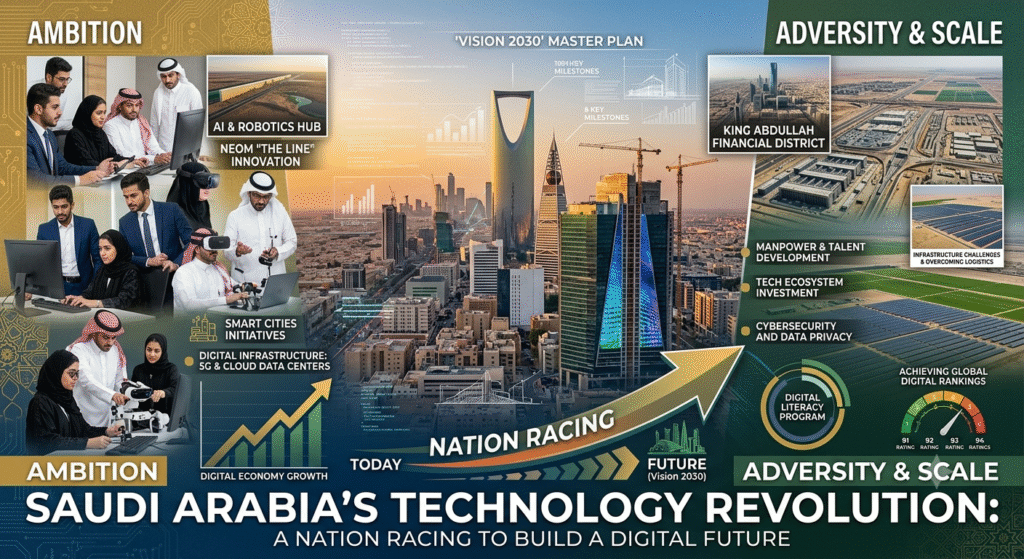
In September 2026, Saudi Arabia is not merely adopting technology—it is building a national industry. The recently concluded LEAP 2026 conference, held under the theme “Into New Worlds,” showcased the extraordinary scale and ambition of the Kingdom’s technological transformation. With nearly $15 billion in investments and agreements announced, the event confirmed that Saudi Arabia is positioning itself as a global leader in AI and digital infrastructure .
🏗️ Building the Digital Backbone: Cloud and AI Infrastructure
The most significant announcements at LEAP 2026 revolved around the physical infrastructure needed to support AI at scale. The Kingdom is moving rapidly from investment promises to tangible projects.
Amazon Web Services confirmed that its first cloud infrastructure region in Saudi Arabia will launch in December 2026, backed by a planned investment of more than $5.3 billion . This will allow businesses and government entities to run applications and store data locally, a crucial step for data sovereignty and low-latency AI applications.
Microsoft Azure will follow, with its cloud region becoming available in November 2026 . The arrival of both major cloud providers signals Saudi Arabia’s emergence as a regional digital hub.
HUMAIN, the Public Investment Fund-owned AI company, is emerging as the primary vehicle for national AI infrastructure expansion. New partnerships include :
- A collaboration with Together AI to provide 55 MW of AI computing capacity, with a new data centre targeting 250 MW
- Expansion with AMD starting with 25 MW of deployed infrastructure, targeting 250 MW over the next two to three years
- Partnerships with AWS to provide up to 50 MW of capacity in Saudi Arabia’s first AI Zone by 2028
Additional major investments were announced by Al Moammar Information Systems ($1.2 billion to expand data center capacity to 192 megawatts) and NHC Innovation ($800 million to develop Khuzam Digital Valley, targeting 65 megawatts by 2033) .
🤖 AI Applications: From Arabic Models to Autonomous Trucks
Saudi Arabia is ensuring its AI ecosystem reflects its national identity. A landmark partnership between Adobe, the Ministry of Communications and IT, and HUMAIN involves a commitment exceeding $4 billion. By end of 2026, more than 27 million eligible citizens and residents will receive free access to Adobe Firefly Standard and Adobe Express Premium features for 12 months .
Crucially, the partnership will develop the first image-generation model using Adobe Firefly Foundry, designed in collaboration with HUMAIN to reflect Saudi culture and context through Arabic-language prompts . This represents a deliberate effort to ensure AI understands and represents local culture rather than relying on models trained primarily on Western data.
HUMAIN has also partnered with Chinese AI company MiniMax to launch the HUMAIN-M3 Arabic language model, which reportedly achieved the highest average performance among advanced models in seven public Arabic language tests . The company is also expanding its enterprise solutions: HUMAIN Enterprise Chat has already attracted over 30 customers within weeks of launch, while HUMAIN Marketplace provides a centralized platform for AI models and applications .
Beyond software, AI is moving into physical infrastructure. HUMAIN has partnered with U.S.-based Applied Intuition to establish a national-scale autonomous logistics network, with thousands of autonomous trucks planned along major Saudi freight corridors by 2030 . The partnership with Chinese autonomous driving company WeRide could see a fleet of up to 10,000 robotaxis operating in Riyadh .
🏛️ Government Digital Transformation: A Record of Investment
The scale of Saudi Arabia’s digital government transformation is reflected in record spending figures. The Digital Government Authority’s 2025 report revealed total government spending on ICT services reached SAR31.90 billion (approximately $8.5 billion) , with more than 6,145 contracts .
Key highlights include :
- Cloud computing spending increased by 42% compared to 2024
- AI and emerging technologies spending rose by 20%
- Government digital spending generated over SAR9.5 billion in direct value added to the economy
- Local content accounted for 49% of government software procurement
Digital government services have been integrated into unified platforms. Tawakkalna, the national app, now integrates services from more than 60 government entities, providing a single platform for beneficiaries . At LEAP 2026, 62 government entities were honoured for completing service integration .
🌏 Global Recognition and International Partnerships
Saudi Arabia’s digital progress is gaining international recognition. The Digital Government Authority governor has stated the Kingdom constitutes a “global reference model” in using technology in service of humanity . The size of the digital economy market has reached approximately $199 billion .
International partnerships are flourishing across multiple geographies. Tencent Cloud has received a licence to operate in Saudi Arabia, serving government and financial sectors, building on $150 million in previous investment . Lenovo is preparing to begin commercial production at its Riyadh facility before the end of 2026, manufacturing laptops, desktops, servers, and smartphones, supporting Saudi efforts to localise technology manufacturing . This coincides with the announcement that BytePlus (TikTok’s parent company) will launch its first public cloud region in the Middle East and Africa in Riyadh through a partnership with Mobily .
🔮 Conclusion
Saudi Arabia’s technology revolution has entered an execution phase. The scale of investment—$15 billion at LEAP 2026 alone—is matched by a strategic focus on national AI models reflecting local culture, major cloud infrastructure, and emerging applications like autonomous logistics. With the Year of Artificial Intelligence 2026 as a backdrop, the Kingdom is demonstrating that its technology ambitions are increasingly tangible, building the infrastructure, talent, and partnerships to become a genuine global technology leader.
