

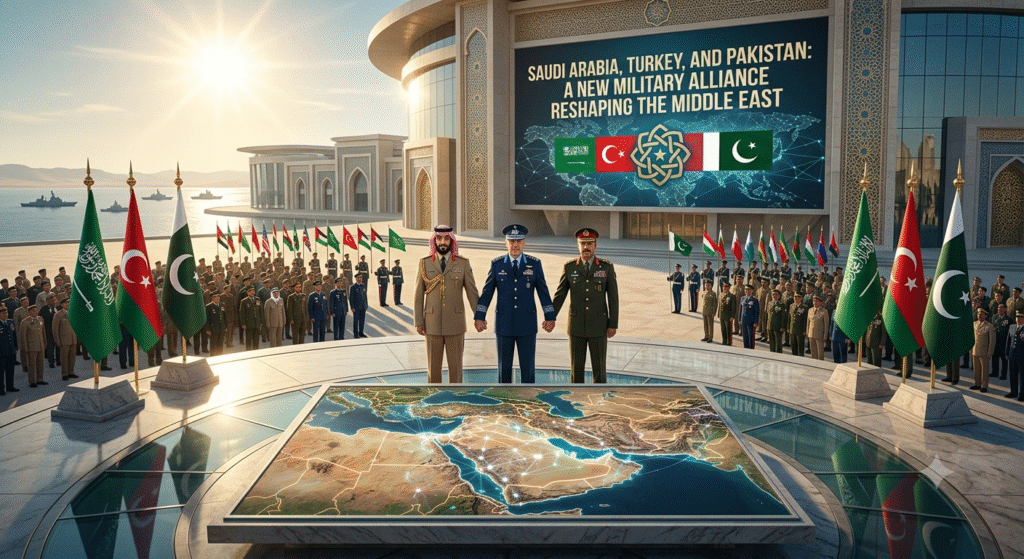
August 7, 2026, marked a historic turning point in Middle Eastern geopolitics. In the holy city of Makkah, Saudi Arabia, Turkey, and Pakistan formally signed the “Makkah Joint Defense Agreement,” a mutual defense pact stipulating that an armed attack against any one of the three nations would be considered an attack against all . This unprecedented trilateral alliance brings together three major Muslim-majority military powers—nuclear-armed Pakistan, NATO-member Turkey, and Gulf powerhouse Saudi Arabia—under a single collective-security framework, signaling a fundamental shift in regional power dynamics amid heightened geopolitical tensions .
The Anatomy of the Makkah Agreement
The agreement was signed by Saudi Crown Prince Mohammed bin Salman, Turkish President Recep Tayyip Erdogan, and Pakistani Prime Minister Shehbaz Sharif during the Makkah Summit for Joint Defense . While the pact includes a strong collective-defense clause, few operational details have been made public, leaving uncertainty about each state’s specific commitments .
The agreement seeks to “bolster collective deterrence against any act of aggression” and “deepen defense cooperation across all sectors,” according to the joint statement . Saudi Deputy Minister for Public Diplomacy Rayed Krimly emphasized that the agreement “does not represent an effort to establish a military axis or a sectarian bloc,” nor is it “linked to any nuclear ambitions or arms race,” but rather “focused on building sustainable capabilities” .
The pact builds on a pre-existing bilateral “Strategic Mutual Defense Agreement” signed between Pakistan and Saudi Arabia in September 2025, which treated aggression against either as aggression against both . Turkey’s inclusion transforms this bilateral arrangement into a trilateral security architecture .
The Geopolitical Catalyst: A Post-US Order
The signing of this agreement cannot be separated from the shifting geopolitical landscape in the Middle East, particularly the US-Israeli strikes on Iran that began in February 2026 . The war has exposed Gulf states’ security vulnerabilities, disrupted shipping through the Strait of Hormuz, and forced regional powers to reassess their reliance on the American security umbrella .
As Iranian missiles struck Saudi energy facilities and US bases in Bahrain and Qatar, Gulf states realized that “the US security umbrella was no longer absolute” . Analysts note that Turkey sees the pact as a way of “strengthening security and deterrents when there are questions over the reliability of the US” and President Trump’s commitment to NATO .
The region is witnessing “not just a rearrangement of alliances but a redefinition of security itself,” with permanent blocs giving way to flexible issue-based alignments that defy Cold War-style divisions . The quadrilateral cooperation among Turkey, Saudi Arabia, Pakistan, and Egypt reflects this new reality—driven by shared concerns over regional instability rather than ideological alignment .
Complementary Military Strengths: What Each Nation Brings
The strategic logic of the alliance lies in the complementary military and economic capabilities each nation contributes . According to analyst Furkan Hamit, Turkey brings “a large and experienced military and rapidly developing domestic defense industry,” Pakistan contributes “military experience as well as missile and nuclear capabilities,” and Saudi Arabia offers “strong financial resources and substantial defense spending” .
Turkey’s Defense Industry: Turkey has a booming domestic defense industry producing drones, missiles, and fifth-generation fighter jets . Turkish companies are already sharing drone technology with both Pakistan and Saudi Arabia, and Ankara is seeking to bring both countries into its KAAN fifth-generation fighter jet program . Turkey is also Pakistan’s second-largest arms supplier, accounting for 11% of its total arms imports, with joint projects including Milgem warships and F-16 fleet modernization .
Pakistan’s Nuclear Deterrent: Pakistan is the only nuclear-armed Muslim country, providing a strategic deterrent capability that neither Saudi Arabia nor Turkey possesses . Its military is battle-hardened with longstanding ties to Gulf states, and recent meetings between Pakistani air force leadership and Saudi defense officials have emphasized enhanced joint training and operational collaboration .
Saudi Arabia’s Financial Power: The kingdom is pouring billions into defense diversification beyond the US and investing in homegrown technology under Vision 2030 . Saudi Arabia is also a significant source of financial aid and energy supplies for Pakistan . Recent Saudi interest in Pakistan’s JF-17 Thunder fighter jets, with discussions reportedly valuing a potential deal at $4 billion, highlights the growing defense-industrial dimension of the partnership .
Regional Implications and Challenges
The Makkah Agreement represents the culmination of nearly a year of negotiations and reflects a broader trend of middle powers restructuring defense cooperation in response to a changing global order . However, analysts have expressed skepticism about its operational impact.
Baris Doster, a professor of international relations at Istanbul’s Marmara University, questioned whether the pact would evolve into an effective security mechanism, noting that “diplomatic history is full of thousands of treaty texts” . He expressed doubt that the three countries would conduct joint military maneuvers in sensitive areas like the Strait of Hormuz, warning such a move could unnecessarily antagonize Tehran .
The agreement also highlights the region’s fluid and potentially fragmenting geopolitics. While the Turkey-Saudi Arabia-Pakistan axis represents one emerging alignment, another partnership has developed between the UAE and Israel, including a multi-billion-dollar joint defense fund to develop advanced air defense systems . These two alliances are “not necessarily on a collision course,” but their “coexistence raises profound questions about the future of Gulf and Arab solidarity” .
Conclusion: A New Strategic Landscape
The Makkah Joint Defense Agreement marks a significant milestone in the reshaping of Middle Eastern security architecture. It reflects the realization among regional powers that “regional security is increasingly shaped by regional actors themselves” . The alliance brings together complementary strengths—Pakistan’s nuclear deterrence, Turkey’s defense industrial capacity, and Saudi Arabia’s financial resources—to create a multifaceted strategic platform capable of protecting maritime corridors, enhancing defense self-sufficiency, and balancing regional pressures without overdependence on external powers .
As the region continues to navigate the volatile post-Iran war environment, the effectiveness of this pact will ultimately depend on the political will of its signatories to translate the treaty’s collective-defense provisions into concrete military and operational collaboration. The coming months will reveal whether this historic agreement becomes a genuine security mechanism or remains a symbolic expression of shared strategic intent.
