

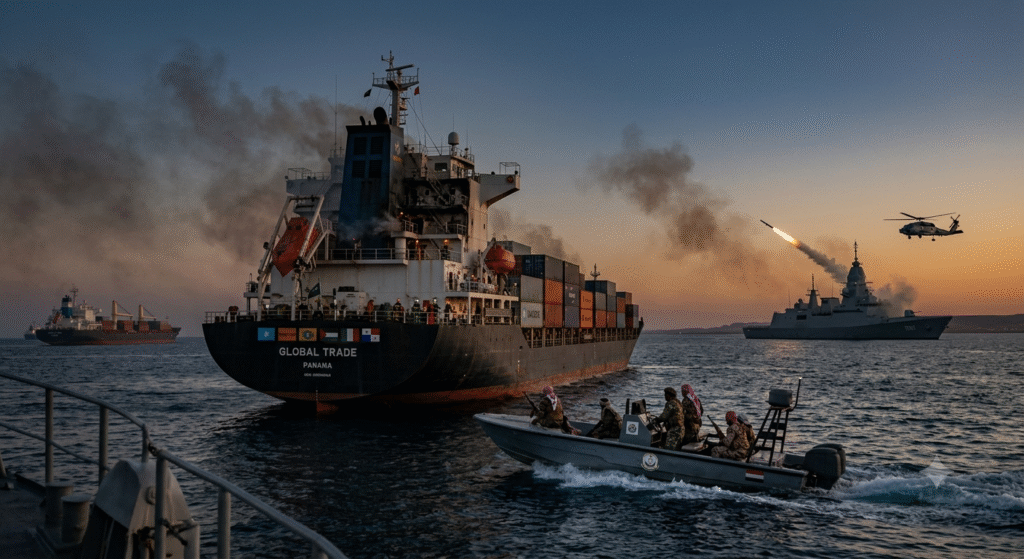
After years of relative calm following a UN-brokered truce in 2022, the conflict between Saudi Arabia and Yemen’s Iran-backed Houthi rebels has erupted once more in July 2026, plunging the region into a new phase of confrontation that threatens to disrupt global shipping lanes and destabilize the broader Middle East .
A Maritime Blockade Sparks Military Response
The current escalation began on July 20, when the Houthis announced an immediate naval blockade targeting Saudi Arabia in the Red Sea and the Bab al-Mandeb Strait . Houthi military spokesperson Yahya Saria declared the blockade a “tit-for-tat” response to what the group describes as a Saudi “siege” of Yemen .
Days later, on July 22, the Houthis claimed responsibility for attacking two Saudi oil tankers—the Encelia and the Layla—for allegedly violating the blockade . Saudi authorities confirmed that the Encelia had been struck and caught fire, while another vessel, the NCC MASA, sustained minor hull damage in a separate attack . The coalition confirmed all crew members were safe, but the attacks represented a significant provocation.
Saudi Arabia and the Coalition Strike Back
In response to these attacks, the Saudi-led coalition launched airstrikes against Houthi positions in Yemen’s Hodeidah province, marking a major escalation after years of relative de-escalation . According to reports, the strikes targeted military facilities used to threaten commercial shipping, including missile launch platforms, weapons depots, and Katyusha rocket sites .
The Houthi-controlled SABA news agency reported that the airstrikes hit telecom infrastructure in the port city of Hodeidah and Kamaran Island in the Red Sea . The Saudi-led coalition, in its first official confirmation of the attacks, emphasized that Hodeidah port itself was not targeted and that all Yemeni ports remain open to maritime navigation . Coalition spokesman Turki al-Malki stated that operations would continue “uncompromisingly” if Houthi hostility persists .
Houthi Retaliation and Threats of Escalation
The Houthis swiftly retaliated. On July 25, the group announced it had launched missile and drone attacks on Aramco facilities in the Saudi Red Sea cities of Yanbu and Jizan . Saudi civil defense confirmed alerts sounded in both cities, though the kingdom has not commented further on damage .
Houthi leaders have made clear that this is only the beginning. Mahdi al-Mashat, head of the Houthi Supreme Political Council, threatened that the group would expand its operations based on a policy of “blockade for blockade” and “escalation for escalation” . The Houthi-run foreign ministry declared that the Saudi strikes marked the start of a new phase and held Riyadh responsible for any resulting developments .
The Geopolitical Chessboard: Iran’s Role and Regional Tensions
The current flare-up cannot be understood in isolation. It unfolds against a backdrop of escalating U.S.-Iran tensions over the Strait of Hormuz, where shipping has been repeatedly disrupted following confrontations between Iran and the United States . If the Houthis effectively close or exert pressure on the Bab al-Mandeb, two of the world’s most critical energy chokepoints could be simultaneously affected .
Iran has offered to mediate between Saudi Arabia and the Houthis. Foreign Minister Abbas Araghchi stated that “there is no military solution” to the conflict and expressed Tehran’s readiness to play a constructive role in negotiations . Iranian foreign ministry spokesman Esmaeil Baqaei echoed these sentiments, calling for “dialogue” and a return to the agreed peace roadmap .
Saudi Ambassador to Yemen Mohammed Al Jaber, however, blamed the Houthis for obstructing peace, accusing the group of turning “Yemen into a card in the hands of external parties” to advance outside interests at the expense of Yemen’s stability .
Global Implications: A Threat to World Trade
The Bab al-Mandeb Strait is a vital maritime chokepoint through which approximately 12% of global maritime trade, including a quarter of container traffic and millions of barrels of oil, pass daily . It is the gateway connecting the Red Sea to the Gulf of Aden and the Suez Canal—the shortest route between Asia and Europe.
For months, Saudi Arabia has been diverting large quantities of its oil exports from the Gulf to the port of Yanbu on the Red Sea coast to avoid risks in the Strait of Hormuz, where Iran has repeatedly threatened a blockade . However, if the Houthis gain control of or attack the shipping lanes at Bab al-Mandeb, oil tankers would have no way out of the Red Sea to enter the Indian Ocean . The only alternative would be a lengthy detour around the Cape of Good Hope, adding thousands of nautical miles and 10 to 20 days of shipping time, with crippling increases in fuel, charter, and insurance costs .
Experts warn that simultaneous disruption of both the Strait of Hormuz and the Bab al-Mandeb would trigger the most serious shipping crisis since the COVID-19 pandemic, putting unprecedented pressure on global energy supply chains .
A Fragile Peace Shattered
The 2022 UN-brokered truce had largely halted major fighting in a conflict that has killed hundreds of thousands of people through violence, hunger, and disease . That fragile calm has now been shattered. The Houthis have threatened further attacks, the Saudi-led coalition has vowed to respond “uncompromisingly,” and the UN Special Envoy for Yemen, Hans Grundberg, has expressed deep concern that Yemen could be plunged back into large-scale conflict .
As the world watches, the coming days will be critical in determining whether diplomatic efforts can de-escalate this dangerous confrontation, or whether the region—and global trade—will pay a heavy price for a conflict that has already caused immeasurable suffering.
