

June 12, 2026
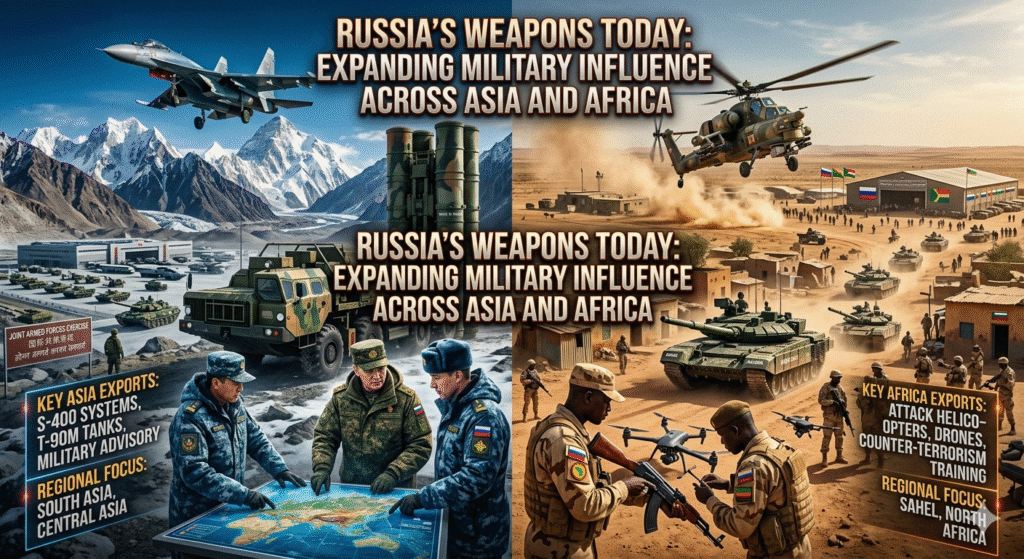
As Western sanctions continue to squeeze Russia’s economy, Moscow has accelerated one of its most effective counter-strategies: the aggressive expansion of arms sales and military cooperation across Asia and Africa. From loitering munitions destined for the Middle East to advanced fighter jets delivered to Ethiopia, and from shadowy cargo flights shuttling weapons to the Sahel to licensed small-arms production in Southeast Asia, Russia is leveraging its defense industry to bypass sanctions, secure resources, and project power on two continents.
Here is a comprehensive look at Russia’s weapons activities in Asia and Africa today.
Part 1: The Big Picture — Russia Aims for Second Place Globally
Despite comprehensive sanctions imposed following its invasion of Ukraine, Russia is ramping up exports of military products and has set its sights on becoming the world’s second-largest arms supplier. Sergey Chemezov, CEO of Russia’s state tech corporation Rostec, made this clear in April 2026: “Despite sanctions, Russia is increasing export volumes and aims to be second in the world in terms of military-technical cooperation” .
Chemezov emphasized that Rostec is actively developing export relations with countries of the CSTO, BRICS, and SCO, “as well as with partners in Asia, Africa and Latin America” . The push is strategic: by the time MGIMO students graduate, Chemezov noted, they are being prepared “to promote Russian technologies in foreign markets in practice” .
Part 2: Africa — Russia’s Priority Front
Africa accounts for a staggering 30 percent of Rosoboronexport’s order portfolio, with contracts for technological cooperation projects worth over $1.7 billion . The Russian weapons exporter currently partners with 46 African countries, with which it has concluded intergovernmental agreements on military-technical cooperation .
Alexander Mikheyev, CEO of Rosoboronexport, framed this relationship in historical terms: “Russia’s friendship with African countries is based on decades of good and trusting relations. Our state has always provided comprehensive assistance to countries of the continent, helping them fight for independence, justice, and freedom, including with reliable and effective weapons” .
Russian Foreign Ministry Director for Sub-Saharan Africa Anatoly Bashkin confirmed that military-technical cooperation is developing “with virtually all [African] countries” and “practically everywhere, regardless of any political aspirations or preferences of our partners” .
Part 3: Ethiopia — A Key East African Partner
One of the most concrete examples of Russian-African arms cooperation is Ethiopia. In January 2026, Russia delivered up to six Yak-130 advanced trainer and light combat aircraft, along with at least one Orion combat drone, to the Ethiopian Air Force . This marks the first publicly confirmed instance of Russia exporting its Orion UAV — a medium-altitude, long-endurance system that has seen combat in Ukraine .
The Yak-130s, bearing tail numbers 2301 through 2306, were displayed at the Aviation Expo 2026 at Bishoftu Air Base. Designed primarily for pilot training, these jets can also perform light combat missions .
The delivery adds to Ethiopia’s growing drone inventory, which already includes Turkish Bayraktar TB2 and Akinci drones, Iranian Mohajer-6 systems, and Chinese Wing Loong I UAVs. Russia has not disclosed the value of the deal or the payment terms, leaving open the possibility of barter or resource-backed arrangements .
Ethiopia is a long-time Russian military customer. Its air force inventory includes eight Su-27s, three Su-27UBs, two Su-30K fighters delivered in January 2024, plus Su-25s and MiG-23BN jets . Beyond aviation, Russia reportedly delivered a Krasukha-4 electronic warfare system to Ethiopia in October 2023, and the two countries have agreed to cooperate on establishing a joint naval command structure — despite Ethiopia having no navy .
Analysts suggest these transfers “may serve more as a signal of continued relevance than as large-scale commercial successes,” but they also reflect deeper resource-backed relationships. Leaked Rostec documents have revealed that Russia had been quietly preparing to export six Su-35 fighter jets to Ethiopia, identified in the documents by code “231” .
Part 4: The ‘Air Wagner’ Network — Evading Sanctions Across Africa
Perhaps the most revealing development in Russian-African military cooperation is the emergence of a shadowy fleet known as “Air Wagner.” According to an investigation by Defense News, Russian cargo aircraft were tracked making at least 167 flights to five Algerian air bases between March 2025 and April 2026 .
These flights roughly coincided with deliveries of Russian-made warplanes to Algeria, where jets have been seen and heard near the Oum El Bouaghi Air Base. The fleet’s flight patterns suggest it provides logistics for Africa Corps, Wagner’s successor, and Moscow uses these air bases to avoid sanctions .
“Algiers appears to be a convenient staging ground for West African operations, and one that may be under less scrutiny than some other staging grounds previously used by Russia,” wrote Linus Höller, a Defense News correspondent .
Russia is Algeria’s top weapons supplier. Algiers is currently receiving Russian Su-57 fighter jets and Su-35 fighters, while continuing to operate a fleet of about 60 Su-30s and around 40 MiG-29s .
Many of the Russian aircraft operating in Algeria attempt to evade detection by falsifying itineraries and switching off ADS-B transponders. After leaving Algeria, aircraft have been tracked heading to Guinea, Mali, Burkina Faso, and other African countries .
Two of the Russian airlines involved — Gelix and Aviacon Zitotrans — are technically civilian-run but operate on behalf of the Kremlin’s State Property Management Office and are directly subordinate to Russian President Vladimir Putin .
In late 2025, Russia began moving 1,000 metric tons of uranium through an airlift in Niamey, Niger’s capital. An aircraft that reports directly to a heavily sanctioned Russian military flight unit left Niger with uranium before flying to Libya — with its transponder turned off during portions of the journey .
Part 5: The Lancet-E — Russia’s Next Big Export to Africa and the Middle East
Russia’s most battle-tested weapon system from the Ukraine war is now heading to international markets. The Lancet-E loitering munition — a strike and reconnaissance system — has received approval for exports, and Russia expects to sign contracts with “several African and Middle Eastern countries” by the end of 2026 .
The Federal Service for Military-Technical Cooperation told TASS that “there has been growing interest from certain African and Middle Eastern countries in Russian UAV systems, including the Lancet-E. Active marketing efforts are underway” .
The Lancet-E system includes the Z-16E reconnaissance drone and loitering munitions equipped with dual X-shaped tails — the Izdeliye 51E, 51E-IK, 52E, and 52E-IK. The munition has proven highly effective in combat, and Russia is now packaging it as a turnkey tactical solution for export partners .
Part 6: The Rus-PE — Kalashnikov’s New Loitering Munition
At the World Defense Show 2026 in Riyadh, Saudi Arabia, the Kalashnikov Group unveiled its latest product: the Rus-PE reconnaissance and strike system with guided munitions .
The munition, which had its world premiere in Riyadh, drew significant interest from the Middle East, Africa, and Southeast Asia. “Partners from the Middle East, Africa, and Southeast Asia are frequently visiting our stand,” a Kalashnikov spokesperson told TASS. “Among them are many representatives from countries that are the company’s long-standing partners, and we also see new partners joining them” .
The Rus-PE is a carrier with an X-shaped aerodynamic layout, equipped with a warhead, control equipment, and a homing head. It is launched from a portable container/launch tube by pneumatic launch and can operate in fully autonomous mode, using AI algorithms for target acquisition and identification. It is designed for “the rapid, high-precision engagement of single, stationary, and moving enemy targets” .
Part 7: Southeast Asia — Licensed Production and Air Defense
Russia is not merely selling weapons to Asia; it is offering to build them locally. Rosoboronexport announced in April 2026 that it is ready to supply modern Russian small arms to Southeast Asian countries and to organize their licensed production in the region .
The company noted that “the new Russian small arms meet modern requirements and standards, and several models have been successfully tested in armed conflicts. They are well suited to the climatic and natural conditions of Southeast Asia due to their high reliability” .
The calibers offered — 9x19mm Luger, .223 Remington, and .308 Winchester — correspond to the most popular in the region .
At the Defense Services Asia (DSA) 2026 exhibition in Kuala Lumpur, Rosoboronexport showcased an entire line of small arms manufactured by Kalashnikov Group, including:
- AK-15, AK-19, and AK-308 assault rifles
- RPL-20 belt-fed light machine gun
- Lebedev 9mm pistol line
- PPK-20 submachine gun
- Chukavin SVCh sniper rifle
Beyond small arms, Russia is also ready to export anti-aircraft weapon systems to Southeast Asia. Rosoboronexport presented a model of the Pantsir-S1M surface-to-air missile/gun system at DSA 2026, noting that “many of these have proven highly effective in combat” .
The Pantsir-S1M can be effectively used in combination with other air defense systems, can use three types of surface-to-air missiles (including short-range SAMs designed to combat UAVs), is capable of destroying ground targets and facilities, and features high mobility with the capability to fire on the move .
Part 8: The Su-35 Question — A Deal in the Making?
Leaked documents obtained by the hacking group Black Mirror have revealed that Russia has been quietly preparing to export six Su-35 fighter jets to Ethiopia . Internal Rostec orders dating back to 2022 confirmed plans to produce critical systems for aircraft designated for Ethiopia, identified in the documents by code “231” .
If confirmed, this would represent a significant escalation in Russian-Ethiopian military cooperation and would place advanced fourth-generation fighter jets in the Horn of Africa — a region already tense with disputes over the Grand Ethiopian Renaissance Dam and maritime access.
Part 9: The Resource Connection — Gold, Uranium, and Arms
Underpinning Russia’s arms sales is a resource-based strategy. According to recent investigations by RAND and C4ADS, Moscow has turned to African gold as a key alternative source of financing, using it in state-to-state payments, weapons deals, and sanctions-evasion schemes .
With gold exports to Western markets blocked, Russia has expanded military and security partnerships across Africa — often tying arms supplies to broader economic and political cooperation. The uranium airlift from Niger to Libya is a prime example: military transport aircraft carrying nuclear material, with transponders turned off, flying through countries where Russia maintains mercenary forces .
“In this context,” as one analysis noted, “even limited aircraft deliveries may reflect not just defense trade, but deeper resource-backed relationships beyond Western oversight” .
Part 10: The Geopolitical Message
Beyond the commercial and resource dimensions, Russia’s weapons sales carry a clear geopolitical message: Moscow remains a major power capable of projecting force and arming allies despite two years of war and unprecedented sanctions.
The Yak-130 delivery to Ethiopia, as UNITED24 Media noted, “may serve as a signal of continued relevance than as large-scale commercial successes” . The flights of the “Air Wagner” fleet demonstrate that Russia has established logistics networks spanning the African continent, from Algeria to Mali to Niger to Libya .
And the aggressive marketing of Lancet-E and Pantsir-S1M systems — both battle-tested in Ukraine — sends a message to potential buyers: Russian weapons are combat-proven, effective, and available without the political strings attached to Western alternatives.
Conclusion
Russia’s weapons activities in Asia and Africa today represent a comprehensive strategy of economic survival and geopolitical competition. By selling arms — from Su-57 fighters to loitering munitions, from air defense systems to licensed small-arms production — Russia is securing revenue, evading sanctions, and deepening relationships with countries that do not share the West’s view of the Ukraine war.
For Asia and Africa, Russian weapons offer an alternative to Western dependence. For Russia, these sales keep its defense industry alive and its global influence intact. As Chemezov put it, Russia aims to be the world’s second-largest arms exporter, “sanctions or no sanctions” . On current evidence, that goal is well within reach.