

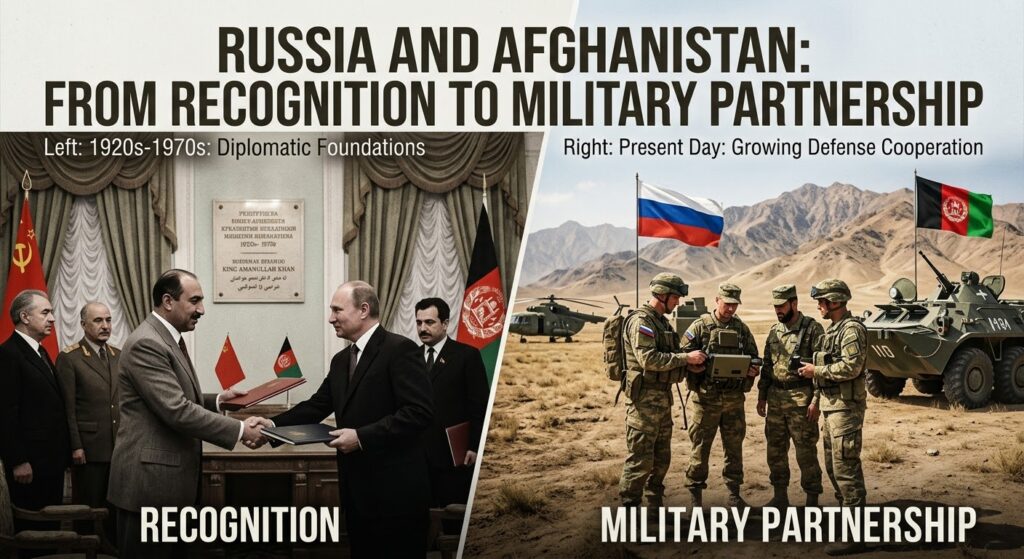
The past weeks have witnessed a remarkable consolidation of ties between Russia and Afghanistan’s Taliban government, culminating in a formal military cooperation agreement and deepening political consultations—a rapprochement that signals Moscow’s determination to reassert influence in Central Asia while challenging the Western-led order that defined the post-2001 era.
The Military Deal: Signing in Moscow
The defining moment came on May 27, 2026, when Russia and Afghanistan signed an agreement on military-technical cooperation on the sidelines of the inaugural International Security Forum hosted by the Russian Security Council in the Moscow region . The document was signed by Sergei Shoigu, secretary of Russia’s Security Council, and Mohammad Yaqub, the Taliban’s defense minister .
While neither side has released the text of the agreement or offered details about its scope, Yaqub emphasized its significance: “Interaction with Russia is important for us. Afghanistan and Russia have long-standing historical relations, and we want to continue moving in this direction. We have expanded bilateral relations” .
Military-technical cooperation agreements can cover a wide range of activities, including arms sales, training, maintenance, logistics support, or technical assistance. However, experts caution that the deal is more likely a political signal than a substantive shift in military support .
Hameed Hakimi, a nonresident senior fellow at the Atlantic Council, noted constraints on both sides: “Russia is too economically stretched to provide free military aid to the Taliban government. Meanwhile, the Taliban government does not have deep coffers to purchase such a quantity of military equipment, which would make it a consequential military trading partner in Moscow’s eyes” .
Diplomatic Foundations: Recognition and Engagement
The military deal is the culmination of a steady diplomatic rapprochement. In July 2025, Russia became the first country in the world to formally recognize the Taliban government of Afghanistan after accepting the credentials of the new Afghan ambassador in Moscow . This marked a major step in ending the Taliban’s international isolation .
The groundwork had been laid months earlier. In April 2025, Russia’s Supreme Court suspended the ban on the Taliban’s activities, removing the movement from the register of terrorist organizations—a designation it had held since 2003 . The Russian Foreign Ministry stated at the time that it saw strong prospects for developing bilateral ties and planned to expand cooperation in security, counterterrorism, energy, transport, agriculture, and infrastructure .
By May 2026, Shoigu was already framing the relationship as a “full-fledged partnership.” Speaking at a regional security meeting in Kyrgyzstan, he said Russia had built a “pragmatic dialogue” with the Taliban and was developing cooperation across political, security, trade, economic, and humanitarian spheres .
The Second Round: Political Consultations in Kabul
On July 3, 2026, the second round of political consultations between the Ministries of Foreign Affairs of Afghanistan and Russia was held in Kabul . The two sides discussed the expansion of bilateral relations, regional and international developments, regional security and stability, economic cooperation, increased trade, investment attraction, and the activation of transit corridors .
The consultations emphasized continued coordination within regional and international organizations, and the two sides agreed that the third round would be held in Moscow . The same week, Afghanistan’s Ambassador to Moscow, Mawlawi Gul Hassan Hassan, participated in the St. Petersburg International Economic Forum, meeting with Russian officials and economic representatives to discuss strengthening economic and trade cooperation .
The Pakistan Dimension: A Shared Concern over Terrorism
Russia’s engagement with Afghanistan is complicated by its relationship with Pakistan. On July 8-9, 2026, Interior Ministers from Pakistan and Russia met at the United Nations Headquarters in New York and agreed to formulate a joint strategy to counter terrorist networks operating in the region, particularly those based in Afghanistan .
Pakistan’s Interior Minister Mohsin Naqvi emphasized the scale of the threat, stating that more than 25 terrorist organizations are currently active in Afghanistan . Both sides agreed to sign a memorandum of understanding to institutionalize cooperation in counterterrorism, counter-narcotics, cybercrime prevention, and joint police training exercises .
This cooperation reflects a shared concern: Russia views Afghanistan-based extremist groups, particularly Islamic State Khorasan (IS-K), as a direct threat to its security and the stability of Central Asia—which it considers its “strategic backyard” . IS-K claimed responsibility for the March 2024 attack on a packed concert venue outside Moscow that killed nearly 150 people, the deadliest attack in Russia in two decades .
The Border Crisis: Russia’s Call for Restraint
Just days before the Pakistan-Russia security talks, Moscow had issued a sharp diplomatic intervention regarding escalating conflict along the Afghanistan-Pakistan border. On June 30, 2026, the Russian Foreign Ministry expressed concern over Pakistan’s airstrikes on the eastern Afghan provinces of Paktya, Paktika, and Konar the previous night .
The UN reported that 28 people were killed, including minors, and approximately 50 more were injured . “Moscow is concerned about the ongoing military confrontation between Afghanistan and Pakistan, which primarily affects civilians,” the ministry stated, calling on both sides to “end the armed conflict and resolve disputed issues through political and diplomatic means” .
The Russian response reflects the delicate balance Moscow seeks to maintain: while deepening ties with the Taliban, it must also manage relations with Pakistan, a country with which it shares security concerns but which is increasingly embroiled in conflict with the Taliban government over border issues.
Historical Irony and Strategic Calculation
The rapprochement carries deep historical irony. The Soviet Union invaded Afghanistan in 1979 and spent a decade fighting the mujahideen, many of whom later formed the Taliban . Relations remained hostile for years after Soviet troops withdrew, although Russia was later accused of quietly supporting Taliban factions following the US invasion of Afghanistan .
Russia’s current strategy is driven by pragmatic geopolitical calculation. Moscow views itself as a counterweight to Western influence in the region and has repeatedly called on Western countries to “unfreeze blocked Afghan assets” and “fully recognize their responsibility for their 20-year presence in Afghanistan” . At the security forum, Shoigu made clear that Russia expects the West to bear “the burden of the country’s post-conflict reconstruction” .
Looking Ahead: An Expanding Partnership
The trajectory suggests continued deepening of Russia-Afghanistan ties. The military cooperation agreement, while symbolic for now, provides a framework for future expansion. The political consultations process is institutionalized, with a third round already scheduled. Economic engagement is growing, with Afghanistan participating in Russian forums and seeking expanded trade and investment.
For the Taliban, closer ties with Russia offer diplomatic legitimacy at a time when the country remains largely isolated internationally. As Hakimi noted, “The symbolism of the agreement with Russia will allow the Taliban to claim external legitimacy and create a PR moment to influence public opinion domestically” .
For Russia, the engagement serves multiple purposes: reasserting influence in a region where the US withdrawal created a vacuum, countering the threat posed by IS-K, challenging Western sanctions, and positioning Moscow as a key interlocutor on Afghan security issues.
The coming months will reveal whether the military cooperation agreement translates into substantive support or remains a diplomatic gesture. But the direction is clear: after decades of hostility, Russia and Afghanistan are moving toward a partnership that reshapes the geopolitics of Central Asia.
