

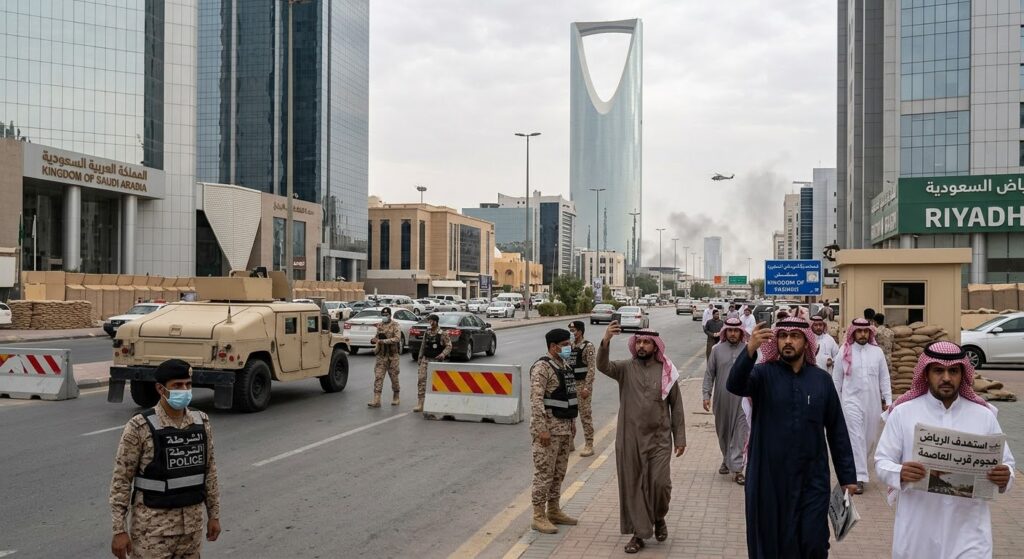
RIYADH — The Saudi capital is reeling. What was once considered a sanctuary from the region’s conflicts has become a frontline target. In the span of a single week, King Khalid International Airport—the kingdom’s busiest aviation hub—has been struck repeatedly by Houthi ballistic missiles and drones, killing at least 14 people and wounding more than 300, forcing the airport’s closure until October 17, and shattering the assumption that Riyadh’s distance from Yemen’s battlefields offered protection.
The Deadliest Week in Decades
The attacks began on October 5 and escalated dramatically through the weekend. On Saturday, October 10, a missile struck King Khalid International Airport, causing 12 fatalities and 309 injuries. The Saudi General Authority of Civil Aviation confirmed the dead included four Saudi citizens and residents of nine other nationalities: two Bangladeshi, one American, one Egyptian, one Jordanian, one Syrian, one Palestinian, one Sudanese, and one Pakistani . Among the wounded, many remain in critical condition .
The following day, another strike hit the airport, killing a Pakistani national and wounding 11 others . On Monday, October 12, the Houthis launched a third consecutive day of attacks on the airport, though the full extent of casualties and damage from that strike was not immediately disclosed .
The combined toll—at least 14 dead and over 320 wounded—represents the most severe loss of life at a Saudi airport from hostile action in decades . The sheer scale of the casualties, and the diversity of nationalities among the victims, underscores the indiscriminate nature of the attacks on a civilian facility.
The Airport at the Center of the Storm
King Khalid International Airport, located 35 kilometers north of central Riyadh, is not merely an aviation hub—it is the gateway to the kingdom. It handles tens of millions of passengers annually and serves as a key transit point for travelers between Asia, Europe, and Africa. Its closure has sent shockwaves through global aviation networks.
The General Authority of Civil Aviation announced that airport operations would remain suspended until October 17, pending completion of damage assessments and safety inspections . An aviation source told AFP that radar and communication equipment had been damaged, and that the condition of the airport’s runways also needed to be assessed .
The Saudi Ministry of Education ordered schools in the capital to switch to remote learning for a week . The U.S. Embassy in Riyadh issued its third security alert in three days, urging American citizens to exercise “extreme caution” when using airports in Saudi Arabia and warning of potential flight cancellations, airspace closures, and sudden travel disruptions .
A Warning to the World
The Houthis have made clear that the attacks are not limited to Riyadh. Military spokesman Yahya Saree declared that all Saudi airports—with the exception of those in the holy cities of Mecca and Medina—are “exposed to offensives” by Yemeni forces . He explicitly warned airlines, travelers, and workers at Saudi airports to stay away, describing these facilities as legitimate military targets .
The Houthis claimed a series of four operations over 24 hours, targeting not only King Khalid International Airport but also King Fahd International Airport near Dammam in the Eastern Province, and two Aramco facilities: the Shedgum gas facility and the Tanajib facility, both in the Eastern Province. Saree claimed “direct hits” and large fires at the Aramco sites .
On October 13, the Houthis announced another “qualitative military operation” targeting Aramco in Dhahran, King Fahd International Airport, and the Riyadh Aramco refinery. They claimed the strikes were precise and caused destruction and fires, and vowed to continue operations against Saudi airports and oil facilities in the coming days .
Riyadh Under Siege
The psychological impact on Riyadh’s residents has been profound. A city of over seven million people, Riyadh has long been insulated from the direct violence of the Yemen war. That insulation has now been shattered.
Saudi Civil Defense announced that four people—two women, a man, and a child—were wounded in Riyadh by falling debris from two intercepted cruise missiles on Tuesday. The debris also caused light material damage to 15 homes . Explosions were heard in northern Riyadh and near the Aramco building in Dhahran .
The Houthis’ stated rationale is retaliation for Saudi airstrikes on Yemen. Saree claimed Saudi warplanes conducted 124 airstrikes across Yemen in a single 24-hour period, targeting Sanaa and the provinces of Taiz, Marib, Al-Jawf, Hajjah, Hodeidah, and Saada . The Houthis have framed their campaign as “an eye for an eye” — imposing a siege for a siege, and escalation for escalation .
Economic Ripples and the Limits of Resilience
The attacks come at a delicate moment for Saudi Arabia’s economy. The Council of Economic and Development Affairs met via videoconference on October 8 to review the kingdom’s economic performance amid “rapidly evolving geopolitical conditions.” The council’s report highlighted the Saudi economy’s “strength and resilience,” noting that the Purchasing Managers’ Index rose to 53.8 points in August 2026—its fifth consecutive month of growth—and that the Business Confidence Index stood at 56.7 points .
But the war is exacting a heavy toll. The IMF now projects Saudi Arabia’s economy will contract by 3.3 percent in 2026, a sharp reversal for a country accustomed to robust growth . S&P Global Ratings noted that the kingdom recorded a fiscal deficit of 160 billion riyals ($42.7 billion) in the first half of 2026, up 71 percent from the previous year, largely due to higher capital expenditure .
The attacks on Aramco facilities—the beating heart of the Saudi economy—add a new dimension of risk. The Houthis have demonstrated their ability to strike deep into Saudi territory with precision, targeting not only airports but the infrastructure upon which the kingdom’s prosperity depends.
A Kingdom at a Crossroads
Riyadh today is a city navigating an unfamiliar reality. The streets remain busy, the malls open, the coffee shops full. But beneath the surface of normalcy, there is a new awareness: the war has arrived at the capital’s doorstep.
The airport’s closure has stranded thousands of travelers and disrupted business travel, a crucial lifeline for a kingdom positioning itself as a regional commercial hub. Schools are teaching remotely. Embassies are warning their citizens. And the Houthis have promised more attacks to come.
For Crown Prince Mohammed bin Salman, whose Vision 2030 reform program depends on projecting an image of stability and progress, the attacks represent a direct challenge. The kingdom’s air defenses, despite intercepting many incoming missiles, have not been able to prevent casualties and damage. The debris from intercepted missiles falling on Riyadh’s neighborhoods is a visceral reminder that even successful interceptions carry risks.
The question now is how Saudi Arabia responds. The Saudi-led coalition has vowed to dismantle the Houthi missile network, and airstrikes on Yemen have intensified. But the Houthis have shown that they can absorb punishment and continue firing. The war that Riyadh long sought to keep at arm’s length has come home. And the capital’s residents—like the millions of Yemenis who have endured years of bombing—are now learning what it means to live under the shadow of missiles.