

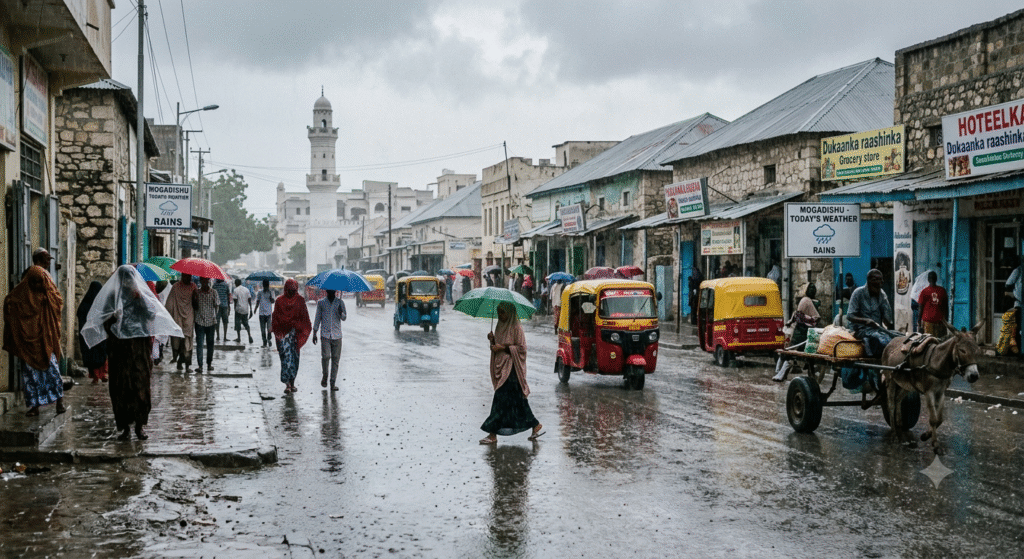
As of July 24, 2026, Mogadishu is experiencing a day of significant rainfall, with weather forecasts indicating a transition from light showers to heavier downpours. According to the latest meteorological data, the Somali capital is expected to see 小雨转中雨 (light rain turning to moderate rain) throughout the day, with temperatures ranging between 25°C and 29°C and winds shifting from 4-5级 (4-5 scale winds) to 3-4级 . The rain is part of a broader climatic pattern that is raising alarm bells across the Horn of Africa.
The Weather Today in Mogadishu
Today’s weather in Mogadishu reflects the complex and volatile climatic conditions currently affecting the region. The forecast indicates persistent rainfall, with the morning bringing light rain that is expected to intensify into moderate rain by the evening . This pattern is consistent with the seasonal shifts that East Africa is experiencing, but it carries a weight far beyond a typical rainy day.
For the residents of Mogadishu, particularly the hundreds of thousands living in informal settlements and internally displaced persons (IDP) camps, today’s rain is not just a weather event—it is a test of resilience. The city’s infrastructure, already fragile after decades of conflict, struggles to cope with even moderate rainfall. The combination of 4-5级 winds and saturated ground creates conditions ripe for localized flooding . Weather services have also noted wave heights reaching 1.8 to 1.9 meters along the coast, which, combined with strong gusts, could affect the city’s coastal areas .
The Looming Shadow of El Niño
While today’s rain is manageable, it is a precursor to what humanitarian organizations warn could be a catastrophic flood season. The International Rescue Committee (IRC) has issued stark warnings that Somalia could once again face severe flooding and a worsening humanitarian emergency if El Niño weather conditions return later this year . The concerns are that the country may relive the devastation experienced during the 2023 floods, which submerged entire towns, displaced hundreds of thousands, and destroyed more than 10,000 tons of agricultural crops .
The anticipated weather pattern, driven by a rapidly intensifying El Niño, threatens to bring extreme rainfall to parts of East Africa . Somalia is considered among the countries most vulnerable to these climate shocks, alongside Kenya, Uganda, Pakistan, and Bangladesh . The US-funded early warning body FEWS NET has already assessed a “credible risk of famine” in southern regions if flooding later this year matches the catastrophic levels of 1997 or 2023 .
A Government on High Alert
In response to these warnings, Somalia’s government has stepped up its flood preparedness efforts. Following a meeting between the Ministry of Agriculture and Irrigation and the Somali Disaster Management Agency (SoDMA), officials announced that they are actively preparing for potential heavy rains in the coming months .
SoDMA Commissioner Mahmoud Moallim Abdulle has warned that the expected rains could cause flooding in Mogadishu, Baidoa, and areas along Somalia’s rivers, and that the forecast floods could be worse than those recorded in 2023, potentially exceeding even the impact of the historic 1997 floods . Preparations include food distribution, the staging of rescue boats and emergency equipment, and identifying higher ground for possible evacuations . Nearly four million internally displaced people in Somalia are considered especially vulnerable because many live in weak shelters that cannot withstand heavy rains .
A City Caught in the Climate Crossfire
Mogadishu today finds itself caught between two devastating extremes: drought and flood. While rain is falling in the capital, vast regions of Somalia continue to suffer from the effects of severe drought. Mudug region, for example, is facing severe food and water shortages after three consecutive years of failed rains destroyed livestock and dried up water wells . This paradox—where some areas are parched while others risk flooding—is a hallmark of the climate crisis affecting the Horn of Africa.
The rainfall data for Mogadishu shows a significant shift. While no rainfall was recorded for June 2026, the city received 63.13 mm in April and 54.81 mm in May . Today’s rain is part of this broader pattern, with the official climate outlook for July 2026 through January 2027 predicting a 21.8 mm increase in precipitation above the historical average for October . This confirms that the capital is transitioning into a wetter phase, increasing the risk of flooding.
As the sun sets on Mogadishu today, the rain serves as a reminder of the city’s fragility and resilience. For the families in IDP camps, every downpour is a fight against flooding, disease, and displacement. For the government, it is a test of preparedness. And for the world, it is a call to action—to support a nation that, despite contributing little to global emissions, finds itself on the frontlines of climate change.