

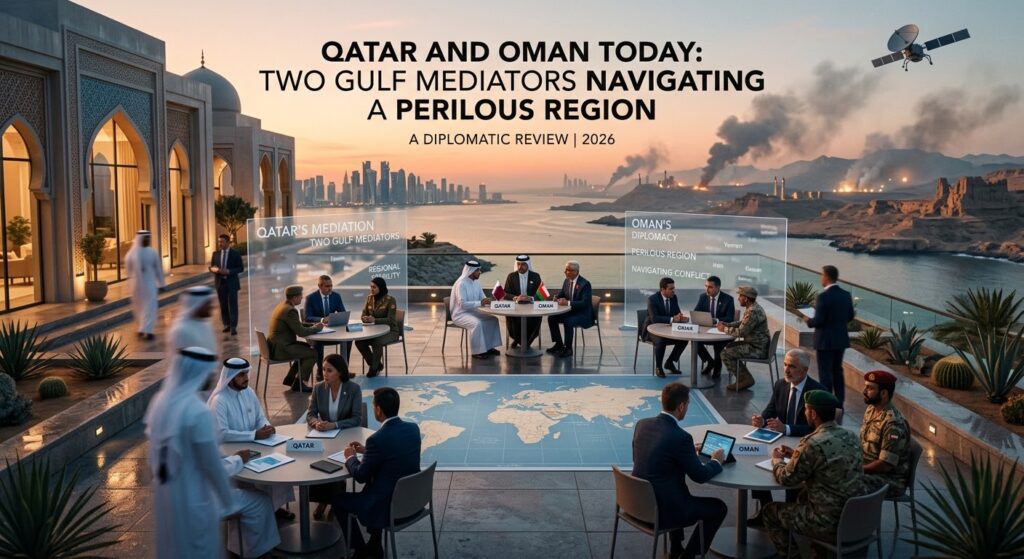
In the final days of September 2026, the foreign ministers of Qatar and Oman stood before the United Nations General Assembly and articulated two distinct but complementary visions of how to survive—and perhaps stabilize—a region teetering on the edge of wider war. Their words, and the diplomatic activity surrounding them, reveal the unique positions these two small Gulf states occupy in a Middle East defined by the ongoing Iran conflict, the war in Gaza, and the disruption of global energy flows through the Strait of Hormuz.
Qatar: The Combative Mediator
On September 29, Qatari Prime Minister and Foreign Minister Sheikh Mohammed bin Abdulrahman Al Thani gave an interview to British journalist Piers Morgan that marked a rhetorical escalation in Qatar’s public posture. Asked whether he considered Israeli Prime Minister Benjamin Netanyahu a war criminal, Sheikh Mohammed did not hesitate: “Of course. What’s been committed in Gaza is war crimes, and whoever is responsible for this is a war criminal”.
He went further, accusing Netanyahu of attacking Qatar politically to deflect attention from his own conduct. The reference was to Israel’s September 9, 2025 strike on Doha, which targeted Hamas officials while Qatar was engaged in mediation efforts and killed five Hamas members and a Qatari security officer. “We were attacked by Israel while we were mediating,” Sheikh Mohammed said, describing the strike as “an unprecedented attack on a mediator”.
Despite this blunt language, Qatar’s core message remained unchanged: it would continue prioritizing diplomacy. Sheikh Mohammed outlined three issues that needed to be addressed to defuse the regional conflict: Iran’s nuclear program and sanctions, freedom of navigation through the Strait of Hormuz, and regional security arrangements involving Iran and the Gulf Cooperation Council states.
Qatar’s diplomatic activity in late September reflected this dual approach. On September 30, Sheikh Mohammed held a phone call with Egyptian Foreign Minister Badr Abdelatty to discuss “joint diplomatic efforts to de-escalate regional tensions”. The call came as both Qatar and Egypt, active mediators in regional crises, continued efforts to address the disruption affecting maritime navigation.
Earlier in the week, Qatar participated in a high-level UN meeting on defending international law, where Dr. Majed Al-Ansari emphasized that “the credibility of the international legal system depends on its consistent application, without selectivity or double standards”. Qatar also participated in a joint ministerial meeting of the Arab League and the Organization of Islamic Cooperation, where it condemned Israeli escalation at the Al-Aqsa Mosque and reaffirmed support for Palestinian rights.
Oman: The Quiet Architect of Dialogue
If Qatar’s approach combines sharp public criticism with persistent back-channel diplomacy, Oman’s strategy is defined by a near-total absence of public confrontation. On September 26, Omani Foreign Minister Sayyid Badr bin Hamad Al Busaidi addressed the UN General Assembly in language that was measured, principled, and carefully calibrated to preserve Muscat’s role as a mediator acceptable to all sides.
“The region witnessed at the beginning of this year a war that could have been avoided,” Al Busaidi said, in a reference to the US-Israeli attack on Iran that began in late February. “Subsequent events have shown that the escalation has extended to threaten the security of the countries of the region, and paralyze navigation and trade through the vital Strait of Hormuz, affecting energy security, price stability, and confidence in the current international order”.
Oman’s specific focus has been the Strait of Hormuz, the waterway that sits across from its coastline and through which a substantial share of global energy passes. Iran’s tightening grip on the strait since the war began has severely disrupted regional oil exports. In August, Iran and Oman issued a joint statement announcing their intention to establish a temporary joint shipping corridor in the strait. At the UN, Al Busaidi reaffirmed Oman’s commitment to “safeguarding navigation in the Strait of Hormuz, in accordance with the principles of international law and the United Nations Convention on the Law of the Sea,” and called upon all parties to cooperate with Oman in these efforts.
The Omani foreign minister also met with Iranian Foreign Minister Abbas Araghchi on the sidelines of the UN General Assembly, where they discussed “efforts to mend rifts in various regional relationships” and “efforts regarding the safety of navigation in the Strait of Hormuz and the assurance of freedom of passage”. This meeting exemplified Oman’s unique position: it maintains channels with Tehran that few other Gulf states possess, and it uses those channels not to pressure but to facilitate.
Oman’s diplomatic philosophy was summarized in Al Busaidi’s UN address: “Dialogue is the true value capable of reminding us of what unites us, as well as its being the optimal means of overcoming differences, building trust and understanding, and resolving issues and crises”. He called upon all parties to “settle their outstanding disputes through pursuing a policy of self-restraint and foresight, and through engaging in dialogue to reach consensual political solutions”.
Economic Ties: The Quiet Bilateral Track
While their public diplomacy diverges in tone, Qatar and Oman have quietly deepened their economic partnership. On September 4, officials from both countries convened at the Invest Oman lounge to explore expanded cooperation in trade, investment, industry, transport, logistics, and modern technologies.
The meeting brought together Omani officials Anwar bin Hilal Al Jabri and Said bin Hamoud Al Maawali with Qatar’s Minister of Commerce and Industry, Sheikh Faisal bin Thani Al Thani. Both parties emphasized the potential to bolster mutual investments and encouraged private-sector initiatives to spearhead joint projects. The discussions highlighted the need to reinforce coordination between business communities and government agencies to enhance trade and investment flows, support economic diversification, and improve competitiveness.
This economic track complements the diplomatic coordination between the two countries. On September 13, Sheikh Mohammed held a phone call with Omani Foreign Minister Al Busaidi to discuss “diplomatic efforts and joint coordination to de-escalate and strengthen security and stability in the region”. The two foreign ministers have clearly established a working relationship that allows for regular consultation on regional developments.
Two Models of Mediation
The contrast between Qatar’s and Oman’s approaches is instructive. Qatar’s mediation model is high-profile, often conducted in the full glare of international media, and increasingly willing to name and condemn parties it views as acting in bad faith. Its role in Gaza negotiations, its hosting of Hamas political leadership, and its direct criticism of Netanyahu represent a willingness to absorb political costs in exchange for influence.
Oman’s model is quieter, more process-oriented, and deliberately avoids assigning blame. Its value lies precisely in its acceptability to all parties—Iran, the United States, Saudi Arabia, and the Houthis. Oman does not seek to shape outcomes as much as it seeks to create conditions in which outcomes become possible.
Both models are being tested by the current crisis. Qatar’s mediation has been complicated by Israel’s direct attack on its territory and by the difficulty of negotiating with a government it now publicly labels criminal. Oman’s quiet diplomacy faces its own challenge in the Strait of Hormuz, where its efforts to establish a shipping corridor require the cooperation of Iran, whose grip on the waterway is the source of the disruption.
What unites the two countries is a shared conviction that military solutions cannot resolve the region’s crises. As Al Busaidi put it at the UN, “refraining from the use of force and interference in the internal affairs of states, and being guided instead by the Charter of the United Nations and international law, and respecting the sovereignty and independence of states, can provide a sound framework that governs international relations”.
In a region where that framework has rarely been more fragile, Qatar and Oman occupy positions of unusual importance. They are not great powers, and they cannot impose outcomes. But they are the states that keep the channels open, that carry messages, that host negotiations, and that remind the parties—however unsuccessfully—that the alternative to dialogue is the war that has already begun to consume their neighborhood. Whether that reminder will be enough is the question that hangs over both capitals as the region’s multiple conflicts continue to unfold.