

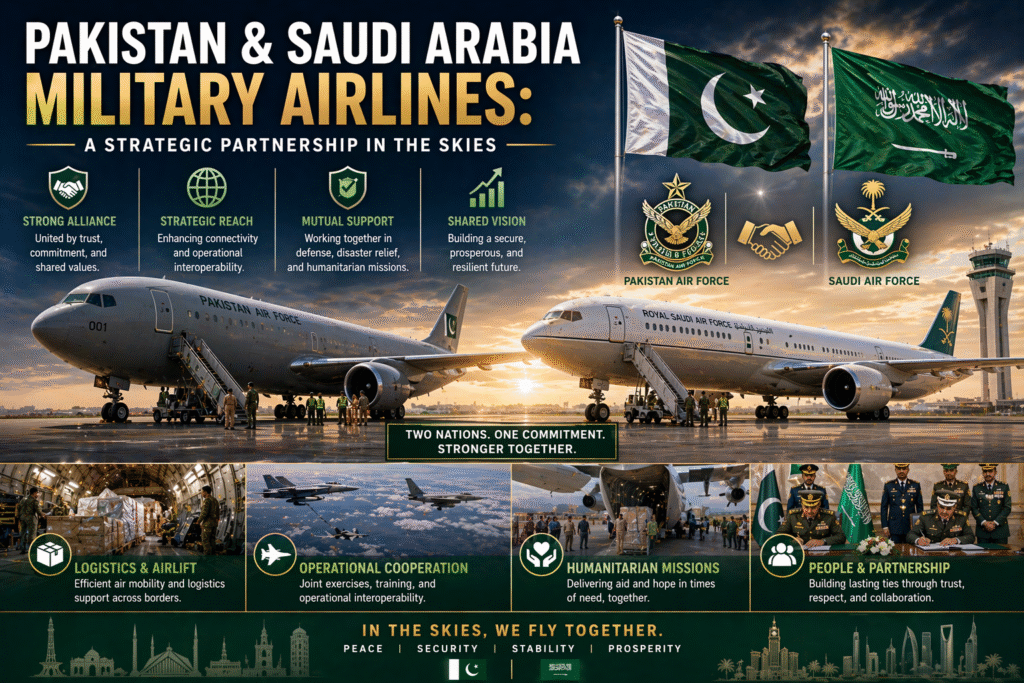
In a significant display of military cooperation, Pakistan has deployed fighter jets and support aircraft to Saudi Arabia’s King Abdulaziz Air Base, marking the first visible military mobilization under a landmark defense pact signed between the two nations in September 2025 . This deployment comes at a critical moment—amid a fragile ceasefire between the US, Israel, and Iran—and signals the depth of a strategic relationship that has evolved over seven decades.
This article examines the state of Pakistan-Saudi Arabia military aviation cooperation in 12 key dimensions.
Part 1: The April 2026 Deployment – Fighter Jets Arrive
On April 11, 2026, the Saudi Defense Ministry announced that a Pakistani military contingent had arrived at King Abdulaziz Air Base in Saudi Arabia’s Eastern Province . The contingent comprises fighter jets and support aircraft from the Pakistan Air Force (PAF), deployed under the bilateral defense framework between the two countries .
The Saudi statement emphasized that the deployment aims to “strengthen joint military coordination” and “raise the level of operational readiness between the armed forces of the two countries” . It also noted the move would “support security and stability at both regional and international levels” .
This deployment is the first visible military action under the Strategic Mutual Defence Agreement signed in September 2025—a pact that declares “any aggression against either country shall be considered an aggression against both” .
Part 2: The Strategic Defence Agreement – A Mutual Commitment
The September 2025 agreement represents a significant escalation in the longstanding Pakistan-Saudi relationship. Signed during Prime Minister Shehbaz Sharif’s visit to Riyadh at the invitation of Saudi Crown Prince and Prime Minister Mohammed bin Salman, the pact binds both nations to collective defense .
Under this framework, both countries committed to:
- Joint military deployments in times of need
- Intelligence sharing on regional threats
- Coordinated responses to external aggression
The agreement transformed what was previously an informal “special relationship” into a binding treaty-level commitment. As Foreign Minister Ishaq Dar later revealed, Pakistan formally warned Iranian leaders in early March that Islamabad was bound by its obligations to Riyadh under the agreement .
Part 3: The Regional Context – Why Now?
The April 2026 deployment did not occur in a vacuum. It came amid a volatile Middle Eastern security landscape following the outbreak of war between the US, Israel, and Iran on February 28, 2026 . Saudi Arabia itself had been the target of Iranian attacks.
According to reports, Saudi Arabia suffered repeated Iranian strikes during the conflict, with critical energy infrastructure damaged and at least one Saudi national killed . These attacks prompted Saudi leaders to activate the defense pact with Pakistan.
The deployment also coincided with Pakistan hosting US-Iran ceasefire negotiations in Islamabad—a role that placed Pakistan at the center of diplomatic efforts to de-escalate the regional crisis . Notably, the Pakistani fighter jets arrived in Saudi Arabia on the same day that senior US and Iranian officials were meeting in Islamabad to negotiate the terms of the fragile ceasefire .
Part 4: Pakistan’s Diplomatic Balancing Act
Pakistan’s position in the conflict required careful navigation. The country maintains strong ties with both Saudi Arabia—its longtime strategic partner—and Iran, its neighbor with a 900-kilometer shared border.
Pakistani Foreign Minister Ishaq Dar revealed in early April that he “personally warned Iranian leaders that Islamabad was bound by its obligations to Riyadh under the agreement” . According to Dar, Iran sought guarantees that Saudi territory would not be used to attack it—assurances that Pakistan was able to provide.
Army chief Field Marshal Asim Munir traveled to Riyadh in early March to discuss measures to halt Iranian strikes under the pact’s framework . Just four days before the fighter jet deployment, Prime Minister Sharif called the Crown Prince to pledge that Pakistan would stand “shoulder to shoulder” with the kingdom .
Part 5: Exercise Spears of Victory – January 2026
Before the wartime deployment, Pakistan had already demonstrated its aviation commitment to Saudi Arabia through participation in Exercise Spears of Victory-2026. In January, a PAF contingent comprising F-16 Block-52 fighter aircraft—along with dedicated air and ground crew—arrived at King Abdulaziz Air Base for the multinational aerial combat exercise .
The exercise featured participation from ten countries: Saudi Arabia, Pakistan, France, Italy, Greece, Qatar, Bahrain, Jordan, the United Kingdom, and the United States of America . It provided a platform to enhance interoperability, operational synergy, and mutual understanding among participating air forces, with particular focus on:
- Large force employment
- Night composite air operations
- Integrated Intelligence, Surveillance, and Reconnaissance (ISR)
- Operations in advanced electronic warfare environments
The fact that PAF aircraft undertook a non-stop flight from their home base in Pakistan to Saudi Arabia demonstrated the long-range operational reach and expeditionary capabilities of the Pakistan Air Force .
Part 6: The Diplomatic Signal – More Than Military
Security analyst Imtiaz Gul offered an important perspective on the April deployment. Speaking to Al Jazeera, he noted that “three jets won’t make much of a difference militarily” given the size of Saudi Arabia’s own air force .
Instead, Gul argued, “It’s messaging Tehran to be flexible in these talks, but also it is underlining to them that Pakistan has obligations under the mutual strategic agreement it has with Riyadh” .
Michael Kugelman, a senior fellow at the Atlantic Council, described Pakistan’s move as “a bit of a risky gambit” . He explained: “This is Pakistan signalling to Iran that if Iran is not willing to make the types of concessions that lead to a deal and the conflict resumes and escalates, there is a chance that Pakistan could move itself closer to Saudi Arabia and conceivably invoke the mutual defence pact” .
Part 7: The Economic Dimension – Financial Support
The military cooperation is intertwined with significant economic support. On April 10—the day before the fighter jet deployment—Saudi Finance Minister Mohammed bin Abdullah Al-Jadaan met with Prime Minister Shehbaz Sharif in Islamabad . During the meeting, the Saudi minister “reaffirmed his country’s full financial backing for Pakistan” and reiterated Riyadh’s confidence in Islamabad’s role in facilitating dialogue between the US and Iran .
Saudi Arabia is home to approximately 2.5 million Pakistani workers whose remittances help sustain Pakistan’s fragile economy . The Kingdom has repeatedly stepped in to provide financial assistance to Pakistan during periods of economic stress, including a $6 billion support package in 2018 ($3 billion deposit at the central bank plus $3 billion in oil supplies on deferred payment) .
This economic support creates a symbiotic relationship: Saudi Arabia provides financial lifelines, while Pakistan provides military and diplomatic backing.
Part 8: Military Coordination Beyond Aviation
While the April deployment focused on aviation assets, the Pakistan-Saudi defense relationship extends far beyond fighter jets. In January 2026—just two weeks after the Spears of Victory exercise—PAF Chief Air Marshal Zaheer Ahmed Baber Sidhu made an official visit to Saudi Arabia .
During the visit, Sidhu met with Commander of the Royal Saudi Air Force Lieutenant General Turki bin Bander bin Abdulaziz and Chief of the General Staff General Fayiadh bin Hameed Al-Rowaily . The discussions covered:
- Bilateral defense cooperation
- The prevailing regional security environment
- Future avenues for collaboration
The Saudi leadership praised “the professionalism, operational excellence and combat readiness of the PAF” and expressed “strong interest in enhanced joint training and operational collaboration, particularly in the domain of multi-domain operations” .
Part 9: PAF’s Modernization – A Multi-Domain Force
A key aspect of Pakistan’s value to Saudi Arabia is the modernization of its air force. During his January 2026 visit, Air Chief Marshal Sidhu “underscored the transformation of the Pakistan Air Force into a robust multi-domain force, integrating space, cyber, electronic warfare and artificial intelligence capabilities” .
This modernization—demonstrated through operational performance in exercises like Spears of Victory—makes the PAF a valuable partner for the Royal Saudi Air Force, which is itself undergoing transformation. The PAF’s F-16 Block-52 aircraft, equipped with modern avionics and Beyond Visual Range capabilities, provide a level of interoperability with Western air forces that few other regional air forces can match .
Part 10: Historical Roots of Cooperation
The current military aviation relationship has deep historical roots. Pakistan and Saudi Arabia have maintained defense cooperation since the 1960s, with Pakistan helping in the training of Saudi pilots and its fighter jets stationed in the kingdom at crucial periods of its history .
During the 1970s and 1980s, Pakistani military personnel served in Saudi Arabia in advisory and operational roles. In more recent decades, the two countries have regularly conducted joint military exercises and coordinated on regional security matters .
The signing of the Strategic Mutual Defense Agreement in 2025 marked the formalization of what had long been an informal “special relationship” into a binding treaty commitment.
Part 11: What the Deployment Means for Regional Security
The arrival of Pakistani fighter jets in Saudi Arabia sends multiple signals to different audiences. To Iran, it communicates that Pakistan will honor its defense commitments to Saudi Arabia—a message that carries weight given Pakistan’s role as a mediator in US-Iran talks .
To the United States and other Western allies, it demonstrates that Saudi Arabia has capable partners in the region beyond its own forces, potentially reducing the need for direct Western military intervention in Gulf security.
To domestic audiences in both countries, it reassures citizens that the strategic partnership remains strong and operational—not merely symbolic.
Part 12: The Future of Pakistan-Saudi Military Aviation
Looking beyond the current crisis, the trajectory of Pakistan-Saudi military aviation cooperation appears set to deepen. The January 2026 visit of the PAF chief resulted in an agreement to “further enhance engagement through joint training, operational collaboration and exchange of professional expertise” .
The two countries have committed to expanding cooperation in multi-domain operations—integrating space, cyber, and electronic warfare alongside traditional air power. This suggests that future deployments may involve not just fighter jets but also intelligence, surveillance, and reconnaissance assets, cyber defense teams, and potentially even space-based capabilities.
Moreover, the financial dimension—Saudi Arabia’s $5 billion investment package for Pakistan, announced alongside the military deployment—suggests that economic and military cooperation are now being pursued in tandem .
Conclusion: A Partnership Tested and Proven
The deployment of Pakistani fighter jets to Saudi Arabia in April 2026 represents a watershed moment in the strategic relationship between the two nations. It marks the first operational activation of a defense pact that elevates their partnership from “special friendship” to treaty-level alliance.
For Saudi Arabia, the arrival of PAF aircraft provides tangible reinforcement at a moment of genuine threat. For Pakistan, it demonstrates reliability as a strategic partner and reinforces its position as a key player in regional security—including as a mediator between the US and Iran.
As the Middle East navigates an uncertain security landscape, the Pakistan-Saudi military aviation partnership stands as a rare constant: two nations with deep historical ties, mutual economic interests, and now, a formal commitment to defend each other’s skies. Whether that commitment will be tested further in the coming months remains to be seen, but for now, the message is clear: an attack on one is an attack on both .
