

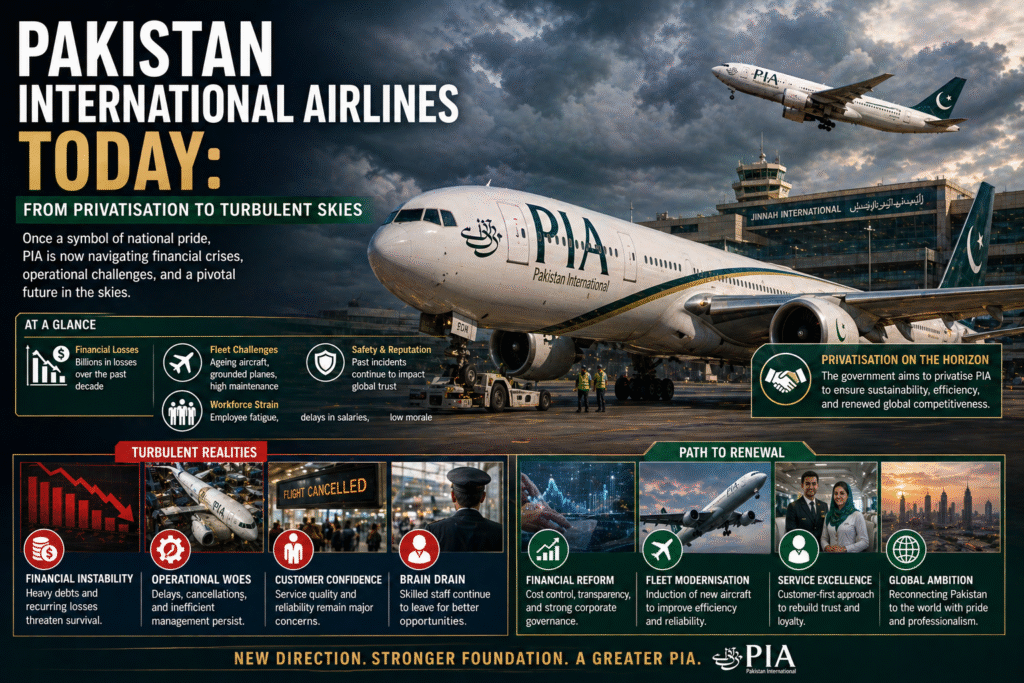
For Pakistan International Airlines (PIA), April 2026 has been a month of dramatic contrasts. Just weeks after celebrating its historic privatisation and the long-awaited resumption of London flights, the national carrier finds itself battling a new crisis: skyrocketing fuel prices driven by the ongoing Middle East conflict. This article examines the state of PIA across multiple dimensions as the airline navigates this turbulent period.
Part 1: The Privatisation – A Historic Milestone
On December 23, 2025, a consortium led by Arif Habib Corporation Limited purchased a 75 percent stake in PIA for Rs135 billion (approximately $482 million), marking the first major privatisation of a state-owned enterprise in nearly two decades . The government retained the remaining 25 percent stake, with the transaction representing a key milestone in Pakistan’s market-driven economic reforms supported by the IMF .
After years of stalled attempts, the process finally moved forward in early 2026. By February, the Ministry of Privatisation issued a “speaking order” rejecting all objections from workers’ unions, effectively closing all legal disputes over the transaction . The Lahore High Court had ordered that petitioners be heard, but the Privatisation Secretary determined that none of the allegations—including claims of undervaluation of PIA’s international slots—had legal standing .
Part 2: Debt Restructuring – Cleaning the Books
Before the privatisation could be finalised, PIA’s staggering debt load had to be addressed. Between 2015 and 2023, the airline accumulated losses of approximately Rs500 billion . Without privatisation, officials warned the national carrier would have continued incurring losses of around Rs100 billion annually .
In late March 2026, the government and domestic lender banks successfully concluded commercial debt negotiations . Under the arrangement, PIA’s commercial domestic debt was moved to a newly established PIA Holding Company, with approximately Rs650 billion in liabilities transferred off the airline’s books . The Scheme of Arrangement was filed with the Securities and Exchange Commission of Pakistan, paving the way for the legal segregation of PIACL .
Part 3: The Consortium – Who Owns PIA Now?
The ownership structure of the winning consortium reflects a blend of industrial and financial expertise. Fauji Fertiliser Company Limited, a military-affiliated and publicly listed giant, holds 25 percent of the privatised stake. The Arif Habib Group, together with Fatima Fertiliser, holds another 25 percent, while the remaining 25 percent is shared among AKD Group Holdings, City Schools, and Lake City Holdings .
Arif Habib, chairman of the investment firm, explained that Fauji Fertiliser joined after the auction at the consortium’s request. “Fauji Fertiliser said whoever wins the auction, they will join that party,” he told reporters. “We told them that if they wanted us to be the Imam of this prayer, they would need to offer the prayer behind us” .
Part 4: The London Route Returns – A Six-Year Wait
Perhaps the most celebrated achievement of the post-privatisation era has been the resumption of PIA flights to London. The Islamabad-London route had been suspended after a 2020 scandal in which it was alleged that around one-third of the airline’s pilots had dubious or fake licences . That scandal, combined with a 2020 PIA crash in Karachi that killed 97 people, prompted the European Union and United Kingdom to suspend PIA operations .
After extensive safety overhauls, the European Union Aviation Safety Agency and the UK Air Safety Committee lifted the bans. PIA resumed direct flights from Islamabad to London Heathrow on March 29, 2026, followed by Lahore to London on March 30 . Federal Minister for Aviation Khawaja Muhammad Asif announced the development on social media, congratulating the Pakistani diaspora in the United Kingdom .
The airline secured four weekly landing slots at Heathrow Airport, one of the world’s most congested and valuable aviation assets .
Part 5: The Fuel Crisis – A New Challenge Emerges
Just as PIA was celebrating its revival, global fuel prices spiked dramatically. The ongoing US-Israel war with Iran, now in its 38th day, has disrupted supply chains and sent jet fuel prices soaring . The Pakistan Meteorological Department issued warnings as jet fuel prices saw a fourth consecutive increase .
The impact on PIA has been immediate and severe. In early April, the airline announced it was scaling back international operations, suspending key routes, and scrapping passenger discounts . A PIA spokesperson said the airline had made a “principled decision” to end all discounts, with concessions remaining only for children and infants .
Part 6: Suspended Routes – Beijing and Kuala Lumpur
As part of the cost-cutting measures, PIA announced it would suspend its Beijing operations from April 11, 2026, and Kuala Lumpur operations from April 14 . Flights to Gulf countries—except Saudi Arabia and the United Arab Emirates—were suspended until the end of April. Operations to the UAE were curtailed to 16 weekly flights .
Officials said these steps were taken to rationalise operations and reduce exposure to rising fuel costs, expressing hope that routes would be restored once global prices stabilise .
Part 7: Austerity Measures – Every Drop Counts
Beyond route suspensions, PIA has introduced a range of operational austerity measures. Under a newly issued internal circular, aircraft are now required to taxi to the runway using only one engine—a practice that conserves significant fuel over time .
Catering for domestic and Saudi Arabia-bound flights is now adjusted strictly according to passenger numbers, with a ban on excess food loading to minimise additional fuel consumption . Onboard electric generators are to be used only in emergency situations . A war risk surcharge has been imposed on cargo shipments .
The measures reflect a fundamental shift in mindset. As Arif Habib noted, under state ownership, previous managements “did not bother to hedge” against risks like fluctuating oil prices because losses were absorbed by the government. Under private ownership, every financial decision carries direct consequences .
Part 8: The Regional Cancellation Crisis – Not Just PIA
The fuel crisis has affected the entire Pakistani aviation sector, not just PIA. On April 6, at least 40 international flights to and from Pakistan were cancelled across major airports . Lahore’s Allama Iqbal International Airport alone saw nine flights cancelled to Dubai, Riyadh, Jeddah, Abu Dhabi, Tehran, and Bahrain. Karachi bore the brunt with 14 cancellations .
Travel agents reported that the twin impact of soaring jet fuel prices and higher fares has reduced passenger numbers, leaving airlines caught between rising operational costs and shrinking demand .
Part 9: Employee and Pensioner Obligations
Amid the financial turbulence, PIA continues to manage significant employee-related obligations. The airline has approximately 16,500 pensioners, while more than 26,000 individuals benefit from medical facilities provided by the organisation . A fund of Rs450 million was created to meet employees’ medical expenses prior to privatisation .
The consortium has committed to no layoffs for at least one year, with plans to offer training and coaching programmes to employees falling short of performance benchmarks .
Part 10: Fleet Expansion Plans – On Hold?
Before the fuel crisis, the consortium had outlined ambitious fleet expansion plans. The new owners committed to reinvesting approximately Rs125 billion from the bid proceeds into fleet modernisation, route expansion, and debt management . The plan called for increasing operational aircraft from the current 15-18 to 38 in the short term, including Airbus A320s, Boeing 777s, and ATR aircraft .
Whether these expansion plans can proceed amid the current fuel price shock remains uncertain. For now, the priority appears to be survival and cost containment rather than growth.
Part 11: The Safety Transformation – Lessons Learned
The 2020 crash and subsequent pilot licence scandal were devastating for PIA’s reputation. Some 262 licences were found to be “dubious,” with 50 pilots dismissed due to irregularities . The International Civil Aviation Organization recertified Pakistan’s aviation sector only after significant safety concerns were addressed .
Pakistan signed an agreement with British civil aviation authorities for its pilots to be tested and certified in the UK . This safety transformation enabled the EU and UK bans to be lifted, paving the way for the London route resumption—a foundation upon which the airline’s privatisation revival was built.
Part 12: The Road Ahead – Hoping for Stability
The immediate future of PIA depends heavily on external factors beyond the airline’s control. If global fuel prices stabilise—as officials hope—suspended routes to Beijing, Kuala Lumpur, and Gulf destinations could be restored. The airline also continues working with US aviation authorities to revive direct flight operations to the United States .
However, as officials acknowledged, the Middle East conflict shows no sign of ending. “The deteriorating situation has also dampened passenger demand, with travellers increasingly postponing plans and opting to fly only when absolutely necessary” .
Conclusion
Pakistan International Airlines today is a study in resilience and vulnerability. Within months, the airline has achieved what seemed impossible for decades: successful privatisation, debt restructuring, and the return to London’s Heathrow Airport. Yet success has been immediately tested by a global fuel crisis that threatens to undo the fragile gains.
Arif Habib described the challenge facing the airline: “PIA incurred losses of nearly Rs800 billion because previous managements did not bother to hedge. They assumed money was going straight to government coffers, so there was little incentive to manage risks” . Under private ownership, that assumption has been shattered.
The coming months will determine whether PIA can navigate the perfect storm of rising fuel prices, regional conflict, and reduced passenger demand—or whether the airline’s long-awaited revival will be cut short by forces beyond Pakistan’s borders. For now, PIA continues to fly, but with one engine taxiing, no excess catering, and a wary eye on the global oil markets.
